



For as long as the metric has existed, customers have wanted a person on the other end of the line, not a machine. That preference has outlasted every wave of automation that came before it, from the earliest phone trees to the chatbots that followed.
But the picture is more complicated than a simple preference for humans would suggest. Phone calls remain the most preferred customer service channel overall; 47% of consumers rank it above every other option. And yet the same analysis of 5,000 negative customer reviews found that 50.5% of communication-related complaints point specifically to frustrating phone interactions.
Businesses aren’t losing customers because people don’t want to call. They’re losing them because the calling experience itself keeps failing.
Old grudges, new technology
The scale of that gap is easiest to appreciate against how firmly the underlying preference for humans still holds. A February SurveyMonkey poll found that 79% of Americans still prefer interacting with a human over a chatbot, eight in ten believe human agents are more accurate than AI, and 89% think companies should always offer a way to reach a real person.
But broken down by generation, the same research shows the preference for AI climbing sharply with each younger cohort; Gen-Z is more than three times as likely as Boomers to say they’d choose AI over a human agent, with Millennials and Gen-X falling in a steady line between them.
Even so, the data does not suggest younger consumers are drifting from the phone itself. Research concluded that 67% of Gen-Z and 70% of Millennials still turn to voice support first for urgent or sensitive issues. If anything, then, that points to a generation that still wants to talk, just increasingly without the same skepticism toward who, or what, picks up.
What’s worth remembering is that the pushback against AI-driven customer service was never really, at its core, about the AI itself. It was a reaction to the endless-loop phone tree, the “your call is important to us” hold music, the voicemail black hole, all representing friction that trained customers to expect the worst long before a machine picked up.
Much of the hostility voice AI faces today is therefore misplaced: leftover frustration with legacy IVR and old-school phone systems, redirected at a technology that had nothing to do with creating it in the first place.
The standard was always about whether a call got handled with minimal inconvenience, not about who, or what, handled it.
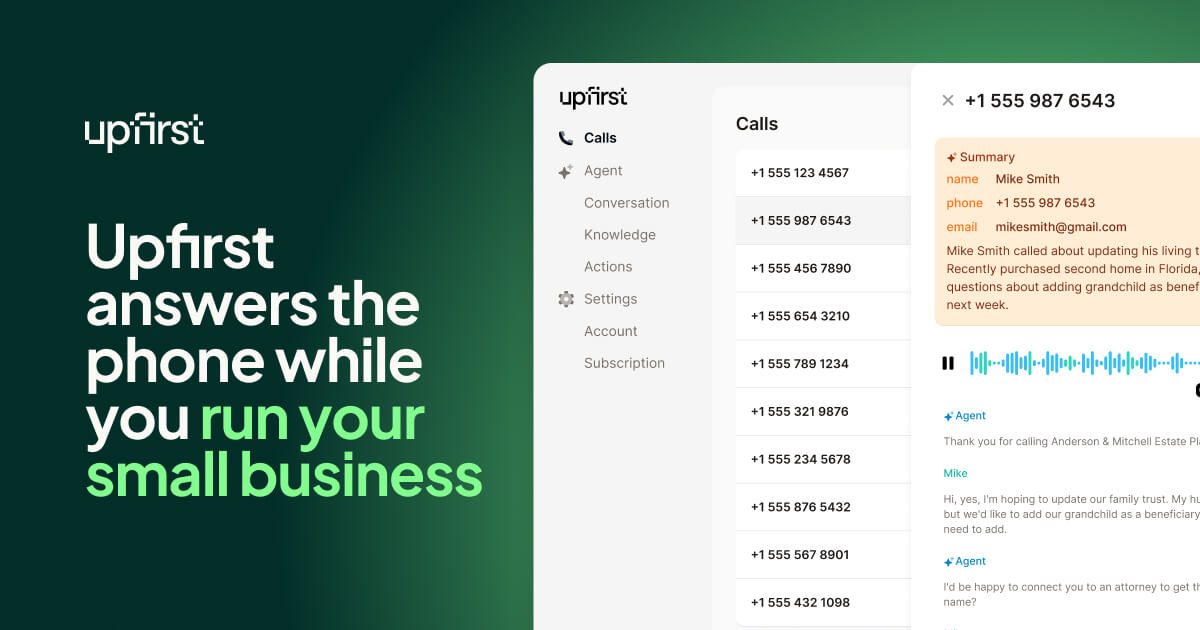
That’s the gap the current generation of tools is closing. Virtual receptionists now capture inbound calls on a 24/7 basis in a way that feels seamless to the caller, while giving businesses a layer of automation they could never have staffed on their own.
Here, Upfirst AI is gaining traction as part of this next generation, with an AI-powered virtual receptionist and answering service built specifically for small businesses.
The cost of an unanswered phone
Large enterprises can afford round-the-clock call centers; small businesses can’t. A solo dentist, a two-person law firm, or a family-run property management company simply do not have the capacity or the budget to man a dedicated team for phone consultations. And, unlike big enterprise, they also usually can’t afford to lose the leads that come in while no one’s at the desk.
The demand is reflected in the data. The global virtual receptionist service market is already valued at $17.84 billion and set to reach $49.55 billion by 2035. This is where the broader AI voice category is moving even faster, too. Grand View Research estimates the global AI voice agents market will hit $3.51 billion in 2026, and grow at a 39% annual rate through 2033, reaching over $35 billion.
The stakes vary sharply by industry, too. According to Upfirst, the value at risk for a single unanswered call sits at around $1,900 for a roofing company and around $620 for a legal practice. For dog groomers, over 30% of every inbound call results in an activity that generates business, such as booking an appointment. This means a missed call there isn’t a hypothetical loss, but a near-guaranteed one.
Until recently, the options for a business in that position were limited: hire a receptionist, outsource to a call center, or accept that some calls go to voicemail. Data from Upfirst suggests how often that last option was happening by default: 31.7% of calls answered by its AI receptionists were captured after hours or while the line was already busy on another call, gaps that would otherwise have gone unaddressed.
Virtual receptionists have effectively created a fourth option, built specifically for businesses too small to justify the first two but unwilling to accept the third.
The businesses adopting this technology aren’t hypothetical. The common story is much simpler: a small business owner who’s already stretched thin, unable to afford losing a single lead, but equally unable to justify hiring someone just to answer the phone.
Dan Metzger, who runs Wisconsin-based landscaping company Nature’s Designers, lived that exact problem. His wife had managed the phones as office manager, until rising health insurance costs forced her back into a full-time job elsewhere, leaving Metzger to run two service divisions and field every call himself.
“My business was hurting because I couldn’t answer the phone enough. But I got other stuff to do. I got crews to talk to and people to meet,” he said.
For service-based businesses, the math is common. Leaving calls unanswered is detrimental to long-term performance, but staffing for round-the-clock coverage has rarely been financially viable for an operation that size – leaving owners like Metzger stuck between two bad options: answer every call themselves or lose the business that comes with the ones they miss.
Making the robot disappear
The technical challenge was never really “can a machine answer a phone”. It’s “can it do so without the caller feeling like they’ve been fobbed off.” That’s a harder problem, and it’s the one an emerging wave of AI-powered virtual receptionists, including platforms like Upfirst, is trying to solve for smaller businesses that could never justify a full front desk hire.
Developing a bespoke voice profile from scratch is normally out of reach for a small business, but platforms like Upfirst let owners choose from a range of voices across accents, tones, ages, and languages – building a profile that resonates with the business, from laid-back and easygoing to buttoned-up and professional.
According to Upfirst’s analysis of 450,000 calls, though, the choice of voice barely moves the needle. What actually determines whether a caller sticks around has less to do with how the receptionist sounds and more to do with what it’s equipped to do. Agents given real capabilities, including the ability to send a text, transfer a call, or book an appointment, paired with proper training on the business itself, had the lowest hang-up rates of all, associated with roughly 30-40% lower odds of a caller hanging up compared to agents without those skills.
The data points to something else, too: the expected recoil against AI just isn’t there. Receptionists that openly disclose they’re AI see about 20% fewer hang-ups than ones that don’t, likely because much of a caller’s hesitation isn’t about talking to a machine but the uncertainty about what they’ve reached in the first place. The suspicion clears the moment the AI simply says so.
That tracks with broader usage data: fewer than 1 in 100 callers answered by an Upfirst receptionist ever asked if they were talking to a machine, the AI resolved the query without transferring the call in 77% of cases, and only 1 in 5 callers asked to speak with a person instead.
For small business owners, the takeaway is straightforward: customers are more interested in having their queries answered promptly and accurately than in whether AI is what’s doing the answering.
One example: The Flossery, a holistic dental practice in Waltham, Massachusetts, started using an AI receptionist to make sure nothing slipped through the cracks when the front desk was slammed with in-office patients.
“It helps us to not lose any missed calls,” says Dr. Yasmin Chebbi, founder of The Flossery. “It’s all in written evidence of who we need to call back.”
It may sound like a simple feature at first glance, but it’s exactly the kind of friction reduction that customers actually care about and the difference between capturing a new business lead or not for a small business.
In the end, people aren’t rejecting AI because it’s AI; they’re rejecting the version of it that makes them feel unheard.
Built by people who knew the problem firsthand
Upfirst wasn’t created out of a fascination with AI for its own sake. As with many startups, it originated from a specific operational problem its founders had experienced directly.
Gene Sigalov, the company’s co-founder and CEO, spent years operating his own boutique law practice in New York, handling insurance arbitration cases. For him, missed calls translated directly into missed clients, yet traditional answering services available to him charged as much as $10 per call.
The cost was viable for his own practice at the time, given the value of the cases being handled, but he was unimpressed with the quality of the call handlers and their ability to manage the complex inquiries common in legal work. Sigalov also recognized that, while the cost worked for his business, many other small businesses would be priced out of the same model entirely.
This was not his first venture addressing a small-business gap, either. Sigalov earlier built and sold SimpleTexting, a business texting and call-answering platform that grew to more than 17,000 paying customers, including Starbucks, DHL and FedEx, before its acquisition by Sinch in 2021. He is also a mentor at USC’s technology incubator.
The serial entrepreneur co-founded Upfirst alongside Alfredo Salkeld, who spent years as SimpleTexting’s brand manager before moving into a brand director role at Sinch. Salkeld now leads marketing and sales at Upfirst as its co-founder.
The team therefore approached the problem with direct prior knowledge of it: thousands of small businesses were losing customers because no one was consistently available to answer the phone.
Unlike large enterprises with dedicated receptionists and call centers, independent practices and local service businesses typically rely on owners or small teams who spend much of the day away from the phone, wrestling with a persistent gap between customer demand, leads, and available staffing.
The bigger shift
None of this changes a fact that’s been true since long before AI: an unanswered call is a damaged relationship, whether it’s a missed sale or a patient who feels like an afterthought.
No amount of automation changes what happens on the customer’s end when nobody picks up. They don’t experience “the business was short-staffed”, they experience “this business didn’t care enough to answer”.
What has changed, however, is who can afford to prevent it. For decades, round-the-clock availability was a luxury reserved for companies large enough to staff it; a genuine, competitive advantage that smaller and service-based companies simply had to concede.
If the data on chatbots says anything, it’s that customers were never asking for more automation. They were asking to not be ignored. In that sense, voice AI, done well, isn’t a replacement for the human touch, but what makes sure that touch is actually there when someone calls.