

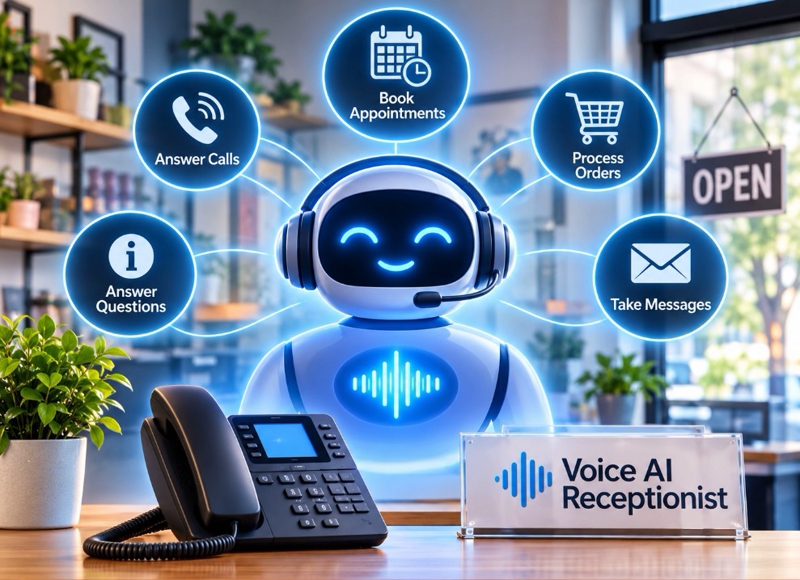


For small businesses in fields like legal firms, ecommerce, insurance, plumbing, and real estate, AI voice receptionists provide an economically-feasible way of handling the influx of calls that come with growing a business with minimal staff.
This is especially important for calls coming in after hours because a missed call often means a missed opportunity to do business.
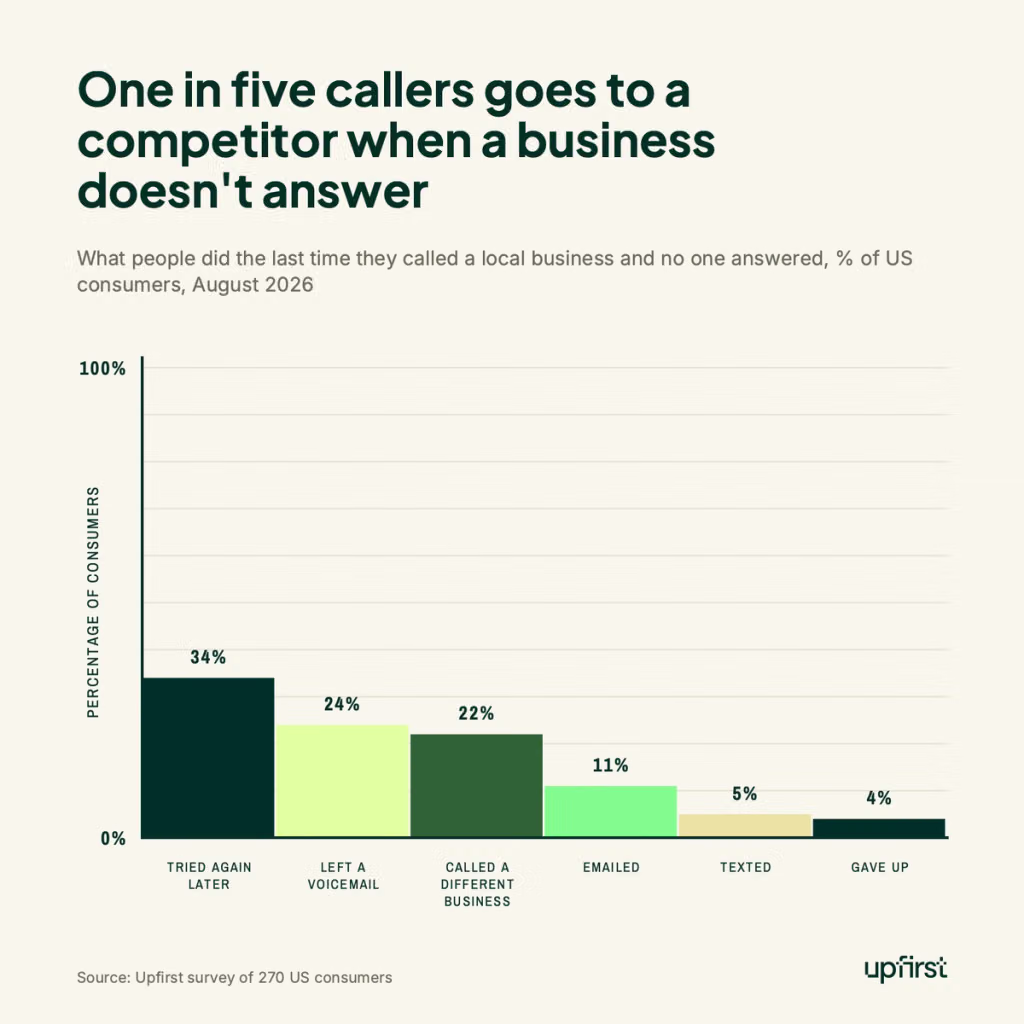
A recent survey on the State of Voice AI for Small Businesses by Upfirst highlights that some 78 percent of those surveyed said they had hired or bought from a competitor because a business never picked up or called back.
Meanwhile, one in five callers will go to a competitor when a business doesn’t answer.
To learn more about AI voice receptionists, The Sociable caught up with Alfredo Salkeld, co-founder at Upfirst.ai, an inbound answering service for calls and text that is on the path towards creating a fully integrated phone system.
“Missed calls equals missed business, or equals anxiety because you’re stressing out about missing a call. AI can answer that call and actually help your customer or capture a lead for a very low price”
Alfredo Salkeld, Upfirst, November 2026
When it comes to businesses that have between 10 and 49 employees, 91 percent will miss at least one potential-customer call in a typical week, and 76 percent will miss four or more, according to the survey.
And when given the choice between leaving a message and hoping for a call back or getting an immediate interaction with an AI receptionist, the survey found that “half of consumers would rather an AI help them immediately than leave a voicemail, in an after-hours scenario where the business cannot answer live.”
But what is the actual experience like for someone who calls a business and an AI receptionist picks up on the other end?
For anyone who has called a business only to receive a glorified answering machine that gives a limited set of options like, “Press One for English, or Press Two for Business Hours,” voice AI is now able to hold seemingly seamless conversations with anyone who calls.
“It’s purely conversational, so there’s no ‘press one or press two;'” says Salkeld, adding, “it’s just like, ‘Hi, thank you for calling [Insert Business Here]; how may I help you?’ and of course you can adjust what it says when it picks up.”
From there people can choose to connect their calendars to schedule consultations and get those appointments booked.
“If the information that a customer is calling about isn’t accessible to the AI, you’ve just got a fancy message taker, and maybe that’s what you want […] but if you’re trying to have something that doesn’t annoy the caller, what you want is something to answer their question right away”
Alfredo Salkeld, Upfirst, November 2026
The range of applications is vast, and this is where adding knowledge and instructions plays a key role.
Business owners generally tend to know the most common and frequent questions asked of them. Therefore, adding knowledge and instructions to an AI receptionist is pretty straightforward.
In Salkeld’s experience, “It really works best when someone has set it up in such a way that they understand what are the most common things people call about, and they have set it up in a way that it can actually answer those questions.”
Adding another AI level beyond voice, some small businesses already have very clear information made readily available on their website, which makes it easy for Upfirst to scrape their website without relying heavily on manual input.
“For some people, it’s enough to just put in their website, and we scrape the information that’s on there, and that’s enough,” says Salkeld.
For small businesses with more complex offerings, “That’s where our team steps in. We have a call, we map out all the different scenarios, and then we help train the agent.”
“We also have a native connector for ChatGPT and Claude, so that way they don’t even have to mess around with our interface; they can just describe to ChatGPT or Claude what it is they want, and then it can connect to our service and adjust things accordingly for them.”
“It’s refreshing when I talk to small business owners who feel a sense of relief from having this [service]. Those are the ones that make me happy, where it’s someone whose life has been made easier and can run their business”
Alfredo Salkeld, Upfirst, November 2026
Many small businesses receive calls about the same handful of questions at volume, and this is where an AI receptionist can really shine.
But some questions can be more complex or more time-sensitive, and some people just want to talk to a human, in which case they’ll almost always “have a path to actually get to an actual human.”
Of course, AI receptionists are not without their challenges, and Salkeld highlights two in particular: the AI picking up on a caller’s “background noise” and “turn detection” — picking up on cues to know who’s turn it is to talk.
A background noise cancellation feature has already mitigated most of the first, and while “getting turn detection right has been a learning process,” Salkeld says it’s getting better and better with each AI model update.
“Right now, we’re an inbound answering service for phone calls and texting. What we want to be is your full phone system […] Ultimately, we’ll become the fully integrated phone system“
Alfredo Salkeld, Upfirst, November 2026
With a very diverse career background, from marketer to copywriter, beekeeper to voice AI company co-founder, Salkeld has always been striving towards maximizing excellence in both the present and future.
At present, Upfirst is an inbound answering service for phone calls and texting.
Looking towards the very near future, Salkeld says, “What we want to be is your full phone system. Why should you have to have both a phone system and an answering service? Right now people usually have to have both.”
“Ultimately, we’ll become the fully integrated phone system.”
Disclosure: This article mentions a client of an Espacio portfolio company.
Image source: AI generated with ChatGPT