



Can you tell when you’re talking to a machine? Probably not as well as you think. In one study, listeners mistook AI-cloned voices for real people 58% of the time. Real human voices only did slightly better, at 62%.
Scroll through social media and you’ll find a whole genre of people cornering bots that refuse to admit what they are. Keep scrolling and you’ll find just as many people trying to sell you an AI sales agent for your business. Both sides are running into the same question: does the customer have a right to know? In most of the U.S., the answer is no.
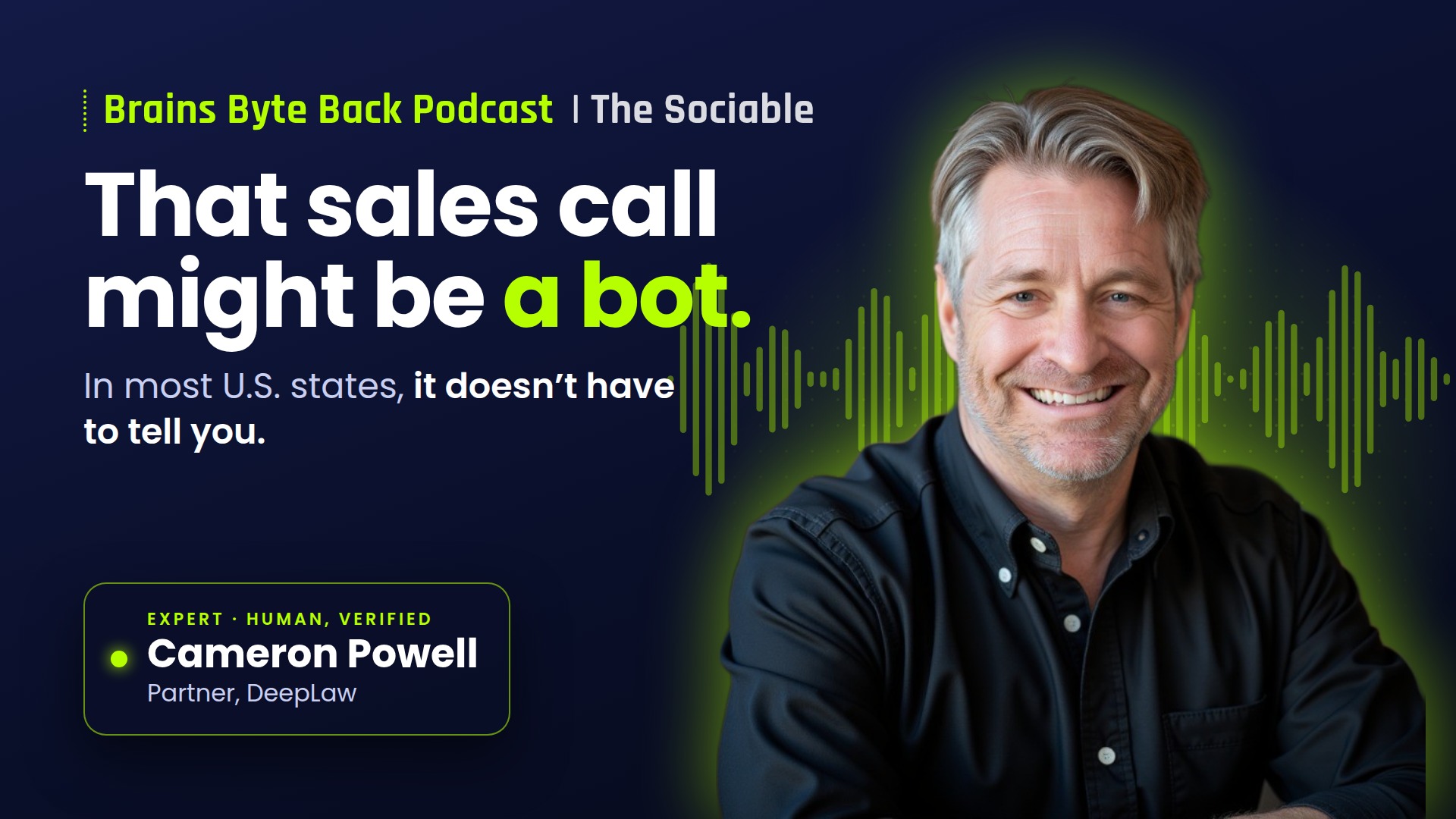
In this episode of Brains Byte Back, Erick Espinosa sits down with Cameron Powell, a partner at DeepLaw, a firm that advises companies on AI and innovation, about why AI disclosure rules depend on where you pick up the phone. Unlike Europe, which has picked a side. Since August, Article 50 of the EU AI Act has required AI systems that interact with people to make clear they’re machines. The U.S., as Powell puts it, is “a patchwork… it’s going to be state by state.”
Maine has the strongest rule. A bot has to disclose whenever it could pass for human, and consumers can sue without waiting on an attorney general. Utah only makes a bot come clean if you ask it directly, a standard Powell says protects the people who think to ask and nobody else. California’s two bot laws, he argues, were built for online bots and answering machines, not “a machine that sounds like a person and talks back.” New Jersey covers only bots selling merchandise or real estate. The Federal Trade Commission could, in theory, could step in anywhere, but according to Powell, it has never seriously gone after unidentified bots.
For sales, marketing and customer service teams, this is about more than compliance. The real question is what it costs when customers find out who, or what, they’ve been talking to.
The technology keeps getting better at sounding human, and the rules aren’t keeping up. Historically, that combination has worked out great for everyone. Well, everyone except the customer.
Find out more about Cameron Powell.
Learn more about https://deeplawfirm.com/
Reach out to today’s host Erick Espinosa – [email protected]
Leave an iTunes review – https://rb.gy/ampk26
Follow us on your favourite podcast platform – https://link.chtbl.com/rN3x4ecY
Transcript
Erick Espinosa: Earlier this year, a woman posted this video on social media, and it’s hit millions of views.
[Clip from the viral video]
Erick Espinosa: So what happens is that she calls the hotel, and the booking agent, with a warm Southern voice for some reason, introduces herself as Jolene. It sounds completely real, but it wasn’t. And the caller catches on. She asks to speak with a real human, and Jolene, for some reason, insists that she’s a live agent, until she finally caves under the pressure.
Look, you could hop on social media right now and you’ll find a whole genre of people cornering bots that don’t want to admit what they are. And here’s the thing: in the U.S., a lot of them don’t actually have to admit it. Unlike Europe, a market that decided people actually have a right to know when they’re talking to AI, and as of August wrote it into law, making disclosure mandatory for companies or face a fine.
In the U.S., it depends entirely on where you pick up the phone. Each state covers different businesses based on who they target, and differs on when and how the disclosure has to happen. I wanted to understand a little bit more about how this works in the U.S., so I connected with Cameron Powell, a partner at DeepLaw, a firm that advises companies on AI and innovation.
Cameron Powell: So it’s kind of a patchwork, and, you know, it’s going to be state by state.
Erick Espinosa: So let’s start with Maine. Anyone using a bot to engage in trade or commerce with a consumer has to clearly disclose that the person isn’t talking to a human whenever the bot could mislead them into thinking otherwise.
Cameron Powell: Maine does reach textual or oral communications, so it covers voice. It’s a pretty favorable standard for people who are in favor of consumer protection. There doesn’t have to be any intent to deceive. Just the fact that you’re doing it is bad enough.
Erick Espinosa: And this one actually has real teeth, because you don’t have to wait on government agencies if you are misled.
Cameron Powell: They can route their violations into the state’s Unfair Trade Practices Act, which gives it teeth, because that means a private citizen can sue. You don’t have to sit around and wait on an attorney general. That’s what we call a private right of action.
Erick Espinosa: Win, and the company has to pay your legal fees, which Cameron says is what drags businesses to the negotiating table.
Cameron Powell: If I don’t settle now, I’m going to spend a lot of time or money or both on lawyers. And if I lose, I’m going to not only pay my attorney’s fees, but the other side’s attorney’s fees. What’s your settlement proposal?
Erick Espinosa: Then we have Utah, which took the opposite approach. There, a bot only has to admit what it is if you think to ask first.
Cameron Powell: Now, who thinks to ask that of a person they think is a real person? “Hey, we’re in the movie Blade Runner. Now, are you a real person?” Right? They shouldn’t have even bothered.
Erick Espinosa: Which leaves a whole demographic, like the elderly, your grandmother if she picks up the phone, that much more exposed and that much more vulnerable.
What’s interesting about California is that you’d assume the country’s tech capital would lead on something like this. Cameron says otherwise.
Cameron Powell: One was written just to be online. It had no connection to telephones. And the other one was written for the answering machine, basically. So like most other states, California has completely failed to deal with what’s arguably the biggest risk of deception: a machine that sounds like a person and talks back.
Erick Espinosa: California’s law is pretty narrow. To take legal action, you have to prove the company deliberately tried to mislead you, and that it did so to get a specific outcome. The problem is, what a company intended to do can be very difficult to prove in court.
Cameron Powell: They’re not going to be as convincing, or as potentially harmful, as a bot you’re talking to in real time, who’s asking you questions and probing your life situation, probing weak spots, and convincing you of something. It’s a much bigger risk than a robocall.
Erick Espinosa: Finally, we have New Jersey, which requires disclosure upfront. But wait, there’s a catch: only when a bot is selling merchandise or real estate. Everything outside of those two categories is not covered.
But underneath all of this sits the Federal Trade Commission, which can treat an undisclosed bot as deceptive, even in states that don’t have bot laws at all. But only in a commercial context, and only if the technology’s presence would actually change what a customer does.
Cameron Powell: The FTC has never tried to enforce anything seriously against any of these unidentified bots. So, yeah, we don’t have a lot going on here.
Erick Espinosa: If you’re a customer, make this a habit. The next time you pick up the phone and it sounds a little bit too smooth rather than too robotic, because it’s getting really hard to tell these days, just ask: “Are you a real person?” In a few states, that answer is protected by law. In most, you’re pretty much on your own. And if you’re a company betting on customers not knowing, with the way things are changing, it might be a good time to update your strategy.
But what are your thoughts? Do you think everyone has the right to know if they’re talking to AI? Let us know in the comments, and give us a follow for The Sociable and for Brains Byte Back. I’m Erick Espinosa.