

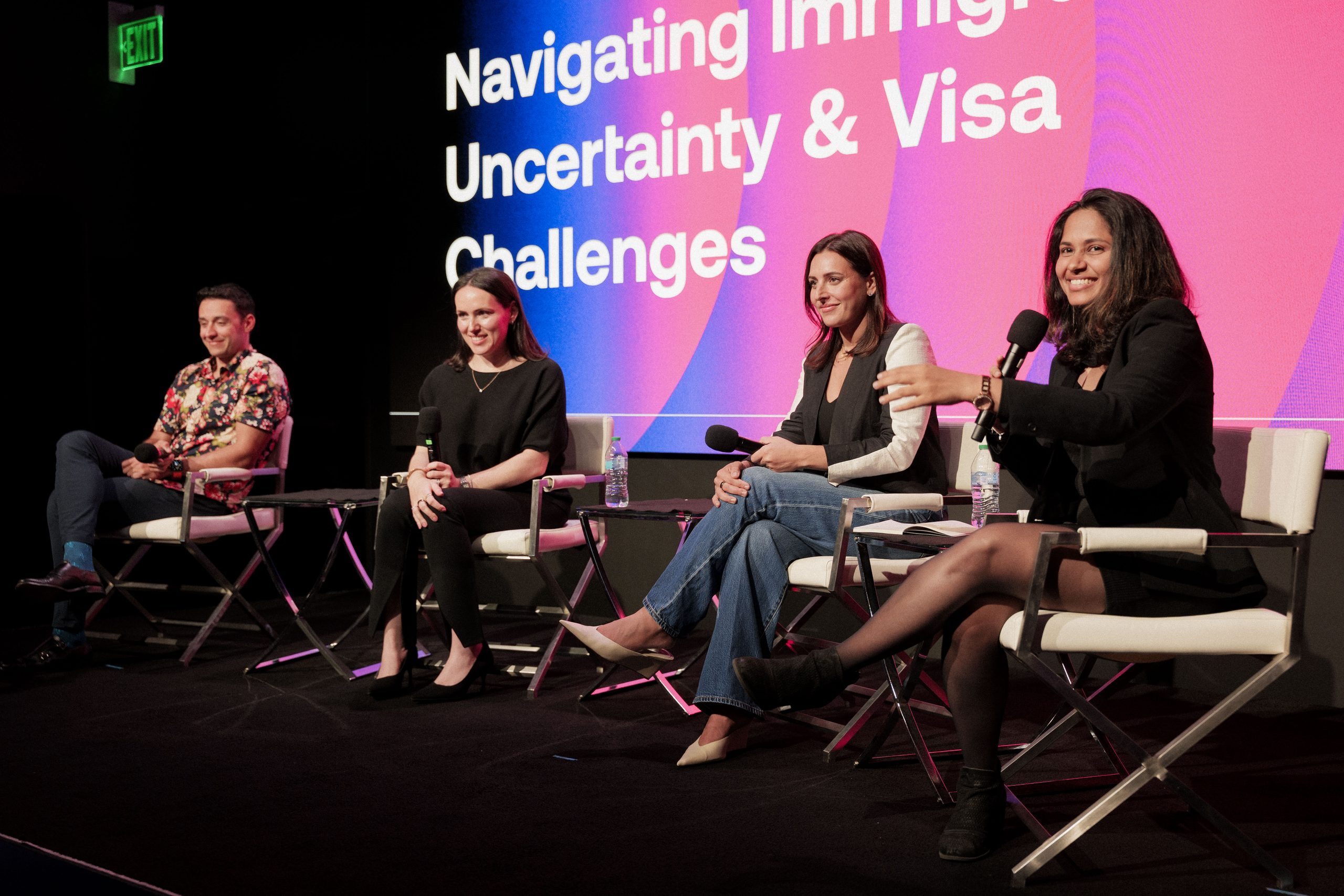


Soundarya Balasubramani planned to open her panel at the One Way Summit in San Francisco with a question for the audience. “How many of you freak out when you enter the border,” she asked, “even though you know you have valid status?”
For the skilled immigrants in the room, the fear has a new source. In September, the Department of Homeland Security proposed eliminating the grace period of up to 60 days that laid-off workers on visas such as the H-1B and O-1 get to find a new job. The public comment period closed on November 10.
If the rule is finalized, workers who lose their jobs would have to leave the country and be processed abroad once they find a new employer.
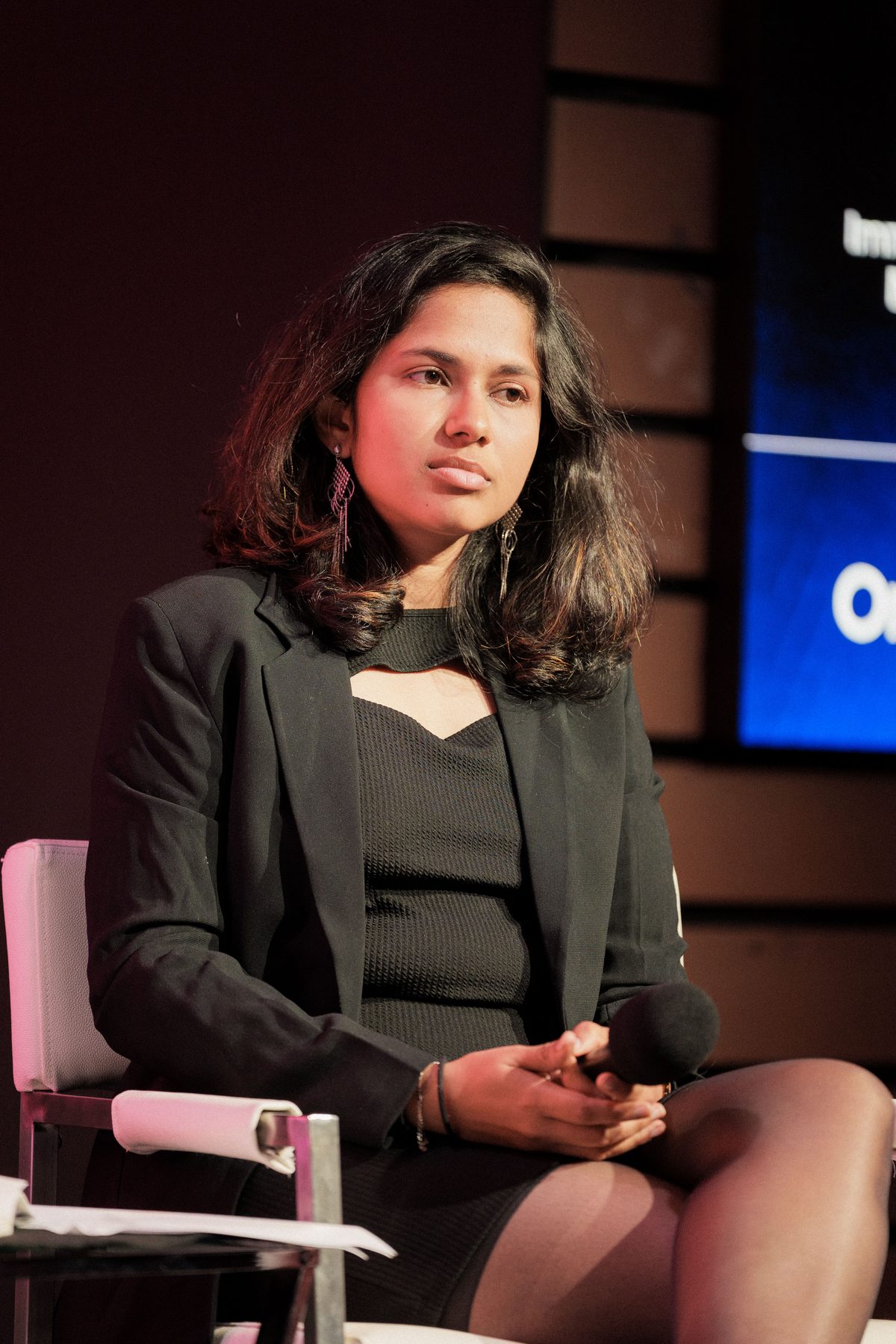
“If you get laid off today, there is no time for you to look for another job. There’s no cushion,” Balasubramani, an author and former founder of Unshackled, a community for high-skilled immigrants, told The Sociable. “People are now more scared to even take a job in the U.S., because it means, what if I get laid off in three months and I have to go back?”
The summit’s main stage spent part of the same week debating whether AI is breaking the social contract most people grew up with. “I go to school, I graduate with a degree, I get a job, get paid, raise a family,” said Lex Zhao, managing partner of One Way Ventures, which organizes the gathering. “All of that seems to be more and more fragile. I would argue it’s fundamentally broken at this point.”
For many immigrants in the audience, that contract had come with conditions all along.
“There’s no cushion”
Courtesy of One Way Summit
Balasubramani has watched those conditions tighten in real time. She posts about immigration policy for her over 300,000 followers on social media, and this year the pace overwhelmed her.
“I have never seen the volume of policies in the last three months,” she said. “I’ve never seen anything like it in the last three years that I’ve been talking about immigration online.”
The people she knows are already making decisions. “I think almost every immigrant knows someone who’s decided to just go back,” she said, “or were forced in some ways, because they didn’t get a job and their clock was running out.”
The effects are spreading past individual workers. “I personally know a friend who helps students come to the U.S. to study abroad. He had to let go of half of his staff, because people are just not wanting to come to the U.S.,” she said. “All they hear is one policy after the other coming out every week, saying that it’s going to make it harder for you.”
Companies that lend money to international students, she added, are seeing more defaults, “because they don’t have a job to pay it back.”
Balasubramani knows her own city cushions some of the blow. “I am in San Francisco, which is a pretty pro-immigrant city,” she said. “So I feel like it is kind of an echo chamber.”
Building a life on borrowed time
Balasubramani’s own story shows how much effort it takes to build a life on a visa. She left southern India for a master’s degree in 2017, partly to escape the limits she faced at home. “My undergrad had a curfew for women only, not for men. You had to be back by 9 p.m.,” she said. “So when I moved to the U.S., I felt very liberated. I felt like I could really do whatever I want.”
She landed at Salesforce on an H-1B, but the job never fit. At 23, she was reading Phil Knight’s memoir Shoe Dog. “He talks about this idea of, don’t just settle for a job or a profession, seek a calling,” she said. “From the first month, I knew I’m going to quit eventually.”
Quitting, though, meant risking her right to stay. “A lot of people may ask, why not just quit and go back to your home country?” she said. “But for some people that’s not an option, because they’ve built a life here, they’ve built a family, they have kids here.”
In 2022 she applied for an O-1, the visa for people with extraordinary ability, as a writer, and was denied. “My lawyer told me it’s one of the worst denial notices he’s ever seen,” she said. “It just felt like there was some level of bias.”
She raised about $100,000 through a grant and crowdfunding, flew back to India to write Unshackled, a guide to legal immigration, set up a company and returned on an O-1 sponsored through it. “The O-1 for me was just a sense of validation,” she said, “that I can do this.”
AI, she explained, has only widened the gap between what people can build and what they are allowed to build. In September, she hosted a free webinar on how founders can sponsor their own H-1B through a company they own. Four hundred people registered.
“They are people who have ideas, and especially with AI, you can build anything you want much faster than before,” she said. “But the visa is a blocker for them.”
The rules can loop back on themselves. “You need to work on your company to make revenue, but to work on your company, you need a visa,” she said. “But you can’t make revenue without having the visa.”
Teaching in the age of Claude
On the main stage, Zhao opened the “AI and the Social Contract” panel by asking the audience who felt optimistic about AI. Hands went up across the room.
“This is higher than usual,” said Anna Makanju, who leads AI for civil society and philanthropy at the OpenAI Foundation.
Even she admitted she isn’t sure how to prepare.
“It’s interesting how little I’m doing in my own personal life about it, because this is the entirety of my work,” she said. As a mother of small children, she feels “less pressure than ever,” for an unexpected reason.
“I have no idea what my kids actually need to learn,” she added. “I just want them to learn how to be good humans in the world.”
Martín Farach-Colton, who chairs computer science and engineering at NYU’s Tandon School of Engineering, has twins who are 26, and he has been blunter with them. One wanted to follow him into theoretical computer science.
“I told her that the days of humans being the best theorem provers are over,” he said. She is now heading into quantum information systems instead.
His own profession is in no better shape. “We don’t actually know how to teach anymore,” he said, a line he says his dean hates hearing. “We literally can’t ask our students any questions that Claude can’t just answer.”
The only universities he sees getting it right are Oxford and Cambridge, with about one professor for every three undergraduates. “NYU is not going to have one professor for every three undergrads. We have 50,000 undergrad students,” he said.
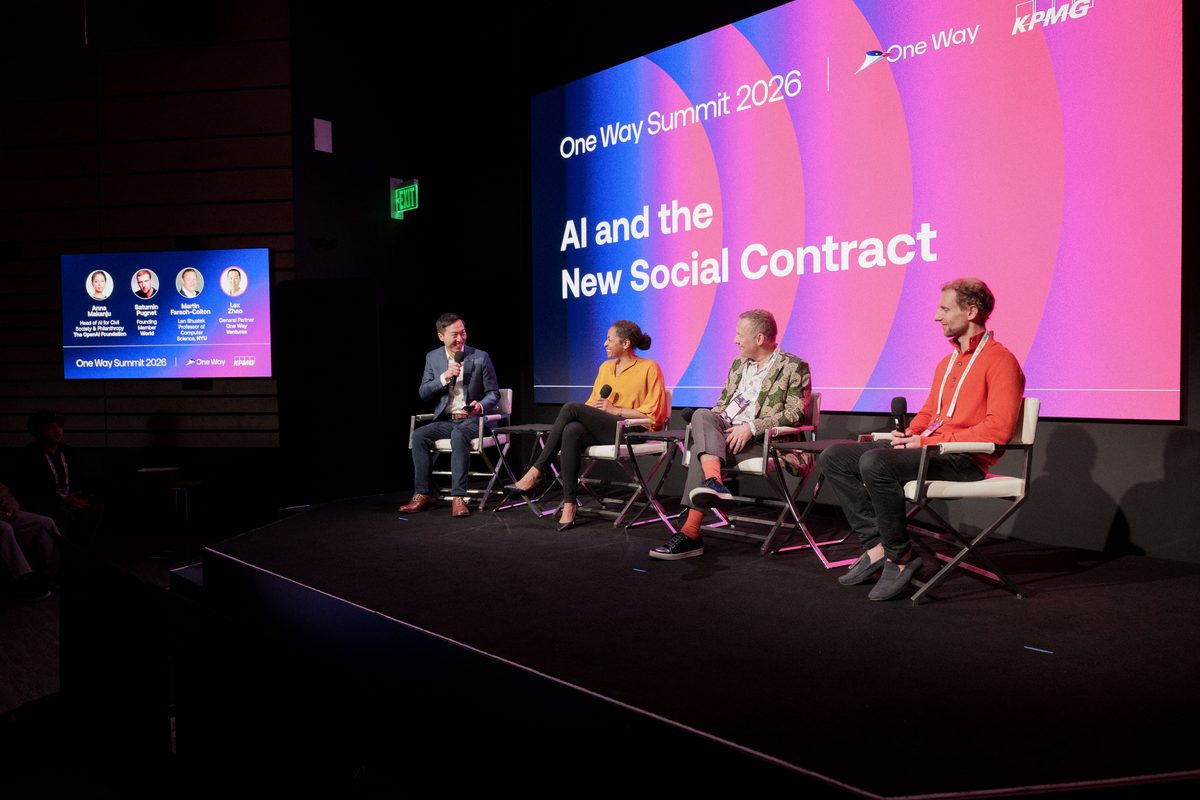
“Anyone who says that they know what a university is going to look like in 10 years is…”
“…trying to get you to donate to a university,” Zhao finished, laughing.
Rewriting the contract from scratch
Saturnin Pugnet, a founding member of World, the identity project associated with Sam Altman, went furthest. “I think I expect much sharper change than most people,” he said. Tweaking universities or governments won’t be enough, he argued. “It has to be rebuilt from the ground up, from very first principles.”
He measures that change in “tokens of thinking” rather than years. By his own estimate, humans and AI will produce more thinking between now and around 2034 “than the amount of thinking that’s been done in the universe since the beginning of time, as far as we know.”
Asking what life will look like for today’s students, he said, is “the equivalent of if you ask people in the Roman Empire what life should be for students in the 2000s.”
Makanju’s job is to make sure the gains reach people who aren’t in rooms like this one. The OpenAI Foundation, she said, received “roughly a quarter” of OpenAI’s value when the company restructured last year.
“You guys are an interesting minority in most rooms,” she told the audience. “People largely are afraid, and many people feel like this is something that they don’t have any control over, and they don’t see this developing in a positive way.”
The foundation has funded AI for public health and precise weather forecasts for smallholder farmers, which “really matters when you’re thinking about harvesting a crop.”
For Pugnet, the real question isn’t a policy. “It’s really, who are we as a species?” he said. “Because it’s not the same question anymore.”
Balasubramani has had to answer a smaller version of it more than once, filing, losing, refiling and finally winning the right to stay. She still won’t call the path closed.
“It’s not easy, but many, many people have done it before, so I don’t think it’s impossible at all.”
Featured image: courtesy of One Way Summit
Disclosure: This article mentions a client of an Espacio portfolio company.