





Every small business owner knows the feeling: the phone rings, nobody can get to it, and a customer quietly goes elsewhere. AI can now hold a conversation well enough to pick up in their place. The harder question is whether callers will trust it.
Making an AI receptionist sound human, it turns out, is not the main hurdle. What matters is whether callers get what they called for, know who (or what) they’re talking to, and can reach a real person when they need one.
That’s the thread running through The State of Voice AI for Small Businesses 2026, a report from the AI answering service Upfirst. It draws on surveys of 270 US consumers and 262 small and midsize business owners and managers, plus an analysis of 677,562 calls handled for 2,967 US businesses between January 2025 and August 2026.
Its central finding: adoption may depend less on whether people tolerate artificial voices in theory, and more on whether businesses use them to fix a problem customers already have.
Missed calls reveal a business problem voice AI could address
Start with what happens when no one answers. Some 78% of the consumers surveyed said they had hired or bought from a competitor because a business never picked up or called back.
Voicemail barely figures in the story. Only 24% said they left a message the last time a local business missed their call. Another 34% tried again later, and 22% went straight to a competitor.

The squeeze is tightest for businesses with 10 to 49 employees. According to Upfirst, 91% of them miss at least one potential-customer call in a typical week, and 76% miss four or more. Seventy-nine percent said an unanswered call had already cost them a customer.
Hiring more people isn’t the obvious fix it seems. Solo operators answer the phone themselves, and larger companies can staff a front desk. Firms in the middle get more calls than their owners can handle, but not enough to justify a full-time receptionist. Voice AI could cover that gap, especially after hours or when the team is busy.
It is also getting cheaper. Upfirst estimates that running a voice agent cost roughly three to five times less over the past year, as providers including xAI, Google and OpenAI launched voice services or cut prices.
Cheaper doesn’t mean customers will buy in, though. The report suggests the technology makes the most sense for businesses with a clear call-handling problem. Among those surveyed, interest in AI receptionists rose from 32% for businesses that didn’t miss calls to 77% for those missing at least four a week. In other words, voice AI looks less like something every company must adopt and more like a response to a specific need.
Customers want transparency more than human-like voices
Business owners, it seems, fear customer backlash more than customers actually express.
In Upfirst’s survey, 51% of owners said their biggest worry about AI receptionists was that callers would be annoyed or would rather talk to a person. Accuracy came second at 17%, then cost at 12%.
Consumers were more relaxed. Some 43% said they were comfortable with a small business using an AI receptionist and 29% were not, while the rest were neutral. Add the comfortable and the indifferent, and you get 71%.
That doesn’t mean people will hand over everything. Comfort depends heavily on the task. Seventy percent would let an AI answer questions about hours, services and pricing, and 62% would let it take a message. For appointment bookings or changes, the figure fell to 45%. For sensitive moments, it collapsed: only 16% were comfortable with an AI taking a payment, and 15% with it handling a complaint.
The lesson for businesses is to draw the line by what’s at stake in each interaction, not by what the latest model can technically do.
Honesty also matters more than polish. Eighty percent of respondents wanted an AI receptionist to say it was AI at the start of the call, and only 13% said they didn’t need to know. Among consumers who were neutral or uncomfortable with the technology, 55% named disclosure as an important factor in trust, while just 19% cited a natural-sounding voice.
Upfirst also pointed to earlier research covering 450,702 calls across 503 AI receptionists. Systems that identified themselves as AI saw about 20% fewer hang-ups than those that didn’t. The company cautioned that this is an association, not proof that disclosure alone made the difference.
Even so, the pattern is hard to miss: a more lifelike voice won’t win trust by itself. Callers want to understand what’s happening, get a useful answer and know there’s a person to turn to.
Voice AI adoption depends on integration, not just automation
The report also complicates the idea that AI receptionists exist mainly to replace front-desk staff.
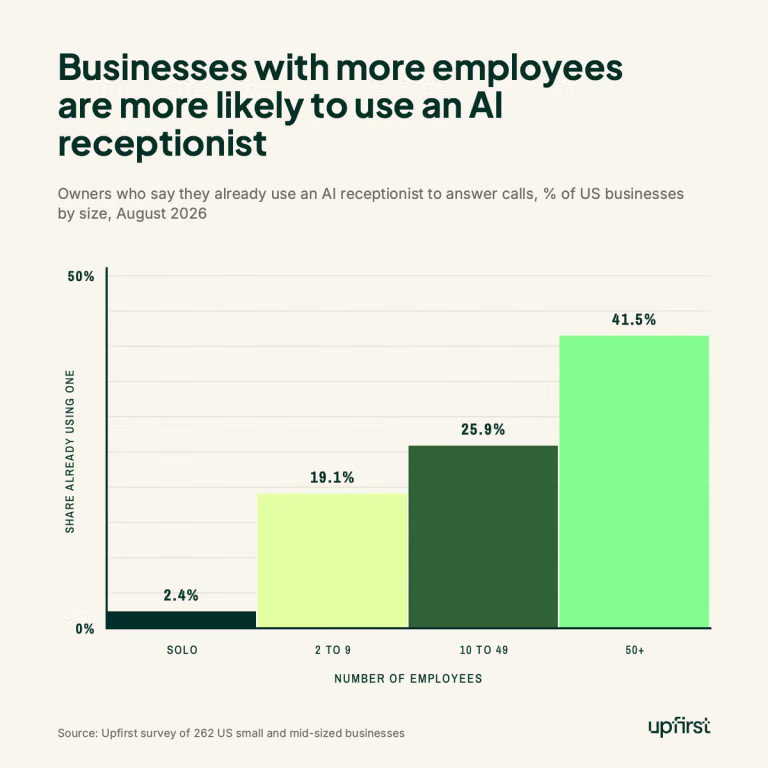
Businesses with 50 or more employees showed the highest adoption, at 41.5%, versus 2.4% among solo operators. Companies already using AI receptionists were also more likely to have people covering calls after hours: 79%, compared with 48% among businesses that weren’t interested in the technology.
Meanwhile, 16.4% of the calls in Upfirst’s dataset included an attempt to transfer the caller to a human. In practice, then, the AI often works as a switchboard, sending calls to the people who can resolve them. A system that answers everything but can’t tell when a situation needs human judgment risks creating new problems instead of solving old ones.
Language is another practical factor. Among 1,102 businesses in the call dataset with at least 50 calls, 90% received at least one call in Spanish, and across the full dataset 13.4% of calls were in Spanish. Separately, 29% of business owners surveyed said a language barrier on the phone had already cost them a customer. Voice AI could let businesses handle the occasional multilingual call without staffing every language, although these figures describe Upfirst’s own customers and shouldn’t be read as representative of all US businesses.
The study has other limits. Both surveys relied on an opt-in online panel rather than a probability sample, and the consumers skewed toward higher-income households. Upfirst acknowledged that this could overstate comfort with AI receptionists, since income was the strongest predictor of acceptance. The call records, for their part, capture only calls routed to an answering service, so they can’t show how often businesses miss calls across the broader market.
That makes the report a useful snapshot of today’s attitudes, not a forecast.
For business owners, the practical question isn’t whether an AI can imitate a human conversation. It’s whether it can capture a lead, answer a routine question, book an appointment or hand off a complicated issue without adding friction. As voice models get cheaper and better, the technology itself may become the smaller obstacle. The harder part will be deciding what to automate, when to bring in a person and how to put customers at ease.
In the end, the success of voice AI may depend less on how convincingly machines sound human than on how reliably they help a business respond when no human is available.

Disclosure: This article mentions a client of an Espacio portfolio company.