


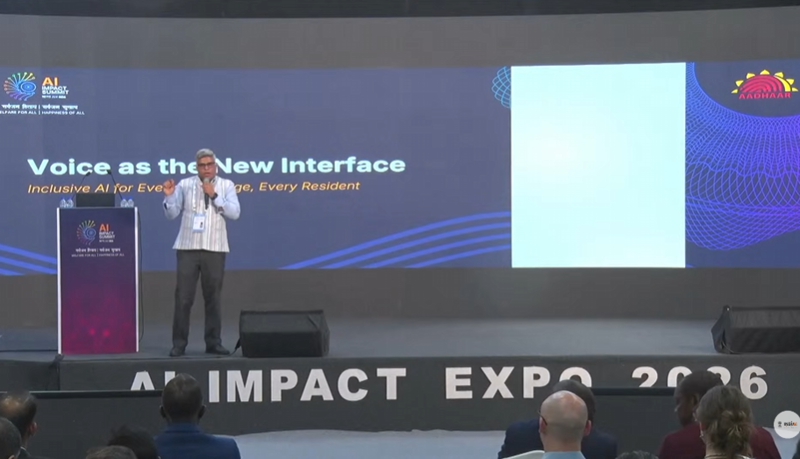


Voice is the next digital ID interface for biometric liveness verification, following facial recognition, fingerprinting, and iris scans, according to a presentation at the India AI Impact Summit.
Gathered this week in India at one of the largest AI conferences in the world — the India AI Impact Summit — the head of engineering at the Unique Identification Authority of India (UIDAI) Barada Prasad Sabut outlined the new digital ID interface during a session called “Aadhaar & Al: The Identity Paradox.”
“Definitely we have been seeing a good amount of success on liveness, whether it is finger liveness or it is face liveness,” said Sabut.
“Also, the detecting fraud at scale relating to biometric capture, whether it is capture of the fingerprint, or face, or iris, we have been successful in detecting them with the help of AI.”
“What we are doing, whenever an authentication request comes to our platform, we detect whether this is a fraudulent attempt or the resident is impacted because his biometrics are not matching — there are multiple attempts we are seeing — and at that point in time we are reaching out to the resident to take a confirmation”
UIDAI Head of Engineering Barada Prasad Sabut, India AI Impact Summit, February 2026
According to Sabut, the UIDAI “need to be ahead of the race, otherwise somebody will try and bring down an identity platform.
“On the voice side, this is a new channel that we are leveraging for to connect with our residents.“
So now, on top of fingerprinting, facial recognition, and iris scans, the UIDAI is making voice the next layer for authentication and verification in India via the Mitra chatbot that calls up residents for confirmation.
The UIDAI is the government entity behind India’s Aadhaar digital identity scheme.
For more than a decade, the story of Aadhaar has been filled with government overreach and courtroom battles to overturn said overreach.
“Enrolment for Aadhaar is entirely voluntary,” reads a government press release from December, 2013.
However, that same year Forbes India reported, “Aadhaar was always voluntary. But over the last year, more and more states and government agencies were making its use mandatory for a host of services, from buying cooking gas to registering marriages and renting houses.”
Then in 2017, Reuters reported that between January and March, 2017, “Various ministries make Aadhaar mandatory for welfare, pension, and employment schemes. Aadhaar made mandatory for filing of income tax returns. Aadhaar holders crosses 1.14 billion.”
That same year, the Reserve Bank of India clarified that Aadhaar linking with bank accounts was mandatory, and if you visit the Aadhaar website in the “myth-busters” section, it will say, “It is mandatory to submit Aadhaar number to the banking service provider” for those wishing to receive certain benefits or subsidies.
In May of 2022, Business Today described how ubiquitous India’s digital identity scheme had become, stating, “Aadhaar has emerged as the national identity and a treated as a preferred/ mandatory identity proof for avail services such as obtaining a SIM card, hospitalization, opening a bank account or availing government subsidies and benefits of various government-run welfare schemes, even for the COVID-19 vaccination.”
Today, India’s digital identity has reached virtually its entire population — 1.4 billion people who “volunteered” to sign up for the scheme.
Speaking on the same stage as Sabut at the India AI Impact Summit on Wednesday, UIDAI CEO Bhuvnesh Kumar said that from a legal standpoint, Aadhaar was just a 12-digit number and that it was never meant to be a document.
“Most people think Aadhaar is a card, and that’s how they’re treated, and that’s unfortunate. It’s a paradoxical situation. Aadhaar is not supposed to be a card. Aadhaar is actually only a 12-digit number, and that is how it was supposed to be. But over the years it has become a document instead of a number. By law, it’s still a number”
UIDAI CEO Bhuvnesh Kumar, India AI Impact Summit, February 2026
On the same stage, UIDAI head of innovation Zach Ninan shared how the organization was holding an “ID’athon” to act like a hackathon for digital ID projects.
Ninan highlighted previous work like scanning QR codes for hotel registry verification.
He added that the UIDAI had put all its anonymized datasets on its portal for other entities to analyze and contribute potential functionalities to the digital ID platform.
“We always keep seeing that we need data. And what the UIDAI has done is they have put the anonymized datasets completely out into the data.gov portal, which can be analyzed — you could probably get a lot of insights — on top of it you can actually build AI solutions”
UIDAI Head of Innovation Zach Ninan, India AI Impact Summit, February 2026
Liveness detection has been around for a few years.
In the US for example, the Department of Homeland Security (DHS), the Transportation Security Administration (TSA), Homeland Security Investigations Forensic Laboratory, and the National Institute of Standards and Technology (NIST) have been evaluating biometric digital ID systems through the Remote Identity Validation Technology Demonstration (RIVTD) program.
“As remote ID validation technologies become more prevalent, liveness/presentation attack detection of bad actors or impersonators will be a critical component of remote, self-enrollment of an individual’s digital identity”
Jason Lim, TSA Identity Capability Manager, January 2024
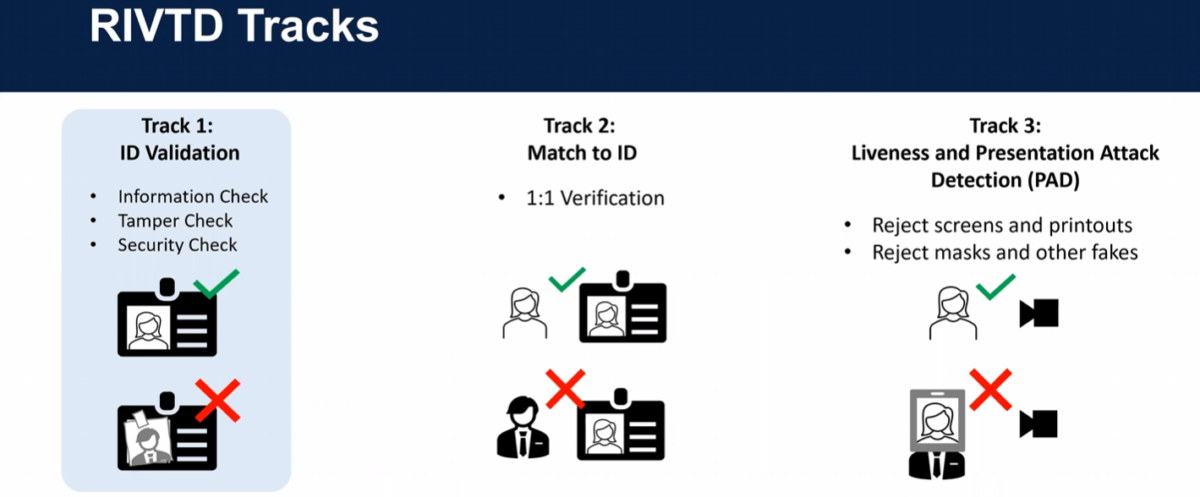
Launched in late 2022, the RIVTD program is “a series of technology challenges to evaluate the ability of systems to authenticate identity documents, assess the ‘liveness’ of selfie photos, and evaluate identity verification using images taken with smartphones and similar devices.”
And in October, 2023, a trade association representing some 300 major airlines announced a proof of concept demonstrating the “first travel experience using digital identity,” which also included a “biometric liveness check” like the one the DHS and TSA were evaluating.
The International Air Transport Association (IATA), in partnership with Swiss-based digital identity solutions provider SICPA, demonstrated “the first fully integrated digital identity travel experience” involving a British Airways flight from London to Rome.
“Our goal has always been a future of travel that’s fully digital and secured with biometric identification”
Nick Careen, IATA Senior Vice President for Operations, Safety and Security, October 2023
Image Source: Screenshot of Barada Prasad Sabut at the India AI Impact Summit during a session called “Aadhaar & Al: The Identity Paradox” February 18, 2026