
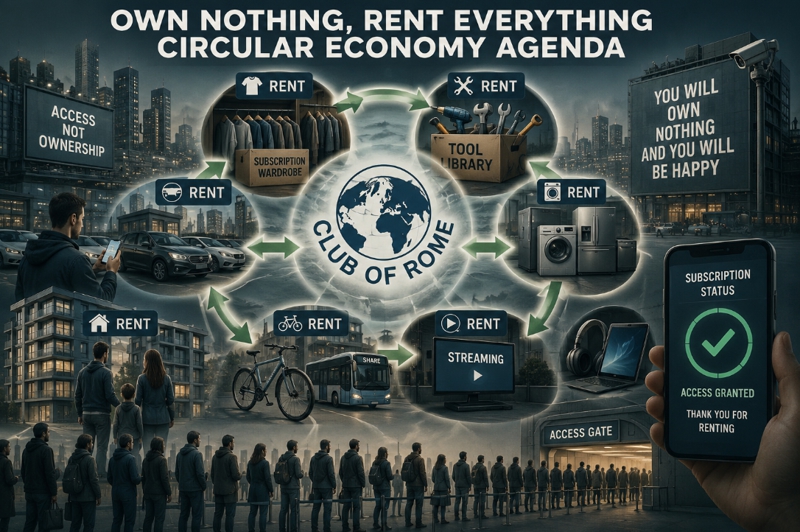


The ‘Own Nothing, Be Happy’ circular economy agenda seeks to turn all products into services, rentals & subscriptions: perspective
The Club of Rome crusade to promote the circular economy agenda requires social behavioral changes for people to accept the idea of owning nothing and renting everything with the help of digital product passports.
The infamous phrase, “You’ll Own Nothing. And You’ll Be Happy,” was based on circular economy business models, specifically, Product-as-a-Service, where manufacturers maintain ownership of their products that they rent out, so that individuals don’t actually own anything.
On June 30, the Club of Rome published a blogpost claiming that a shift in “culture, consumer behavior, and norms” were needed for circular practices to become the default.
And why not? How else do you get people to give up the idea of owning property in exchange for Life as a Subscription?
“Social innovation and behavioral change are essential to embed circular business models in everyday practices, social norms and shared values, supporting well-being and a just transition. They build the trust, legitimacy and participation needed for uptake and long-term viability”
Club of Rome member Lars Fogh Mortensen, Scaling circular business models in Europe and beyond: How to move beyond pilots and make the circular economy mainstream, June 2026
Written by a Club of Rome member, with a disclaimer that reads, “This article gives the views of the author(s), and not the position of The Club of Rome or its members,” the blogpost’s author, Lars Fogh Mortensen, is also an “Expert on Circular Economy, Consumption and Production at the European Environment Agency (EEA).”
Mortensen’s article is a breakdown of the EEA’s briefing published last April, entitled “Scaling circular business models in Europe.”
Some elements for scaling the circular economy include, but are not limited to:
- Access-based circular business models, based on renting, leasing and sharing:
- These are sometimes referred to as product-as-a-service models. They create value by providing temporary access to products through renting, leasing or sharing instead of ownership, increasing how many times each product is used.
- Scaling deep:
- Means shifting culture, consumer behavior and norms so circular practices become the default. Lasting circular transformation requires changes in values and beliefs that translate into preferences, trust and collaboration.
- Technological innovation:
- Is a crucial enabler for developing and scaling circular business model capabilities: from modular design and digital product passports to service delivery and predictive maintenance.
- Social innovation and behavioural change:
- Are essential to embed circular business models in everyday practices, social norms and shared values, supporting well-being and a just transition.
- Coordinated action:
- Is needed across key enablers of policy, finance, technology, behavior and value-chain collaboration is needed now to move from promising pilots to mainstreaming Europe’s circular economy.
Unelected globalist groups like the Club of Rome, the World Economic Forum, and the Fabian Society to name a few, have been pushing for a transition to a circular economy for many years.
Going back over a decade, former Club of Rome co-president Dr. Anders Wijkman claimed that young people didn’t care about owning things — they just wanted services — which is the goal of the circular economy.
“Young people are not so crazy about owning things any longer; they want to share things; they want to benefit from services“
Dr. Anders Wijkman, Club of Rome Co-President, July 2015
Just about all of the Club of Rome’s proposals are aimed at controlling humanity, such as telling people what they should eat, how their land should be used, what types of energy they should be allowed to consume, what they should do with their money, what type of economic system they should have, how schools should be run, and so on and so on.
The circular economy agenda is no different.
To get an even clearer picture of the real goal of the circular economy, have a listen to what Royal Philips Electronics CEO Frans Van Houten had to say at the WEF in 2016.
“In circular economy business models, I would like products to come back to me as the original designer and manufacturer […]
Frans Van Houten, World Economic Forum, February 2016
Why would I actually sell you the product if you are primarily interested in the benefit of the product?
Maybe I can stay the owner of the product and just sell you the benefit as a service”
According to the 2016 Davos Agenda blog post “8 Predictions for the World in 2030,” the very first prediction states, “All products will have become services” thanks to the circular economy.
The blog post is based on an essay written by WEF Young Global Leader and Danish MP Ida Auken that was published in Forbes in 2016 titled, “Welcome To 2030: I Own Nothing, Have No Privacy And Life Has Never Been Better.”
“Welcome to the year 2030. Welcome to my city – or should I say, ‘our city.’ I don’t own anything. I don’t own a car. I don’t own a house. I don’t own any appliances or any clothes,” Auken began.
“Everything you considered a product, has now become a service,” she added, while giving thanks to “the breakthrough of the circular economy.”
Image Source: AI generated with ChatGPT