

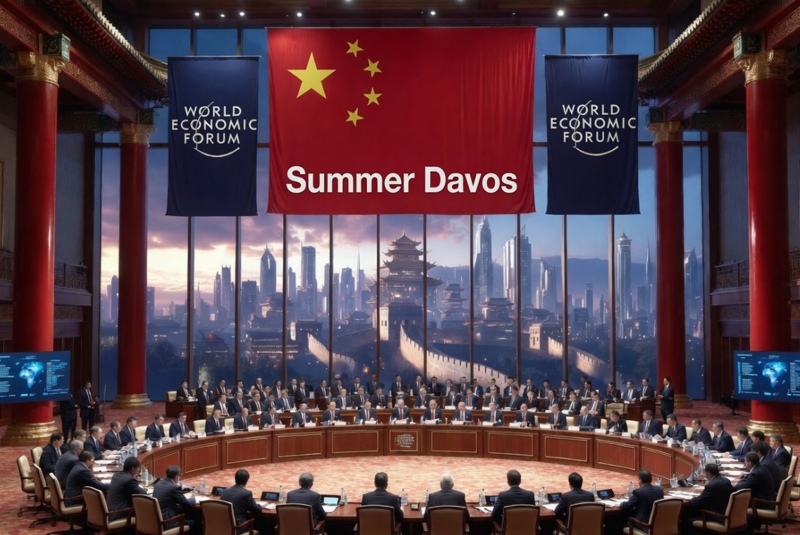


Presently absent from this year’s ‘Summer Davos’ is newly-appointed WEF president and CEO Alois Zwinggi, as well as interim co-chairs Larry Fink and Andre Hoffmann: perspective
Robots among us, pathogens that follow us, nature as infrastructure, and the energy that AI requires will all be on display and more at the World Economic Forum (WEF) Annual Meeting of the New Champions (AMNC), aka “Summer Davos,” in Dalian China from June 23-25.
Update, June 18, 2026: WEF co-chair Andre Hoffmann was added to the panel “Nature Is Infrastructure” following the publication of this article.
The program agenda for the WEF’s annual Summer Davos is out with sessions focusing on all things AI, robotics, financializing everything in nature, and the global economy and China’s role in it.
Here, we take a look at select sessions that are relevant to our audience, along with some background information about the architects of the great reset agenda.
As always, speakers and sessions are subject to change, but here’s where we are at the time of this publication.
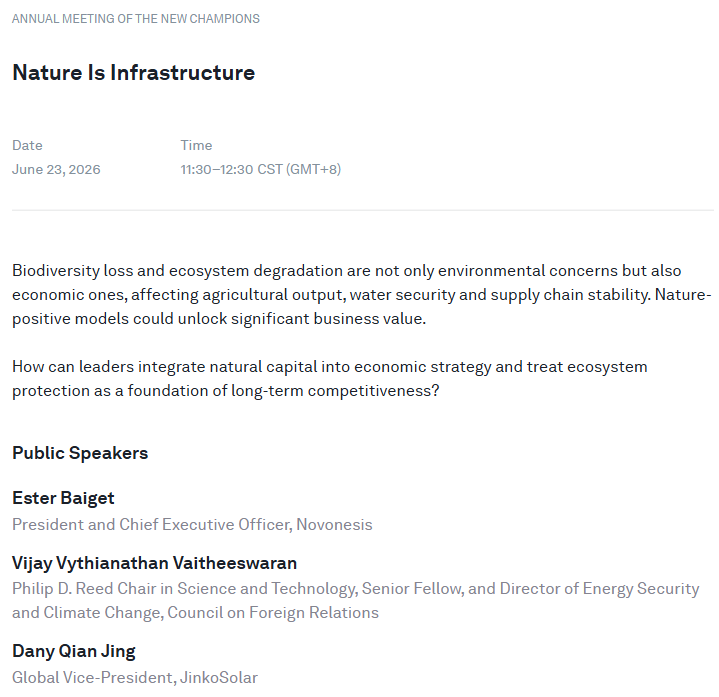
‘Nature Is Infrastructure: Nature-positive models could unlock significant business value’
Starting on Tuesday, June 23, we have “Nature Is Infrastructure,” which has been a common theme over the past couple of years.
Basically, it’s about monitoring, tokenizing, and financializing everything in nature.
Going back two years to the 2024 WEF Summer Davos, we saw University of Cambridge Institute for Sustainability Leadership CEO Lindsay Hooper, who told the panel on “Understanding Nature’s Ledger” that every part of the economy depends on nature, and that in order to protect natural systems, one solution would be to “bring nature onto the balance sheet.”
“We can’t do business on a dead planet. If we’re going to protect natural systems, one of the solutions is to bring nature onto the balance sheet”
Lindsay Hooper, WEF Annual Meeting of the New Champions, 2024
Then in September, 2025, the WEF published the insight report “Finance Solutions for Nature: Pathways to Returns and Outcomes,” which provides “stakeholders” with dozens of financial solutions for monetizing everything in nature.
Nature pricing, biodiversity crediting schemes, natural asset companies, debt-for-nature swaps, and so much more are all packed into this agenda to overhaul the global financial system with nature-based activities.
The WEF has been plowing full-steam ahead with the globalist agenda to monitor and monetize everything in nature, including the air we breathe, the water we drink, and the very earth that we walk upon.
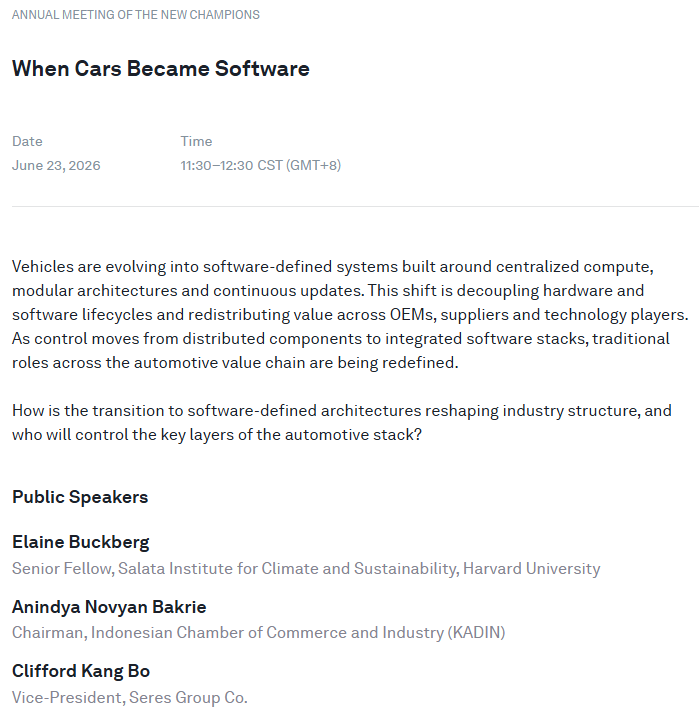
‘When Cars Became Software: Vehicles are evolving into software-defined systems built around centralized compute, modular architectures & continous updates’
Next on the WEF Summer Davos agenda, we have “When Cars Became Software.”
The analog days of yore are fading fast. Now, cars are equipped with a multitude of sensors, cameras, microphones, and other tracking systems recording every move in realtime.
Every year, the WEF publishes a report on what it considers to be the “Top 10 Emerging Technologies,” and the publication is announced at the AMNC.
Last year, “Collaborative Sensing” cracked the top 10.
Imagine a smart city where there are dozens of sensors, cameras, and radars on every block that track-and-trace every pedestrian and vehicle.
The vehicles are equipped with sensors that talk to the street lights, and they both send data to a single, central location using Vehicle-to-Everything (V2X) technologies.
Collaborative sensing “is enormously intrusive in terms of you know where everybody is at all times. What they’re doing. Where they’re going. And that is an ethical dilemma”
IBM Chief Innovation Officer Emeritus Bernie Meyerson, WEF Radio Davos, June 2025
“What collaborative sensing says is, ‘What if we have cameras virtually ubiquitous in a city?’
IBM Chief Innovation Officer Emeritus Bernie Meyerson, WEF Radio Davos, June 2025
Similarly, what if every street light is controlled ubiquitously throughout the city?
What if every vehicle communicates with a central location, again, throughout a city?”
And the vehicles themselves are not just passenger cars or busses, but also unmanned drones that deploy LiDAR and infra-red sensors that can pick up and detect what no human has ever been capable of.
All of the data is collected and processed automatically by AI systems that make autonomous decisions in real-time.
That’s collaborative sensing, where cars become software.
Speaking of AI systems, none of this will be possible without the massive amounts of energy, water, and land needed to power AI data centers.
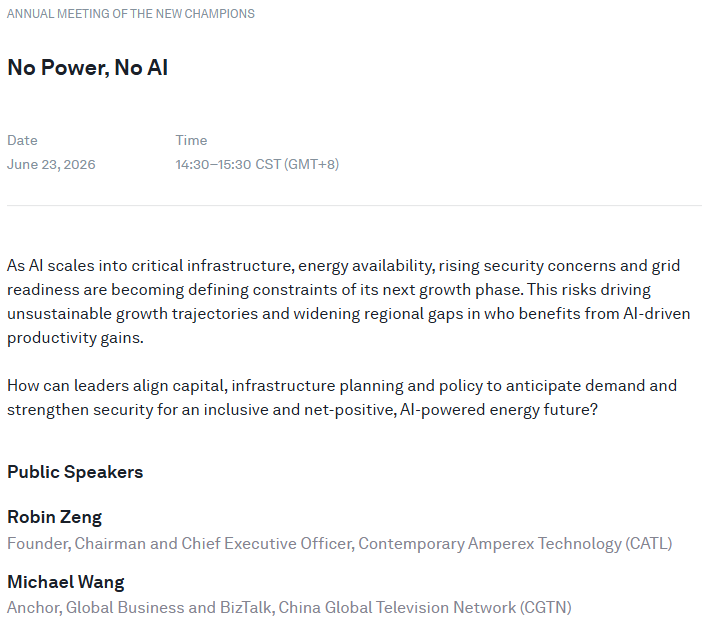
‘No Power, No AI: As AI scales into critical infrastructure, energy availability, rising security concerns & grid readiness are becoming defining constraints’
Continuing with the WEF Summer Davos sessions on Tuesday, we have the panel called, “No Power, No AI.”
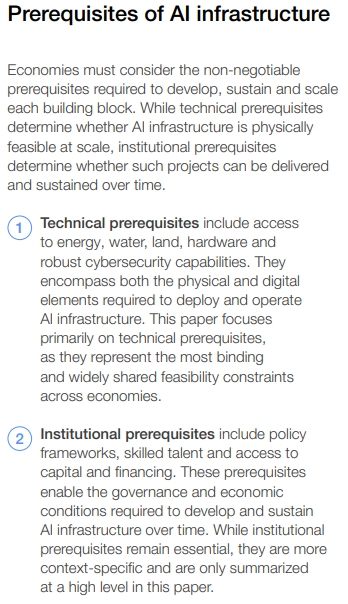
All the land, energy, and water for data centers are “non-negotiable prerequisites” for global AI infrastructure, according to the WEF and Bain and Company report, “AI Infrastructure in the Age of Sovereignty: Requirements, Strategies and a Trusted Framework for Digital Embassies.”
There can be no globally shared AI infrastructure or digital embassies without giving data centers all the land, energy, and water they need.
And the plan is to build data centers in host countries that have all the money and resources to do so, and then allow other countries to access the AI infrastructure through what they call “digital embassies,” which grant them “AI sovereignty.”
“To develop these building blocks at scale, economies rely on a set of non-negotiable technical (energy, water, land, hardware, cybersecurity) and institutional (policy, talent, capital/financing) prerequisites“
WEF, AI Infrastructure in the Age of Sovereignty, May 2026
Digital embassies, where host countries build data centers in their citizens’ backyard for foreign nations to access, is a concept championed by the WEF, the Tony Blair Institute (TBI) for Global Change, and other unelected globalist entities.
For them, digital embassies justify the resource-sucking, land-grabbing, energy-consuming, and water-depleting construction of thousands of AI data centers.
With these data centers, they are building a global, digital gulag of total surveillance and control.
This digital control grid is to extend beyond sovereign borders, further dividing the geopolitical powers between rich and powerful nations and poor and underdeveloped states.
What else will AI power? Why, robots of course!
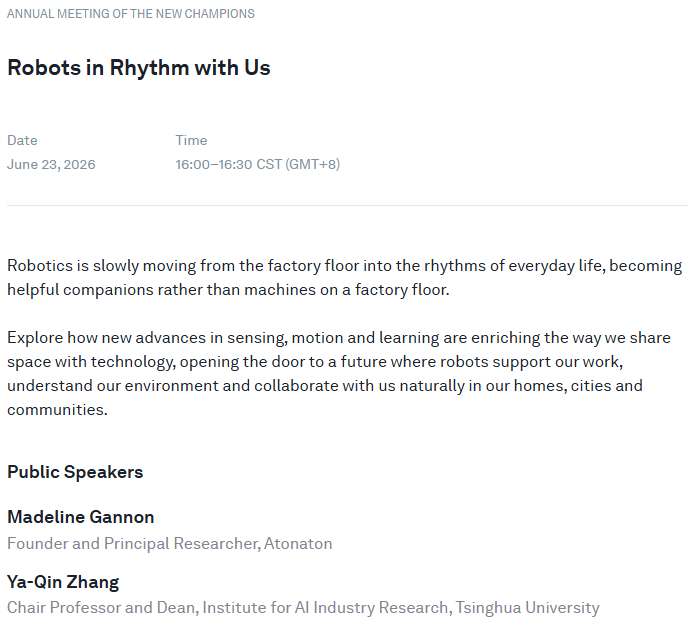
‘Robots in Rhythm with Us: Where robots support our work, understand our environment & collaborate with us in our homes, cities & communities’
On Tuesday, the WEF Summer Davos will discuss “Robots in Rhythm with US.”
In addition to worker robots in factories, this session is slated to explore a future where robots “collaborate with us naturally in our homes, cities, and communities.”
At the 2026 WEF Annual Meeting in January, Elon Musk predicted that he’d be selling humanoid robots commercially by the end of 2027 as that’s when they’d be highly reliable, safe, and have a great range of function.
With the end of 2027 being the projected date for the start of humanoid robot sales, Musk predicted that eventually everyone on earth would have a robot.
“I’d say by the end of next year, I think, we’ll be selling humanoid robots to the public […] That’s when we’re confident that [..] the range of functionality is also very high. You can basically ask it to do anything you’d like”
Elon Musk, WEF Annual Meeting, January 2026
These robots would “saturate all human needs” like taking care of kids, pets, and the elderly.
And just like with mobile devices, there will one day be more humanoid robots than people, according to Musk.
“My prediction is that there will be more robots than people”
Elon Musk, WEF Annual Meeting, January 2026
By 2031 at the latest, Musk predicted that AI would surpass all collective human intelligence.
And going back to last year’s WEF AMNC in China, Future Explorer Society founder Chang Dong-Seon explained that children who will grow up around robots may not be able to distinguish machines from other humans as they would lack the social cues to do so.
“If you look at studies of young people, then they don’t distinguish non-human robots with humans […] They might think they really have feelings, show sympathy, and think of the other non-human beings like they’re human”
Chang Dong-Seon, WEF Annual Meeting of the New Champions, June 2025
But it’s not just younger people who will be affected from being around robots.
In his second scenario, Dong-Seon says that the more we interact with robots throughout our lives, the more we may lose our ability to socialize normally with other humans because our brains would be rewired to treat other people as if they were machines.
“If you are isolated and if you don’t interact with other human beings, over time your brain loses the ability to read social cues from other beings […] if you interact with robots, a lot of people see that you might actually become very aggressive, abusive […] and your non-human actions might convey also to humans when you interact“
Chang Dong-Seon, WEF Annual Meeting of the New Champions, June 2025
Moving on from Tuesday to Wednesday at the WEF Summer Davos in China, we see pathogens on the agenda.
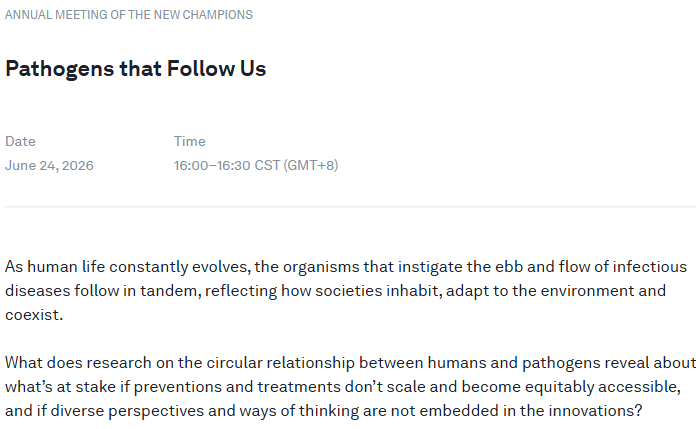
“Pathogens that Follow Us: As human life constantly evolves, the organisms that instigate the ebb & flow of infectious diseases follow in tandem”
As of this publications, there are no assigned speakers for the session “Pathogens that Follow Us.“
However, the WEF has for long supported the notion of “One Health” — which basically says that humans are causing climate change, which affects wildlife health, leading to disease spillovers from animals to humans.
At last year’s AMNC, the description for the panel on “The Value of One Health” stated, “With vector-borne diseases accounting for more than 17% of all infectious diseases, and predicted to expose 500 million more people by 2050, the interconnectedness of humans, animals, plants and ecosystems is only set to grow.”
The concept of One Health ties-in well with the first session mentioned about “Nature Is Infrastructure” and the agenda to monitor, tokenize, and financialize everything in nature.
Speaking at the World Health Organization (WHO) Pan European Commission on Climate and Health (PECCH) meeting in June 2025, WHO regional director for Europe Dr. Hans Henri Kluge explained that one of the goals of the PECCH was to “flip the script” on climate and health messaging in order to influence and persuade governments into investing in globalist initiatives.
“Climate change is already making us sick. It’s killing us, and it’s only getting worse. That’s why we’re launching the Pan European Commission on Climate and Health — because the climate crisis is a health crisis, and climate action is health action“
Dr. Hans Henri Kluge, WHO Pan European Commission on Climate and Health, June 2025
The climate is always changing and has always affected human health going back hundreds of thousands of years for obvious reasons, but the United Nations has declared that since the 1800s, human activity has been the main driver for changing the climate “primarily due to the burning of fossil fuels like coal, oil and gas.”
By merging climate and health, the UN, through its heavily Gates-funded organization the WHO, is consolidating and centralizing policy recommendations, so that everything is interconnected.
No matter the science, the policies for health will be the same policies for climate.
Now, let’s take a look at the last Summer Davos panel of note, which relates to AI and fake food.
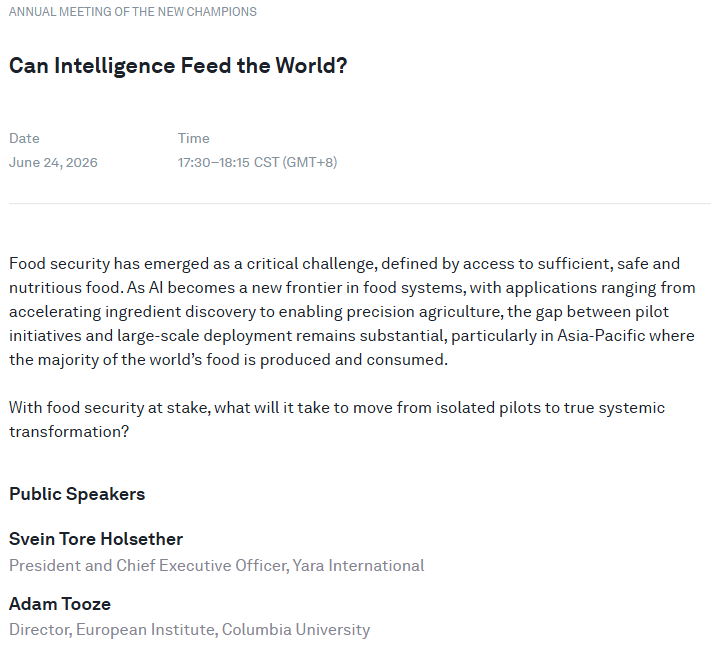
“Can Intelligence Feed the World? With applications ranging from accelerating ingredient discovery to enabling precision agriculture, the gap between pilot initiatives & large-scale deployment remains substantial”
On Wednesday, the WEF AMNC is slated to ask, “Can Intelligence Feed the World?“
One thing that stands out in the panel’s description is about how AI is “accelerating ingredient discovery.”
The agenda to rollout alternative proteins for human and animal consumption has been long in the making.
Most readers will have heard the phrase, “eat ze bugs,” but alternative proteins also come from lab-grown organisms.
Taking it a step further, companies are at work devising new ways into tricking your tongue and brain into accepting artificial chemical compounds that attempt to either mimic natural flavors or create new ones entirely.
Speaking at the 2024 WEF Annual Meeting, Sarah Reisinger, Chief Science and Research Officer at dsm-firmenich how AI and biological data can help unlock our understanding of taste and smell to provide consumers with so-called sustainable solutions.
“If you love the taste and aroma of vanilla, can we have something that is reminiscent of that that is new to the world?”
Sarah Reisinger, WEF Annual Meeting, January 2024
This year’s 17th annual World Economic Forum Annual Meeting of the New Champions will take place from June 23-25 in communist China.
According to the AMNC overview, “The meeting will bring together leaders from business, government, civil society, academia, and the entrepreneurial community to explore how innovation and emerging technologies can unlock new growth models and drive positive economic momentum. It will also offer insights into the economic outlook of key emerging markets, with a particular focus on China and the broader Asian region.”
While speakers and sessions are subjected to change, notably absent from this year’s Summer Davos is newly-appointed WEF president and CEO Alois Zwinggi, as well as interim co-chairs Larry Fink and Andre Hoffmann.
You can check out the WEF website for the entire list of panels and speakers, many of which were not covered in this article.
Image Source: AI generated with Grok