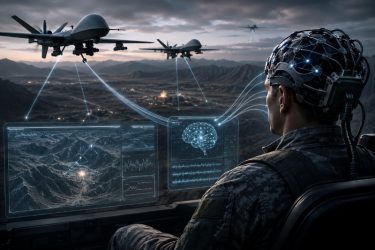


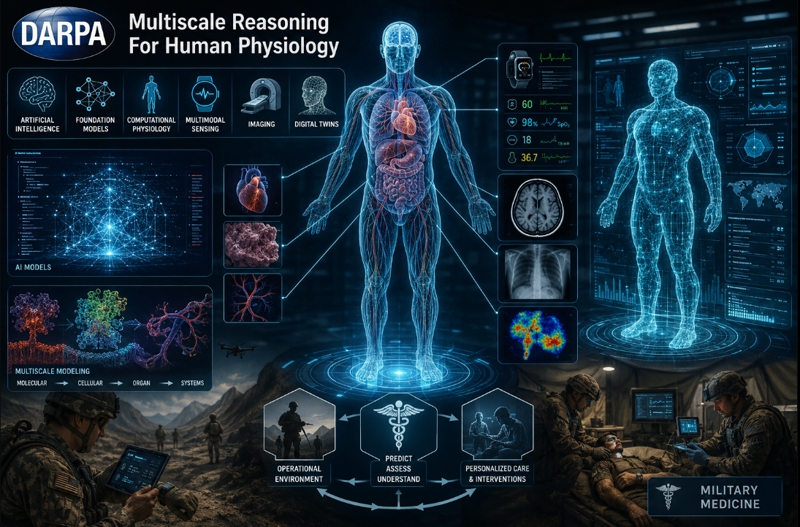


DARPA is looking to model just about every aspect of human health, biology, and physiology to advance military medicine with its proposed Multiscale Reasoning for Human Physiology program.
On Monday, the US Defense Advanced Research Projects Agency (DARPA) put out a request for information (RFI) for its planned Multiscale Reasoning For Human Physiology program.
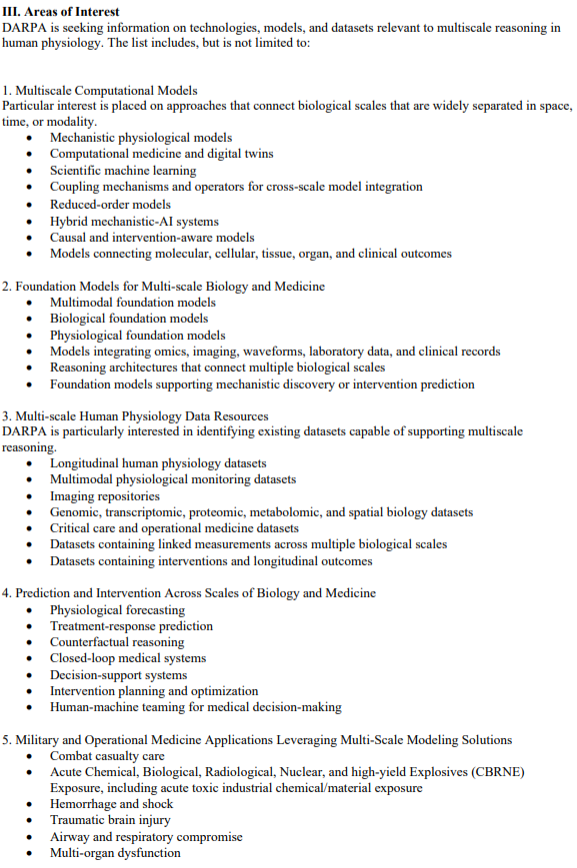
For the military and operational medicine applications, DARPA is looking to leverage multi-scale modeling solutions for just about every injury, illness or ailment that soldiers face, including:
- Combat casualty care
- Exposure to acute chemical, biological, radiological, nuclear, and high-yield explosives, including acute toxic industrial chemical and materials
- Hemorrhage and shock
- Traumatic brain injury
- Airway and respiratory compromise
- Multi-organ dysfunction
- Sepsis and infection
- Prolonged casualty care
- Recovery and rehabilitation
- Human performance and resilience
“Recent advances in artificial intelligence, foundation models, computational physiology, multimodal sensing, imaging, and digital twins have created new opportunities to model human health and disease across these scales”
DARPA, Multiscale Reasoning For Human Physiology RFI, July 2026
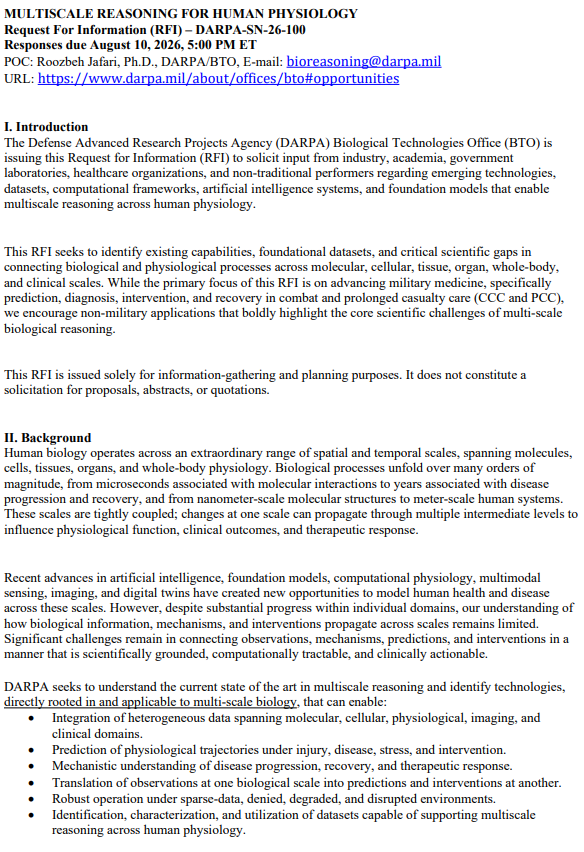
“This RFI seeks to identify existing capabilities, foundational datasets, and critical scientific gaps in connecting biological and physiological processes across molecular, cellular, tissue, organ, whole-body, and clinical scales”
DARPA, Multiscale Reasoning For Human Physiology RFI, July 2026
According to the Pentagon’s research and development funding arm, the primary focus of the RFI is to advance military medicine, incluindg prediction, diagnosis, intervention, and recovery in both combat and prolonged casualty care.
However, DARPA is also looking for “non-military applications that boldly highlight the core scientific challenges of multi-scale biological reasoning.”
What do they mean by that?
For some background:
“Human biology operates across an extraordinary range of spatial and temporal scales, spanning molecules, cells, tissues, organs, and whole-body physiology […] Recent advances in artificial intelligence, foundation models, computational physiology, multimodal sensing, imaging, and digital twins have created new opportunities to model human health and disease across these scales”
DARPA, Multiscale Reasoning For Human Physiology RFI, July 2026
The challenge, then, is in “connecting observations, mechanisms, predictions, and interventions in a manner that is scientifically grounded, computationally tractable, and clinically actionable.”
DARPA’s Multiscale Reasoning for Human Physiology RFI has five general areas of interest, with a whole plethora of subcategories that emcompass just about every known detail of human biology and physiology, along with the technological capabilities for all the modeling, reasoning, predicting, and computing requirements.
The five areas of interest include:
- Multiscale Computational Models Particular interest is placed on approaches that connect biological scales that are widely separated in space, time, or modality
- Foundation Models for Multi-scale Biology and Medicine
- Multi-scale Human Physiology Data Resources: DARPA is particularly interested in identifying existing datasets capable of supporting multiscale reasoning
- Prediction and Intervention Across Scales of Biology and Medicine
- Military and Operational Medicine Applications Leveraging Multi-Scale Modeling Solutions
“Particular interest is placed on datasets containing linked measurements across molecular, cellular, tissue, organ, physiological, and clinical scales, as well as datasets containing interventions and outcomes”
DARPA, Multiscale Reasoning For Human Physiology RFI, July 2026
Ultimately, DARPA “seeks to understand the current state of the art in multiscale reasoning and identify technologies, directly rooted in and applicable to multi-scale biology, that can enable:
- Integration of heterogeneous data spanning molecular, cellular, physiological, imaging, and clinical domains.
- Prediction of physiological trajectories under injury, disease, stress, and intervention.
- Mechanistic understanding of disease progression, recovery, and therapeutic response.
- Translation of observations at one biological scale into predictions and interventions at another.
- Robust operation under sparse-data, denied, degraded, and disrupted environments.
- Identification, characterization, and utilization of datasets capable of supporting multiscale reasoning across human physiology
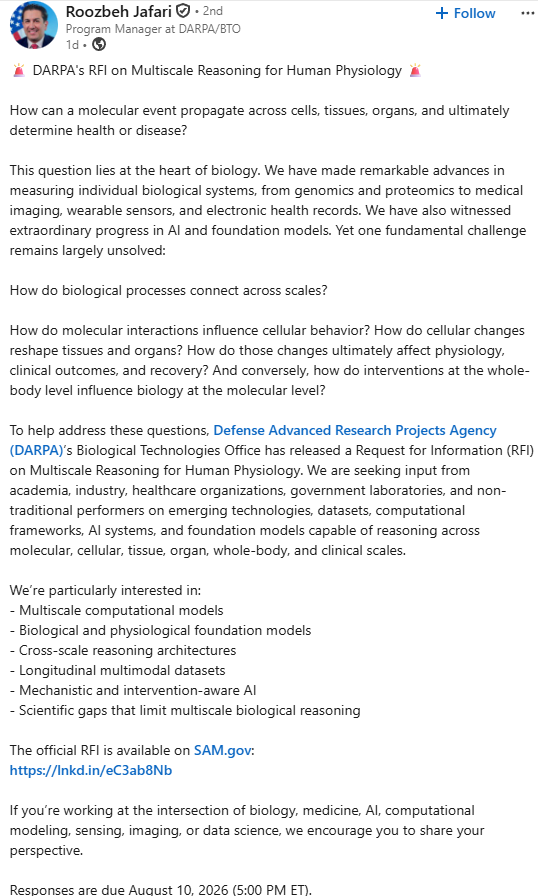
The main point of contact for DARPA’s Multiscale Reasoning For Human Physiology RFI is Dr. Roozbeh Jafari, Ph.D, who according to his bio, became a program manager one year ago this month in July, 2025.
Previously, Dr. Jafari was a principal staff at MIT Lincoln Laboratory and research affiliate at MIT’s Laboratory for Information & Decision Systems and Microsystems Technology Laboratories.
“We have made remarkable advances in measuring individual biological systems, from genomics and proteomics to medical imaging, wearable sensors, and electronic health records. We have also witnessed extraordinary progress in AI and foundation models. Yet one fundamental challenge remains largely unsolved: How do biological processes connect across scales?”
DARPA PM Dr. Roozbeh Jafari, LinkedIn, July 2026
“His [Dr. Jafari’s] laboratory developed groundbreaking technologies including smart rings, smart watches and e-tattoos for continuous cardiovascular monitoring, cuffless blood pressure sensing systems, and precision medicine digital twins“
DARPA.MIL
DARPA program managers come and go. Sometimes, a research program can go through several changes in leadership.
In the case of Dr. Jafari, he’s now associated with at least four other DARPA programs, two of which have been documented here on The Sociable — BETR (2019) and BEST (2025).
These programs now include:
- BETR (Bioelectronics for Tissue Regeneration): To develop technology aimed at speeding warfighter recovery, and thus resilience, by directly intervening in wound healing.
- BEST (BioElectronics to Sense and Treat): To develop wearable, automated technologies that can predict and prevent a wound infection before it can occur, and to eliminate an infection if it has already taken hold.
- MASH (Medics Autonomously Stopping Hemorrhage): To develop robotic systems to autonomously find and stop life-threatening bleeding inside the body, giving injured warfighters a much better chance of survival in combat situations.
- VITAL (Virtual-Integrated Twin for Autonomous Lifesaving): To develop digital twins of the human cardiovascular system to provide doctors with a powerful predictive tool.
“How do molecular interactions influence cellular behavior? How do cellular changes reshape tissues and organs? How do those changes ultimately affect physiology, clinical outcomes, and recovery? And conversely, how do interventions at the whole-body level influence biology at the molecular level?”
DARPA PM Dr. Roozbeh Jafari, LinkedIn, July 2026
If DARPA’s Multiscale Reasoning For Human Physiology RFI becomes a fully-funded research project, it will have the potential to transform healthcare in both military and civilian settings, with an emphasis on connecting biological and physiological processes across molecular, cellular, tissue, organ, whole-body, and clinical scales.
At the same time, cutting edge research and development can often be multi-use and multi-faceted.
Medicine or poison?
DARPA is also in the business of Brain-Computer Interfaces (BCIs) and programming biology to create transhumanistic supersoldiers, and the Pentagon’s research and development funding arm is actively pursuing how to monitor, predict, and manipulate future human behavior.
The same research that goes into understanding how to heal people could one day also be used to find hidden vulnerabilities to unleash devastating harm.
Image source: AI generated with ChatGPT