

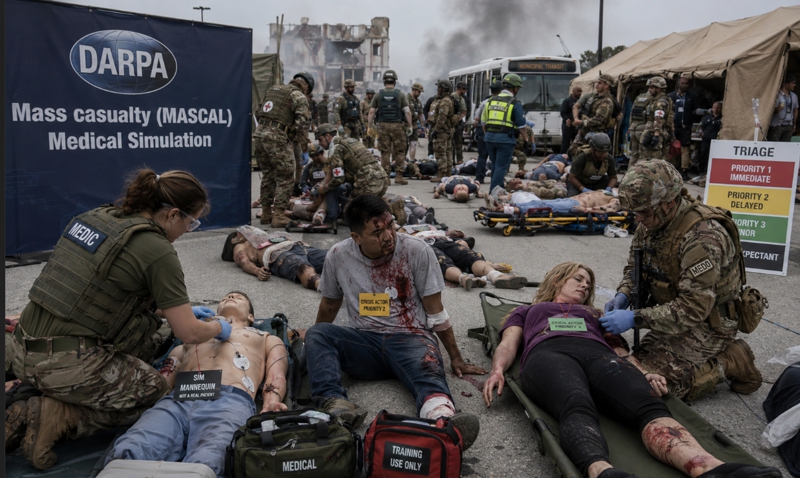


DARPA is looking for input from the public and private sectors for its upcoming mass casualty simulation called Realistic Mass Casualty (MASCAL) Medical Simulation Capabilities.
The US Defense Advanced Research Projects Agency (DARPA) is seeking “input from industry, government support organizations, military training organizations, and civilian emergency preparedness entities regarding capabilities to plan, resource, execute, and assess high-fidelity, large-scale mass casualty (MASCAL) medical simulation events,” according to the special notice.
“This Request for Information (RFI) is a preliminary step to assess current capabilities to conduct realistic MASCAL simulations involving greater than 50, 100, or 200 simulated patients within a single event lasting less than 72 hours, and data sources to assess these events”
DARPA, MASCAL, May 2026
DARPA is quite descriptive with which types of injuries it is looking to simulate, and most are consistent with what you would expect in warfighting scenarios, such as burns, blast injuries, lascerations, hemorrhages, and contaminations.
For example, MASCAL is looking for performers who have experience in conducting simulations that had at least 25 casualties, along with information on what types of capabilities they could provide.
Those capabilities include:
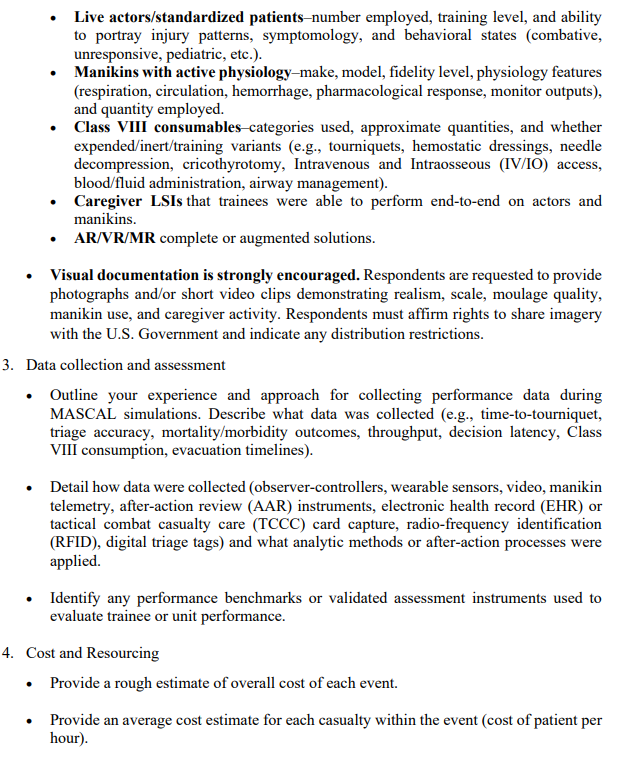
- Moulage techniques, providers, and injury catalog (e.g., penetrating trauma, burns, blast injuries, amputations, evisceration, contamination).
- Live actors/standardized patients–number employed, training level, and ability to portray injury patterns, symptomology, and behavioral states (combative, unresponsive, pediatric, etc.).
- Manikins with active physiology–make, model, fidelity level, physiology features (respiration, circulation, hemorrhage, pharmacological response, monitor outputs), and quantity employed.
- Class VIII consumables–categories used, approximate quantities, and whether expended/inert/training variants (e.g., tourniquets, hemostatic dressings, needle decompression, cricothyrotomy, Intravenous and Intraosseous (IV/IO) access, blood/fluid administration, airway management).
- Caregiver LSIs [Life Saving Interventions] that trainees were able to perform end-to-end on actors and manikins.
- AR/VR/MR complete or augmented solutions
The fact that pediatric is mentioned shows that DARPA is preparing for not just warfighter casualties, but also civilian.
And what live action simulation would be complete without the use of dummies and crisis actors?
“DARPA seeks input from industry, government support organizations, military training organizations, and civilian emergency preparedness entities regarding capabilities to plan, resource, execute, and assess high-fidelity, large-scale mass casualty (MASCAL) medical simulation events”
DARPA, MASCAL, May 2026
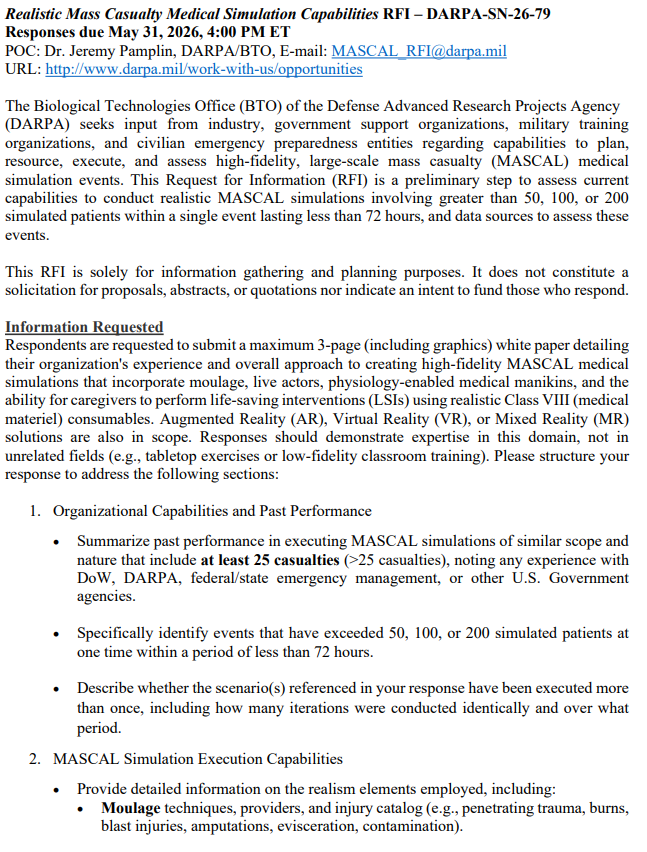
With responses due May 31, “Respondents are requested to submit a maximum 3-page (including graphics) white paper detailing their organization’s experience and overall approach to creating high-fidelity MASCAL medical simulations that incorporate moulage, live actors, physiology-enabled medical manikins, and the ability for caregivers to perform life-saving interventions (LSIs) using realistic Class VIII (medical materiel) consumables.”
The main point of contact for MASCAL is retired Army Colonel Dr. Jeremy Pamplin who, according to his bio, “served as the first commander of TATRC, the only US Army laboratory dedicated to researching and developing advanced technologies to automate casualty care.”
TATRC, which stands for Telemedicine and Advanced Technology Research Center, is headquartered at Fort Detrick in Frederick, Maryland, and played a significant role in the COVID-19 response.
Partnering with Amazon Web Services and Deloitte at the onset, together they launched “NETCCN: a low-resource, cloud-based, virtual health solution that facilitates secure collaboration between onsite and remote medical teams.”
“There is no better place to witness the whole-of-government approach in action than at Fort Detrick, which is playing a significant role in COVID-19 response efforts by relying on unique communities of research and acquisition personnel during this challenging and unprecedented time”
US Army Medical Research and Development Command, “Fort Detrick Installation Utilizes Whole of Government Approach to Tackle COVID-19,” April 2020
Wargaming scenarios and planning simulations is nothing new to DARPA.
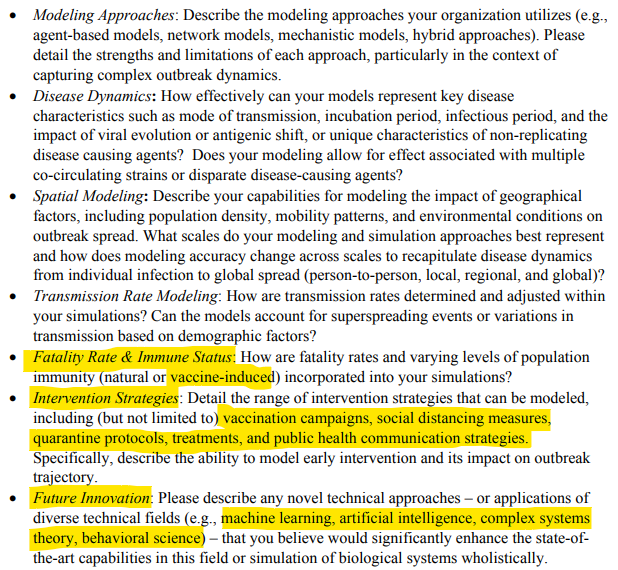
Last year in May, the Pentagon’s research and development funding arm put out a special notice to simulate disease outbreaks, including models for lockdowns, mass vaccination campaigns, and messaging strategies.
If and when the next outbreak occurs, the same draconian and Orwellian measures that governments and corporations deployed in the name of combating COVID are still on the table.
“Intervention Strategies: Detail the range of intervention strategies that can be modeled, including (but not limited to) vaccination campaigns, social distancing measures, quarantine protocols, treatments, and public health communication strategies. Specifically, describe the ability to model early intervention and its impact on outbreak trajectory”
DARPA, Advanced Disease Outbreak Simulation Capabilities RFI, May 2025
AI, Machine Learning, and the military will play an even bigger role than the last time around.
From analyzing wastewater to learning about disease spread; from developing pharmaceuticals to measuring the effects of lockdowns and vaccine passports, from modeling and predicting human behavior to coming up with messaging strategies to keep everyone in compliance — “improving preparedness for future public health emergencies” is becoming more militaristically algorithmic by the day.
With DARPA simulating disease outbreaks and now mass casualty events, are these just precautionary measures for hypothetical emergencies, or are these preparations for not an “if” scenario but an inevitable “when?”
Image Source: AI generated with ChatGPT