





The 50-in-5 Awards are a made-up spectacle to celebrate globalist lapdogs corralling all of society into an interoperable digital gulag: perspective
At the next UN General Assembly, the 50-in-5 Digital Public Infrastructure (DPI) campaign will award countries and individuals demonstrating best DPI practices.
Launched in November 2023, the 50-in-5 campaign is a joint effort of the United Nations, the Bill and Melinda Gates Foundation, and their partners to rollout out at least one component of Digital Public Infrastructure (DPI) in 50 nations within five years.
DPI is a civic technology stack consisting of three major components: digital ID, fast payment systems, and massive data sharing between public and private entities.
Last year, the 50-in-5 campaign reached a milestone of 30 countries, and today that number now stands at 33.
This month, 50-in-5 has opened the voting to its members to nominate individuals and countries that are “demonstrating advancing safe, inclusive, and interoperable DPI.”
“The 50-in-5 Awards aim to highlight best practices, inspire learning, and recognize achievements that accelerate and improve safe, inclusive, and interoperable DPI adoption worldwide“
50-in-5 Awards, April 2026
According to the 50-in-5 Awards announcement, “the global conversation has moved from why DPI matters to how it is being scaled – and the real-world impact that is having on people’s lives and the economies it is helping to strengthen.”
The 50-in-5 Awards categories include:
- Collaboration: The Collaboration Award recognizes that collaboration can accelerate DPI implementation and improve outcomes. It will honor two or more countries that have worked together to implement, or improve a DPI deployment.
- It will assess:
- Common DPI Technology
- Interoperability
- Safety and Inclusion
- Progress / Real Implementation Outcomes
- It will assess:
- Impact: The Impact Award recognizes a country where digital public infrastructure is delivering meaningful improvements to people’s lives. It celebrates tangible outcomes that show how DPI is driving real-world change — such as expanding access to essential services or reaching more people effectively.
- It will assess:
- Quantitative Reach
- Depth
- Growth
- Leadership
- Safety / Inclusion
- It will assess:
- Individual Contribution: The Individual Contribution Award recognizes an individual who embodies the spirit of 50-in-5.
- It will assess:
- Knowledge Sharing
- Advocacy
- Leadership in Collaboration
- Values Around Safe, Inclusive, Interoperable DPI
- It will assess:
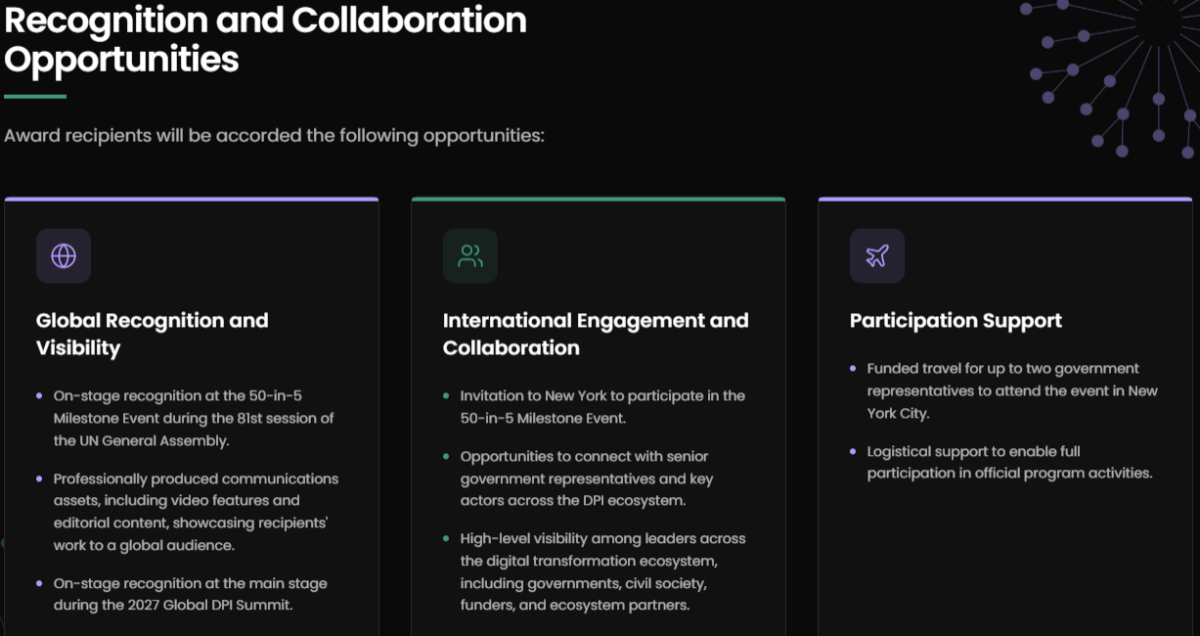
The winners are to receive on-stage recognition at the 50-in-5 Milestone Event during 81st UN General Assembly on September 21 in New York City, as well as at the Global DPI Summit in 2027.
Other winners will be invited to participate at milestone event to connect with others in the DPI space.
According to the award criteria, “Only countries participating in 50-in-5 announced before June 1st, 2026 are eligible to apply; one submission per country per category is allowed, and countries may also nominate a peer 50-in-5 country.”
Nominees will be reviewed by members of the Gates Foundation, United Nations, World Bank, and other DPI advocates like the Center for Digital Public Infrastructure, AfricaNenda, and Estonia’s GovStack.
The 50-in-5 campaign bills itself as a “country-led advocacy campaign;” however, it is organized by a handful of globalist groups that all partner with one another, and who are hellbent on rolling out digital ID and programmable digital currencies worldwide.
Collaborators include the Bill and Melinda Gates Foundation, the United Nations Development Program, the Digital Public Goods Alliance, the Center for Digital Public Infrastructure, and Co-Develop; with support from GovStack, the Inter-American Development Bank, and UNICEF.
The Center for Digital Public Infrastructure is backed by Co-Develop and Nilekani Philanthropies.
Co-Develop was founded by The Rockefeller Foundation, the Bill & Melinda Gates Foundation, Nilekani Philanthropies, and the Omidyar Network.
The Omidyar Network is a funder of MOSIP.
The Digital Public Goods Alliance lists both the Gates and Rockefeller foundations in its roadmap showcasing “activities that advance digital public goods,” along with other organizations and several governments.
On the surface, DPI might seem like something that could benefit the people greatly, and it certainly has the potential to do so.
However, that would require the people to have trust in governments, corporations, and unelected globalists working in lockstep to keep their best interests at heart.
Sold as a mechanism for financial inclusion, convenience, improved healthcare, and green progress, DPI is an all inclusive phrase applied to a looming technocratic governance over people and the “15-minute smart cities” in which they’ll live.
If successful, DPI will give governments and corporations the power to implement systems of social credit that can determine where and how you can travel, what you are allowed to consume, and how you will be able to transact with your programmable money.
The 50-in-5 campaign is an agenda concocted by a coalition of unelected globalists from the Gates Foundation, the United Nations, and partners of the Rockefeller Foundation all working in lockstep to accelerate a technocratic system of control through digital ID, digital payments, and massive data sharing.
The 50-in-5 Awards are a made-up spectacle to celebrate globalist lapdogs corralling all of society into a digital gulag.
Image Source: AI generated with ChatGPT