



If intelligence were to become a utility billed on a meter, then the intelligent age would only benefit the elite and those who could afford it: perspective
The intelligent age is replacing our cognitive capabilities with AI, and universities should prioritize teaching students how to capably use technology over teaching actual knowledge, according to WEF founder Klaus Schwab.
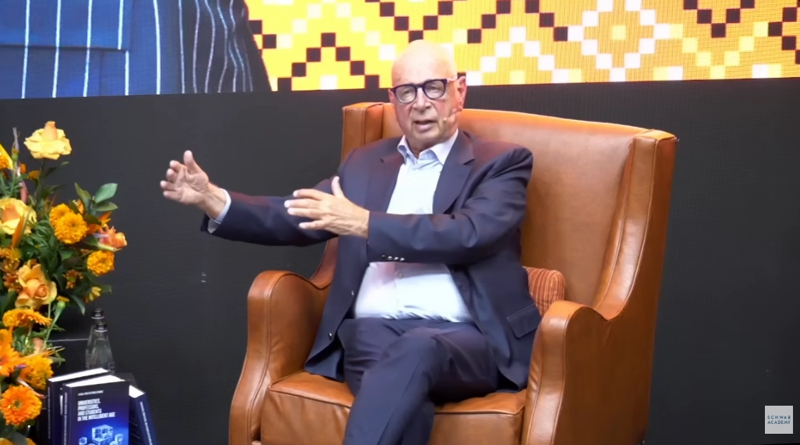
Livestreaming today at the University of Johannesburg in South Africa, Schwab spoke at length about what he calls ‘the intelligent age” and what it means for jobs, students, and humanity.
Comparing previous industrial revolutions to the so-called intelligent age, the grand architect of the great reset agenda said that our thinking abilities were now being delegated to artificial intelligence.
“What is the Intelligent Age doing? It is replacing our cognitive capabilities by algorithm, or by what we call our artificial intelligence”
Klaus Schwab, The Intelligent Age and the Responsibility of African Leadership, May 2026
“Let’s go back to the Industrial Age; what does the Industrial Age do? It replaced our physical activities by the machine,” said Schwab
“What is the Intelligent Age doing? It is replacing our cognitive capabilities by algorithm, or by what we call our artificial intelligence.”
“In order to master this new intelligent age, we have to remind ourselves much more what really creates a human being. What makes us human?” he added.
According to Schwab, the winners in this brave new world where intelligence is delegated to algorithms will be those who are able to adapt.
However, we shall see that adaptability, or as the German-native Schwab calls it “adaptility [sic],” will mean having enough money to be able to afford access to AI knowledge bases and know how to use them to their advantage.
“People don’t really understand anymore what’s going on […] We feel we are not anymore in control of what’s happening […] We may be not anymore completely in control of ourselves, but we have to learn to adapt”
Klaus Schwab, The Intelligent Age and the Responsibility of African Leadership, May 2026
“If you want to succeed in the intelligent age, the key word is adaptability, but combined with adaptability is also resilience,” sad Schwab.
“The world is changing so fast today, and the world has become so interdisciplinary, so complex, that people don’t really understand anymore what’s going on.”
“We feel we are not anymore in control of what’s happening […] I think we have to accept that we are living in a very fluid, in a very fast, exponentially changing world and that we may be not anymore completely in control of ourselves, but we have to learn to adapt very much to this changing world,” the WEF founder added.
Without knowing what is going on in the world — what is real, what is true, what is genuine, what is fake — and the overwhelming amount of information at our fingertips, Schwab said that the way to get to “the truth” was through LLMs like Claude or ChatGPT.
“With artificial intelligence you have many more capabilities to find out what truth is. If I go today to Claude or to ChatGPT or whatever it is, if I make the necessary efforts, I can find out what the truth is”
Klaus Schwab, The Intelligent Age and the Responsibility of African Leadership, May 2026
Notice how Schwab says, “if I make the necessary efforts?” Why is that? It’s because these AI tools scrape the internet and push forward the top ranking results.
Top ranking doesn’t always correlate with truth. The necessary efforts, therefore, are related to human research.
You can’t trust an LLM to bring you the truth because it will spit back whatever some spook had ghost-edited in Wikipedia, or what was allowed by censors at reddit, or what information wasn’t permitted by the gatekeepers at Google and their unelected globalist partners at the UN.
Nevertheless, Schwab puts his faith in AI and the big tech companies for providing all the knowledge we need.
In this scenario, universities are outdated, and according to the WEF founder, higher education should focus more on learning how to use new technologies rather than teaching actual knowledge.
“You don’t have to go to university anymore. For each knowledge question, you can go to Claude, you can go to ChatGPT or whatever. Knowledge is around us and is free of charge”
Klaus Schwab, The Intelligent Age and the Responsibility of African Leadership, May 2026
“You don’t have to go to university anymore. For each knowledge question, you can go to Claude, you can go to ChatGPT or whatever. Knowledge is around us and is free of charge,” said Schwab.
“Should you invest four years to learn something, which you can read on your iPad in realtime whenever you need it, instead of being loaded with knowledge of maybe 90 percent you don’t need in your professional activities?“
So, instead of striving for the pursuit of knowledge, all you have to do is call on big tech and they’ll give you the correct answers for free?
Not if OpenAI CEO Sam Altman has anything to say about that!
In March, Altman declared that after bypassing all copyright and intellectual property infringements by scraping the entrie collective knowledge of humankind from the internet, he wants to sell it back to us on a meter.
“We see a future where intelligence is a utility like electricity or water, and people buy it from us on a meter”
Sam Altman, BlackRock US Infrastructure Summit, March 2026
If intelligence were to become a utility tbilled on a meter, then the intelligent age would only benefit those who could afford it.
Everything Schwab said would be reserved for the elite. The poor would continue to be not just poor, but also dumb.
And it all starts with education.
According to Schwab, we should give up our pursuit of knowledge. We should instead focus on our “capabilities.”
And what types of capabilities are those?
The capabilities to interact with a chatbot, and you should go back to university every year to get your updated certificate as if it were a subscription to be beholden to AI and big tech for life.
Schwab calls this a transition from “learning for life to lifelong learning.”
“Of course you need a training, you need an education, but it should be mainly an education in capabilities and not so much in knowledge”
Klaus Schwab, The Intelligent Age and the Responsibility of African Leadership, May 2026
With only the elite having access to intelligence on a meter and lifelong learning, Schwab acknowledged that the WEF has for long been criticized for being elitist.
However, he never actually denied being an elitist.
Instead, he doubled down on the notion that “we are part of global community,” which flies in the face of sovereign nations and of different cultural values that are not shared by a “global community.”
“Of course the forum was very often criticized for being elite […] I was very often called the elite globalist or whatever. Globalization should not be a philosophy or an ideology. We are part of a global community. We are globally interdependent”
Klaus Schwab, The Intelligent Age and the Responsibility of African Leadership, May 2026
Speaking of the WEF, Schwab said he created it in 1971 as means to reject Nobel Prize lauerate and economist Milton Friedman, who said that the business of businesses was business.
Schwab said NO to that and came up with what he called stakeholdership to rival shareholdership and that the entire focus of the WEF was to be a platform to promote stakeholder capitalism.
“I was fascinated by Milton Friedman […] and he had written an editorial in the New York Times saying, ‘The business of business is business and everything that is social you leave to the government and that they should regulate it.’
Klaus Schwab, The Intelligent Age and the Responsibility of African Leadership, May 2026
I came to the conclusion, ‘No! A company is not just an economic unit; it’s part of society […]’
That’s the reason I created the World Economic Forum — as a platform to develop this idea of stakeholder capitalism”
Stakeholder capitalism is only possible through public-private partnerships — the fusion of corporation and state. The stakeholders are governments, corporations, and civil society — the latter being academics and NGOs and unelected globalist think tanks.
It’s ruled by the so-called expert and technocrat classes that bribe the State into giving them more power and influence while the State delegates what it can’t do legally to the experts and technocrats.
But if you’re looking for well-documented and thoroughly cited research into Klaus Schwab and the origins of the WEF, look no further than investigative journalist Johnny Vedmore and his article “Dr. Klaus Schwab; or How the CFR Taught Me to Stop Worrying & Love the Bomb.“
Vedmore prefaces his investigation with the subheading: “The World Economic Forum wasn’t simply the brainchild of Klaus Schwab, but was actually born out of a CIA-funded Harvard program headed by Henry Kissinger and pushed to fruition by John Kenneth Galbraith and the ‘real’ Dr. Strangelove, Herman Kahn.”
After stepping away from WEF last year, the grand architect of the great reset launched the Schwab Academy as a platform to accompany his book series on the so-called intelligent age.
You can find the entire livestream of Klaus Schwab at the University of Johannesburg on the Schwab Academy YouTube channel below.
Image Source: Screenshot of Klaus Schwab speaking at the University of Johannesburg on May 29, 2026 via Schwab Academy YouTube channel