US spy tech agency IARPA ‘DECIPHER’ program to make sense of new slang, jargon in texts & speech
July 22, 2026
SHARE
IARPA DECIPHER program will be looking at text & voice messages, but could expand to social media, blogs & other digital communications: perspective
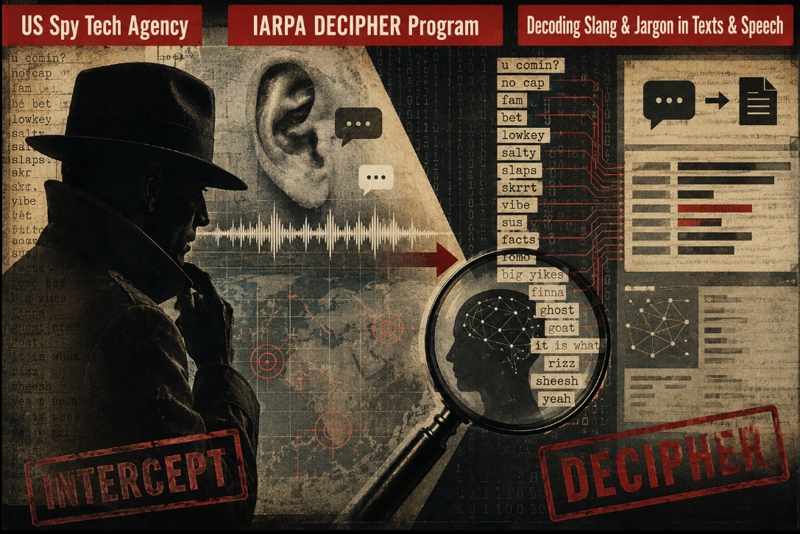
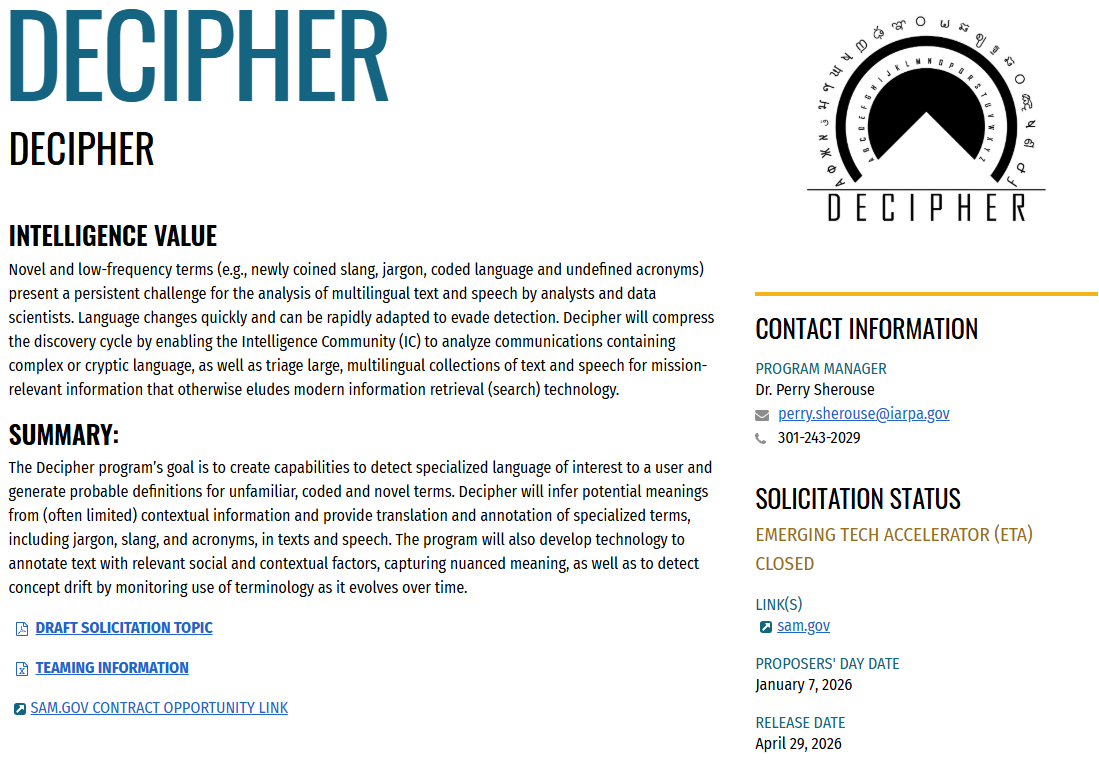
IARPA, the US spy tech agency, is looking to make sense of new slang, jargon, specialized terms, and other coded language in both text and speech with its DECIPHER program.
In April, the Intelligence Advanced Research Projects Activity (IARPA) announced the launch of five new innovative research programs designed to bolster national security.
For IARPA’s DECIPHER program, the goal is to analyze and make sense of communications that contain what they call “complex or cryptic language,” which basically refers to slang, jargon, acronyms, and coded phrases.
“DECIPHER will infer potential meanings from (often limited) contextual information and provide translation and annotation of specialized terms, including jargon, slang, and acronyms, in texts and speech”
IARPA, DECIPHER Program, April 2026
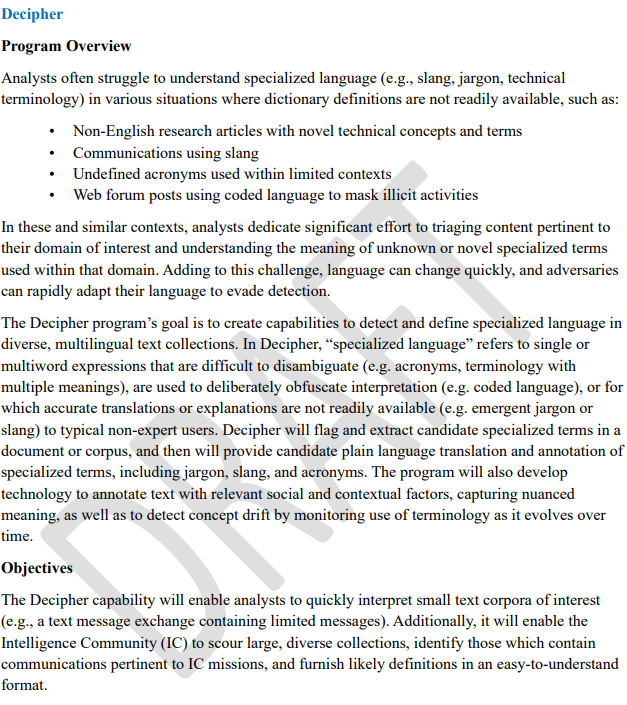
“DECIPHER will flag and extract candidate specialized terms in a document or corpus, and then will provide candidate plain language translation and annotation of specialized terms, including jargon, slang, and acronyms“
IARPA, DECIPHER Program, April 2026
According to the draft solicitation, specialized language refers to “single or multiword expressions that are difficult to disambiguate (e.g. acronyms, polysemic terminology), are used to deliberately obfuscate interpretation (e.g. coded language), or for which accurate translations or explanations are not readily available (e.g. emergent jargon or slang) to typical non-expert users).”
The DECIPHER program has two task areas:
Detection: to find specialized language in a large corpus
Generation: to generate a glossary of specialized terms using limited context
Basically, the program looks to flag and gather all the terms that the spy community doesn’t undestand and then create a database of translations that will be tracked over time.
DECIPHER will also “develop technology to annotate text with relevant social and contextual factors, capturing nuanced meaning, as well as to detect concept drift by monitoring use of terminology as it evolves over time.”
“The Government is especially interested in definition generation capabilities that work on multilingual collections and accurately generate likely definitions despite limited attestations and context”
IARPA, DECIPHER Program, April 2026
“The DECIPHER capability will enable analysts to quickly interpret small text corpora of interest (e.g., a text message exchange containing limited messages). Additionally, it will enable the Intelligence Community (IC) to scour large, diverse collections, identify those which contain communications pertinent to IC missions, and furnish likely definitions in an easy-to-understand format”
IARPA, DECIPHER Program, April 2026
The IARPA DECIPHER program description makes it very clear that it will be looking at communications like text messages and voice recordings; however, this can easily be expanded to include social media posts, blogs, and just about any other type of digital communication.
Looking back 25 years to when instant messaging services like AOL, MSN Messenger, or even ICQ were becoming popular, teenagers began inventing their own acronyms to hide what they were talking about.
I can distinctly remember PAW as being one of those acronyms, which stood for Parents are Watching.
During the massive social media censorship, throttling, de-ranking, de-boosting, de-banking, and de-monetizing phase of the COVID lockdown era, terms like “Coof” and “Vaxx” began popping up to brielfy circumvent algorithm flaggers because nothing was allowed to be posted on those topics that didn’t come from “authoratative sources” like governments, the WHO, the NIH, or CDC.
And Gen Z nowadays is low-key slaying it on vibe checks for sus or main character energy, no cap!
Other terms that social media presenters also use are “pew pew” for a gun, and “unalive” for either killing or suicide. It’s pretty obvious to a human what these mean, but if an analyst or an algorithm were to just search for the word “gun,” it wouldn’t show-up.
With IARPA’s DECIPHER program, the US spy community wants to make sense of all the slang, jargon, and acronyms it can get its hands on, in any language, in any type of communication, both public and private.
“Dr. Sherouse focuses on areas of scientific research at the intersection of technology and human systems, including topics such as social influence, behavior change, and decision-making”
IARPA
Heading up the DECIPHER program is Dr. Perry Sherouse, who according to his bio, joined IARPA in November 2023.
Prior to joining IARPA, Dr. Sherouse worked at a Federally Funded Research and Development Center (FFRDC), MITRE, from 2020 to 2023, “where he served as lead human factors engineer supporting research for national security and civilian government agencies.”
According to his LinkedIn account, Dr. Sherouse manages at least four IARPA programs:
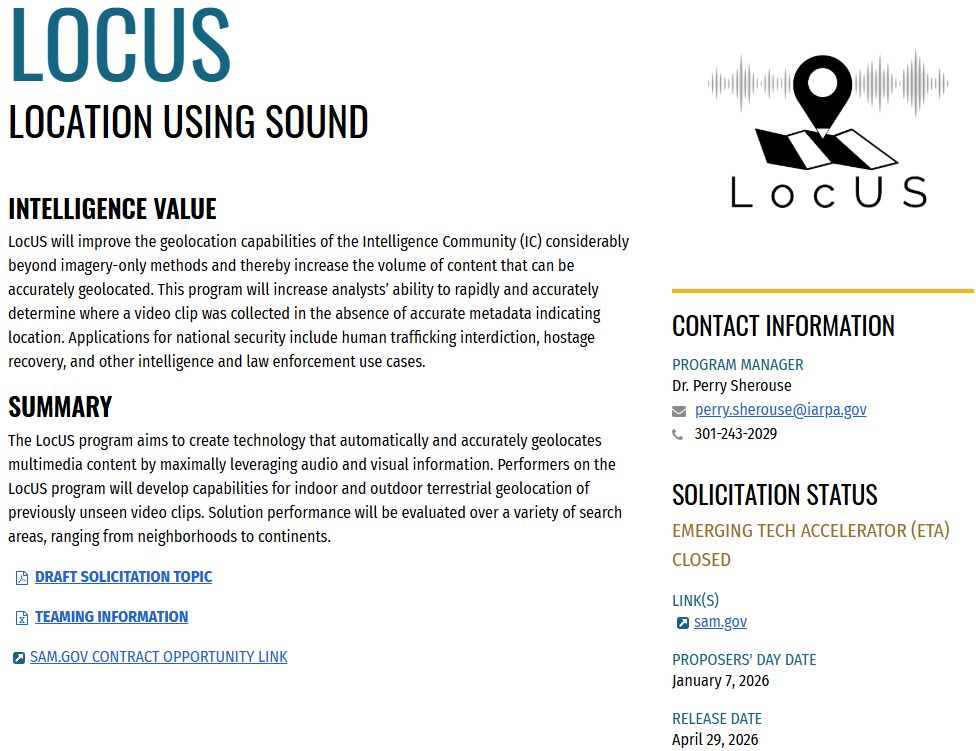
LocUS (Location Using Sound) – Accurately geolocate multimedia (video, image, and audio)
The Sociable covered the HIATUS program on January 4, 2022, and more recently we covered the LocUS program, on July 20, 2026.
“The LocUS program aims to develop technology that can automatically and accurately geolocate an indoor or outdoor image, video, or audio clip taken anywhere in the world”
IARPA, LocUS Program, April 2026
With the LocUS program, IARPA wants to “increase analysts’ ability to rapidly and accurately determine where a video, image, or audio clip was collected in the absence of accurate metadata indicating location.”
Two programs — LocUS and DECIPHER — same program director.
LocUS is for geolocating any audio clip and DECIPHER is for making sense of any coded language from the intercepted communications.
While these may turn out to be powerful tools for national security, spies will be spies, and these same tools could one day be commercialized and/or weaponized domestically.
And CIA officers love to brag about breaking all the laws they can in order to achieve their goals.
Take US Principal Deputy Director of National Intelligence Aaron Lukas, for example.
“I was a CIA operations officer for more than 20 years, and as part of that time, I spent literally years tracking down people, mostly overseas, that had exactly the right access — contriving sometimes very bizarre ways to meet those people, working on convincing them to do very difficult and dangerous things, and in the process breaking all sorts of laws, and I thought it was very fulfilling but very tough work”
Aaron Lukas, ODNI Leadership Remarks, January 2026
Speaking at the Office of the Director of National Intelligence (ODNI) Leadership Remarks on January 7, 2026, Lukas said that convincing people to do very dangerous and illegal things was very fulfilling work.
How will IARPA’s recent research programs like DECIPHER and LocUS be used?
Will they, too, be leveraged to aid in “breaking all sorts of laws?”
Time may tell, or maybe it won’t.
Maybe some other spook (another coded term) will just come right out and say it!
Brains Byte Back interviews startups, entrepreneurs, and industry leaders that tap into how our brains work. We explore how knowledge & technology intersect to build a better, more sustainable future for humanity. If you’re interested in ideas that push the needle, and future-proofing yourself for the new information age, join us every Friday. Brains Byte Back guests include founders, CEOs, and other influential individuals making a big difference in society, with past guest speakers such as New York Times journalists, MIT Professors, and C-suite executives of Fortune 500 companies.
Not Upfront About Your AI Use? It Could Cost You a Patent
byThe Sociable
Using ChatGPT or Claude to develop your invention? According to experts, if you aren’t upfront about how you used the tool, it could one day cost you a patent. In this episode of Brains Byte Back, host Erick Espinosa speaks with Cameron Powell and Gary Shuster, partners at DeepLaw, about how to use AI to build a business without putting the rights to your ideas at risk.
Can using AI put your patent at risk? It comes down to who really came up with the idea, and whether you are open about the role AI played.
What you need to know:
Patents: AI can help you draft, but the idea has to be yours, and how you used it matters.
Copyrights: What the U.S. Copyright Office says about work made with today’s technology.
Trademarks: What founders should know before putting a name on the market.
Whether you are an entrepreneur, a startup founder or a solo builder using AI tools every day, this is the practical guide to protecting your intellectual property.