



Digital ID for people and products brings the EU closer to ‘Own Nothing, Be Happy’ circular economy: perspective
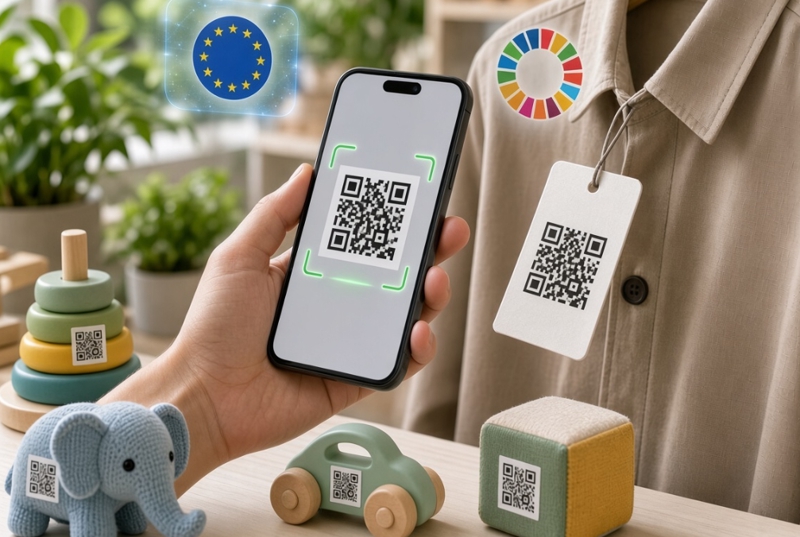
With a few exceptions, almost every product sold in the European Union (EU) will need to have a digital product passport, which will require the use of smart chips or QR codes.
Clothing, batteries, metals, plastics, electronics, and just about anything else imaginable will have to be embedded with some type of track-and-trace technology linked to an online database.
For years, the European Commission (EC) has been pushing the EU towards circular economy business models that favor turning every product into a service to be rented.
The circular economy is part of the UN’s 2030 Agenda, aka the Sustainable Development Goals (SDGs), and circular economy business models are the inspiration behind the World Economic Forum’s (WEF) infamous phrase, “You’ll Own Nothing. And You’ll Be Happy.”
“The Digital Product Passport is a key enabler of the circular economy, a more transparent Single Market and more informed consumer choices”
European Commission, The Digital Product Passport Registry is now live, July 2026
On July 20, the Eurpean Commission launched the Digital Product Passport (DPP) Resgistry to “help ensure a smooth rollout ahead of the first implementation deadline on 18 February 2027 for certain types of large batteries.”
This registry functions as a “database that stores the unique identifiers, registration data, and high-level metadata for each product, rather than the full detailed product information contained in the DPP itself.”
The Registry also supports enforcement activities by:
- Customs authorities, allowing them to verify electronically that imported products have a valid registered DPP and that the commodity code has been provided before they are released for free circulation.
- Market surveillance authorities, facilitating access to registered DPPs for specific purposes.
Laws passed by governments are one thing; rules and terms of service set by corporations are another.
Increasingly the two are blurring the line of who’s allowed to do what thanks to public-private-partnerships, the fusion of corporation and state.
So if a government says it won’t mandate geolocation tracking devices for digital product passports, it doesn’t mean that a company won’t just include it in their terms of agreement.
For now, DPPs in the EU will begin with large batteries, but after the testing phase, it will move onto just about every product imaginable.
And thanks to the circular economy Product as a Service business model, manufacturers will be able to retain ownership of their digitally tagged products, so you and I can keep renting everything without owning anything.
“The Registry will support products covered by the Ecodesign for Sustainable Products Regulation, including textiles, steel and aluminium, tires, furniture, ICT products and energy-related products”
European Commission, The Digital Product Passport Registry is now live, July 2026
“To ensure accountability, each economic operator and value chain actor (such as digital product passport service provider, repairer, refurbisher, remanufacturer, recycler) should be identified through a verification process”
Office Journal of the European Union, Laying down the implementation arrangements for the digital product passport registry, July 2026
To keep track of their products, manufacturers tag them with either a Near Field Communiction (NFC) label, a QR code, or a Radio Frequency Identification (RFID) chip, so they know everything about their products’ life cycle.
This information about the product includes: where the materials come from, who the manufacturer is, how sustainable the product is, where it can be repaired, and how to return it when it no longer serves its purpose.
For the EU DPP registry itself, here is the list of requirements:
- a website providing a secure user interface;
- an Application Programming Interface (API) for registering digital product passports;
- a verification platform to verify and confirm the existence and completeness of the digital product passports;
- an identification and authorization scheme for users;
- a schema for generating unique registration identifiers;
- a storage component for unique identifiers and commodity codes of products intended to be placed under the customs procedure ‘release for free circulation’;
- a semantic repository which serves as the authoritative reference for the semantic meaning, structure, versioning and interoperability requirements of digital product passport data;
- a log system recording relevant operations.
Soon, wherever a company is based in the world, it will need to register digital product passports if it wants to rent or sell products in the EU.
“Any package, pallet or container can now be equipped with a sensor, transmitter or radio frequency identification (RFID) tag that allows a company to track where it is as it moves through the supply chain—how it is performing, how it is being used, and so on […] In the near future, similar monitoring systems will also be applied to the movement and tracking of people”
Klaus Schwab, The Fourth Industrial Revolution, 2016
Ten years ago, WEF founder Klaus Schwab published “The Fourth Industrial Revolution” in which he prophetically imagined what digital product passports would be like on page 22.
He wrote that the same track and trace technologies would apply to humans as well.
On April 12, 2022, the WEF and the World Trade Organization (WTO) published a report “encouraging the development of a global certification framework” for digital identity systems of persons and objects — both physical and digital.
According to the report, “The Promise of TradeTech: Policy Approaches to Harness Trade Digitalization”:
“End-to-end trade digitalization requires a global approach to digital identities of natural and legal persons as well as of physical and digital objects sending or receiving electronic information to avoid creating digital identity silos.”
While the report was concerned with digital identity as it related to digitalizing global trade systems, the seed had been planted to normalize the idea of treating people like products to be tracked, traced, and monitored for compliance with certain standards.
“Traceability can also help to monitor the lifecycle of a product with a view to reducing fraud and theft or to assessing its contribution to a global circular economy”
WEF & WTO, The Promise of TradeTech, April 2022
“Trade agreements could encourage the development of a global certification framework whereby accredited digital identity operators would issue globally recognized digital identities”
WEF & WTO, The Promise of TradeTech, April 2022
Just as RFID chips, IoT devices, and other sensing technologies track and trace products through their “life cycles,” the same can be said about tracking humans through their own “life cycles.”
Treating “people” the same as “any package, pallet, or container” means not just tracking the movement of you and me, but measuring how we are “performing,” how we are “being used,” and so on.
Four years later and everything is progressing exactly as planned — digital ID for people and products.
After that comes the digital twinning of everything in nature.
As the WEF Global Risks Report 2019 states: “Authoritarianism is easier in a world of total visibility and traceability.”
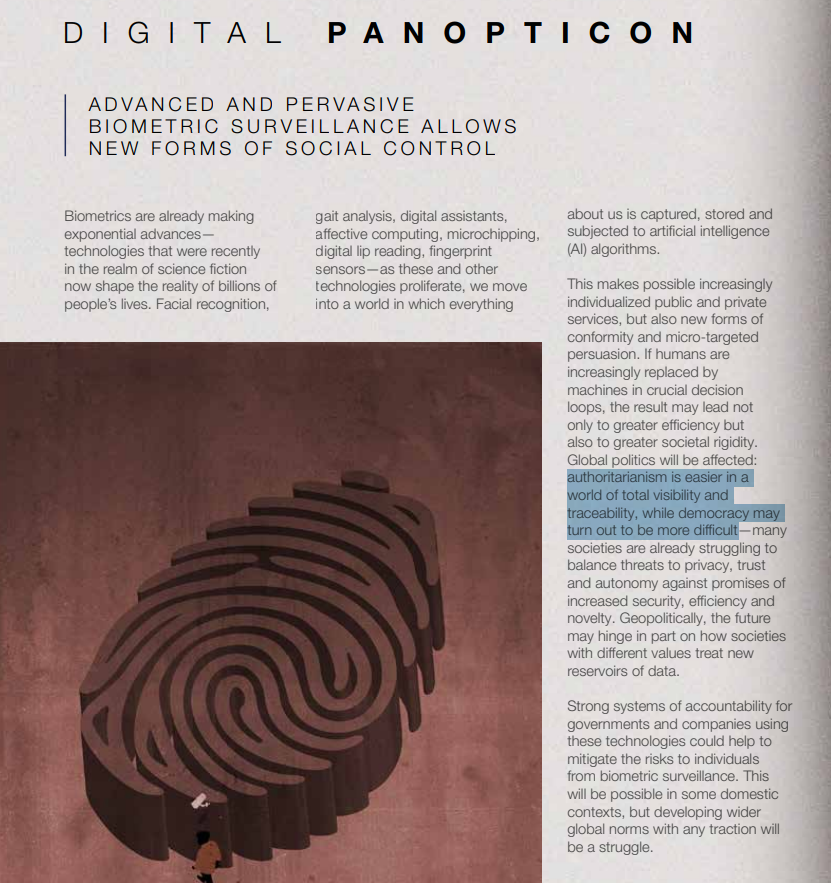
Image Source: AI generated with Grok