




DARPA’s newly-announced “Firefox” program looks to build upon previous successes in non-invasive brain-computer interfaces (BCIs) in order to advance their capabilities in speed, scale, and performance.
The US Defense Advanced Research Projects Agency (DARPA) will hold a proposers day for its Firefox program on September 1, while taking registrations until August 21.
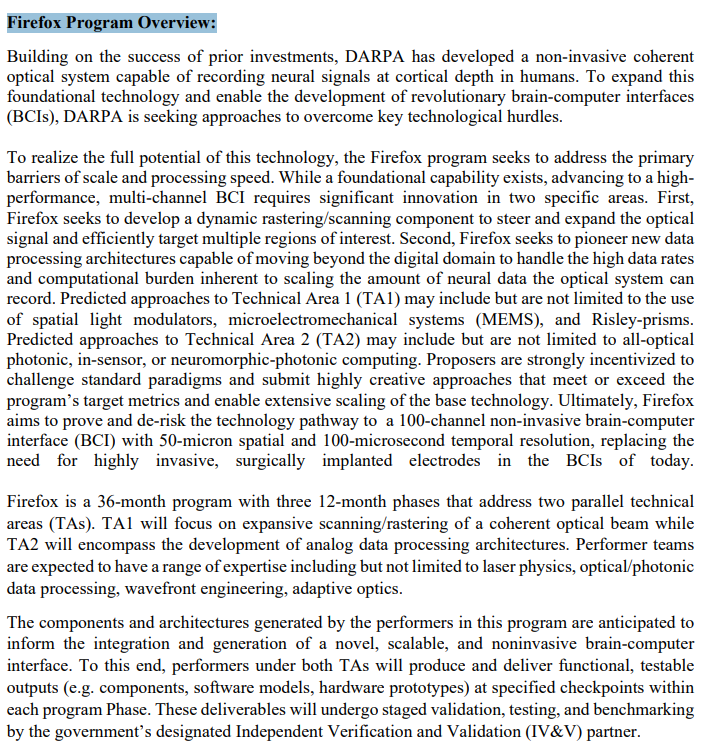
“Ultimately, Firefox aims to prove and de-risk the technology pathway to a 100-channel non-invasive brain-computer interface (BCI) with 50-micron spatial and 100-microsecond temporal resolution, replacing the need for highly invasive, surgically implanted electrodes in the BCIs of today”
DARPA, Firefox, August 2026
Going back decades, DARPA has been figuring out how brain-computer interfaces could allow for things like the seemingly telepathic control of drones, for restoring limb functionality in wounded warriors, for healing neurological disorders, and for maximizing readiness after sleep deprivation, to name a few.
As DARPA’s Firefox program description states of its previous work, “Building on the success of prior investments, DARPA has developed a non-invasive coherent optical system capable of recording neural signals at cortical depth in humans. To expand this foundational technology and enable the development of revolutionary brain-computer interfaces (BCIs), DARPA is seeking approaches to overcome key technological hurdles.”
These technological hurdles involve scale and processing speed in order to achieve a high performance, multi-channel BCI.
Specifically, DARPA is looking significant innovation in two areas:
- Firefox seeks to develop a dynamic rastering/scanning component to steer and expand the optical signal and efficiently target multiple regions of interest.
- Firefox seeks to pioneer new data processing architectures capable of moving beyond the digital domain to handle the high data rates and computational burden inherent to scaling the amount of neural data the optical system can record.
With next-generation BCIs, DARPA is looking to target more areas of the brain while being able to process all the data at great speed.
“Moving beyond the digital domain” refers to new computational capabilities, which can range from quantum computing, neuromorphic computing, and even programming living systems with bio-computing.
A possible reason for naming the program Firefox may be a pop culture one.
As one X user commented, “DARPA wants to turn 1982 Clint Eastwood technothriller about mind-controlled weapons into reality.”
“Firefox” is a film based on the 1977 novel of the same name where, according to IMDB, “The Soviets have developed the MiG-31, a fighter that flies at six times the speed of sound, is invulnerable to radar, and worst of all, has a lethally sophisticated weapons system that the pilot can control through thought impulses.
“As soon as the pilot detects a threat, either visually or on a scope, his thought impulses will direct a missile to that threat, without so much as pushing a button.”
The technical point of contact for Firefox is DARPA program manager Dr. Pedro Irazoqui.
Dr. Irazoqui joined DARPA as a program director in January 2024, and prior to that, he held high level positions at Johns Hopkins University and Perdue University where he specialized “in wearable and implantable wireless medical devices for treating diverse neural pathologies.”
He has been involved with at least four other DARPA research programs that we’ve covered here on The Sociable:
- Energy Harvesting Implantable Health Monitoring Solutions, which sought to fundamentally change the landscape of implantable device powering via a wide range of technical approaches capable of achieving long-term self-sustaining power harvesting/generation to enable safe, reliable, long-lived implanted medical devices.
- Bridging the Gap Plus (BG+), which aims to restore natural functions such as breathing, bowel and bladder control, movement, touch, and proprioception that can be lost when the spinal cord is damaged.
- CoasterChase, which aims to mitigate warfighters’ stress response under extreme conditions by creating an ingestible platform that stimulates neurons in the small intestine.
- Alert WARfighter Enablement (AWARE), which aims to help increase alertness following sleep loss by shining near-infrared light into people’s brains that if successful, would be able to activate and deactivate drugs in their bodies on demand.
Earlier this month, DARPA announced it was holding an information session webcast for its Selective Harnessing of Intrinsic Neuroplasticity Engineering (SHINE) program that looks to develop the next generation of neuroplasticity technologies that can target precise points in the brain to repair dysfunctional neural circuits.
These technologies range from synthetic biology, to molecular engineering and neuromodulation, the latter of which may involve non-invasive brain computer interfaces that can control neural activity through sound, light, or magnetic fields.
Whether it’s for healthcare or warfare, DARPA is pushing the boundaries of brain-computer interfaces that have the ability to create transhumanistic supersoldiers capabable of controlling machines with their minds while performing at levels that have never been humanly possible in our known history.
Image Source: AI generated with ChatGPT