



If the test run in Kenya is successful, paying for healthcare will be like collecting frequent flyer miles to use for your next visit; all you have to do is consent: perspective
With Kenya as the testbed, the World Economic Forum (WEF) blog showcases a pilot program where people share their medical data for healthcare rewards points.
Written by journalist and Head of TEK Communication at the University of Southern Denmark Jane Callesen, the WEF blogpost, “Paying with data, not cash: Towards a new model for affordable healthcare in Africa,” highlights an unnameed project in Murang’a County, Kenya that is testing to see if the value created from citizens’ health data could “flow back to the people whose health journeys helped create it, and help finance the care they rely on.”
“Under the proposed model, approved researchers, universities or life science companies would not buy individual medical records,” the author writes, adding, “instead, they could pay for research services, analysis or access to appropriately governed data environments that keep individual data secure within a trusted and privacy-preserving framework,” according to the WEF blog.
The initiative is supported by Denmark’s Ministry of Foreign Affairs and a Danish health tech company called People’s Group, along with university researchers, healthcare providers, and telecommunications operators.
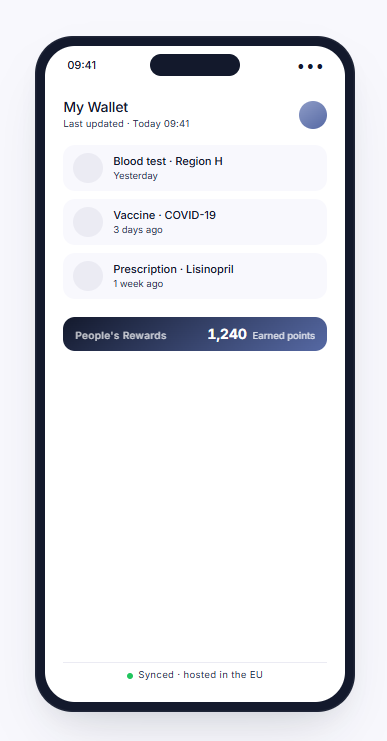
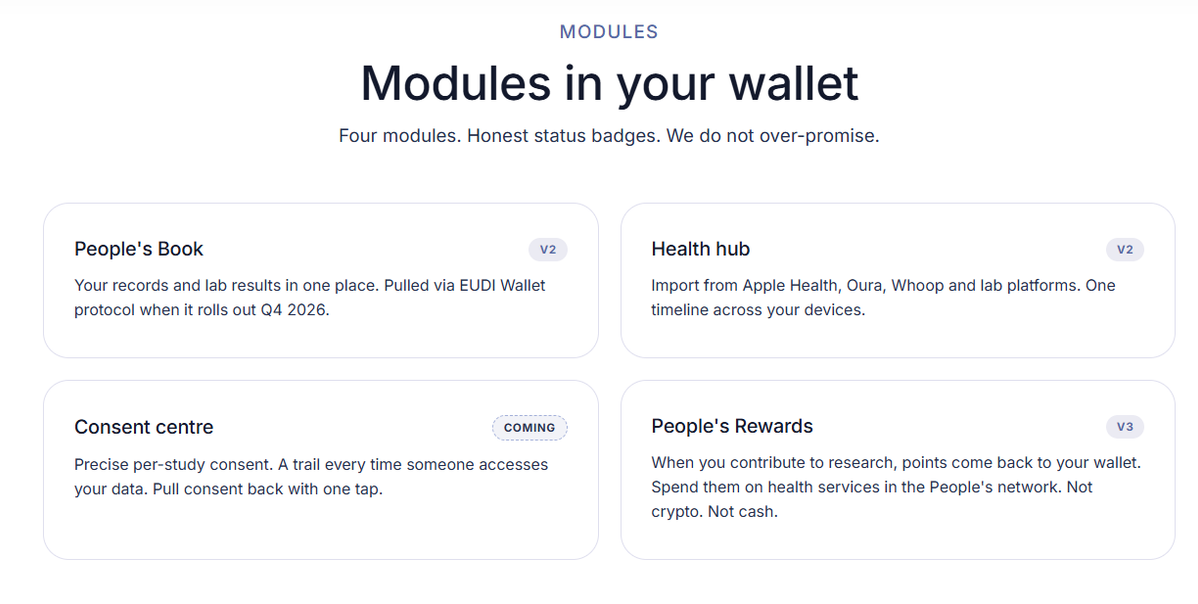
The experiment in Kenya appears to be modeled after the People’s Group’s up-and-coming People’s Wallet brand, which “Works with your EU Digital Identity Wallet.”
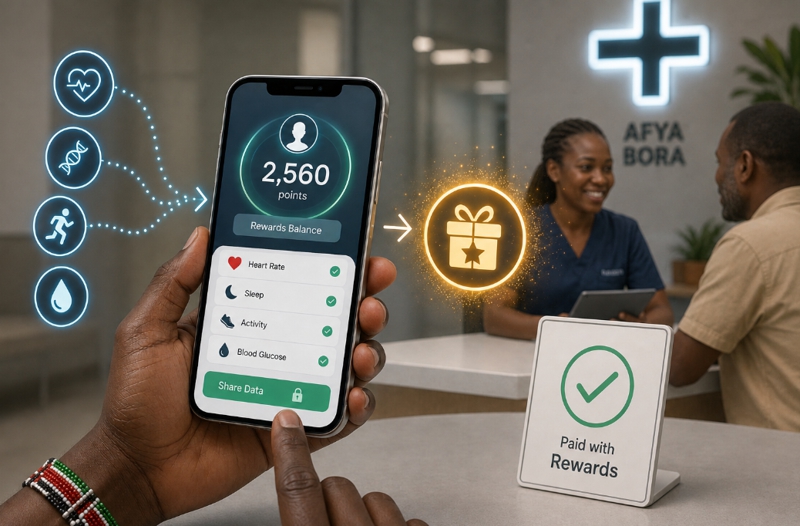
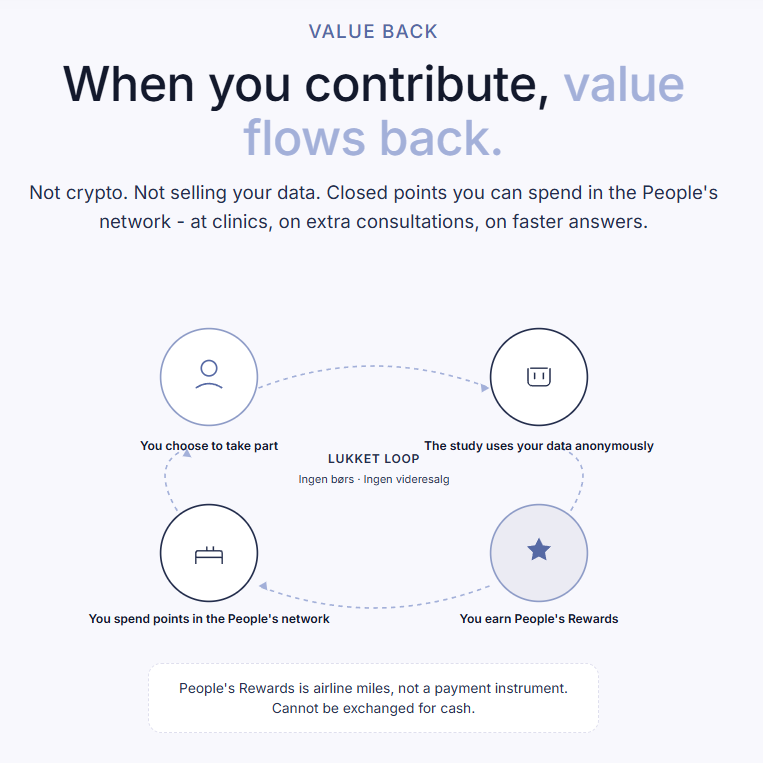
With the People’s Rewards program, participants will be able to earn “points” for sharing their medical data for research purposes.
These points can only be spent on healthcare services associated with the People’s Group network and not for anything else.
“When you contribute to research, points come back to your wallet. Spend them on health services in the People’s network. Not crypto. Not cash,” the People’s Wallet portal explains.
“At the center of the model is what the project describes as citizen data sovereignty: citizens would decide whether information from their health journeys could be used for approved research“
WEF Stories, Paying with data, not cash, August 2026
For the testing phase in Kenya, the messaging is the same as it was for vaccine passports and digital ID — that citizens would be in control of what data they wanted to share.
During lockdowns, if you didn’t want to show your medical records with complete strangers wherever you went, you couldn’t travel or participate in many aspects of society.
Not sharing data means not receiving certain types of benefits.
With the Kenya experiment, if you don’t want to share your data with unknown parties, you won’t be denied access to essential health services, but you also won’t be able to redeem those points to help pay for your healthcare.
That is assuming that the Kenya project will ever go beyond the testing phase.
The rewards system could fail, but hey! the data will have already been collected.
It all depends on whether the “research generates financial value,” according to the WEF blog.
“The proposed wallet mechanism is intended to make those permissions manageable and visible. If research generates financial value, it could eventually help direct part of that value back into care, for example by helping participating citizens cover treatment, medicines, prevention or other health costs“
WEF Stories, Paying with data, not cash, August 2026
The idea of haring your personal data for some type of return, be it for money, for products, for services, for access, etc. is not a new one.
Perhaps one of the most dystopian scenarios in this respect comes from the WEF itself.
Published in April 2021, the WEF insight report “Technology Futures: Projecting the Possible, Navigating What’s Next,” is an anthology of fictional short stories aimed at describing what the future could look like and was not intended to be an agenda or a blueprint.
One of those stories was written by Amy Scout (née Golem), who led Deloitte’s Nascent and Exponential Technologies (NExT) Emerging Technology Research in 2021.
Her work of fiction, “Maple’s Story,” imagined a future where a person named Maple sold his or her medical data for money while not knowing where it would go or how it would be used.
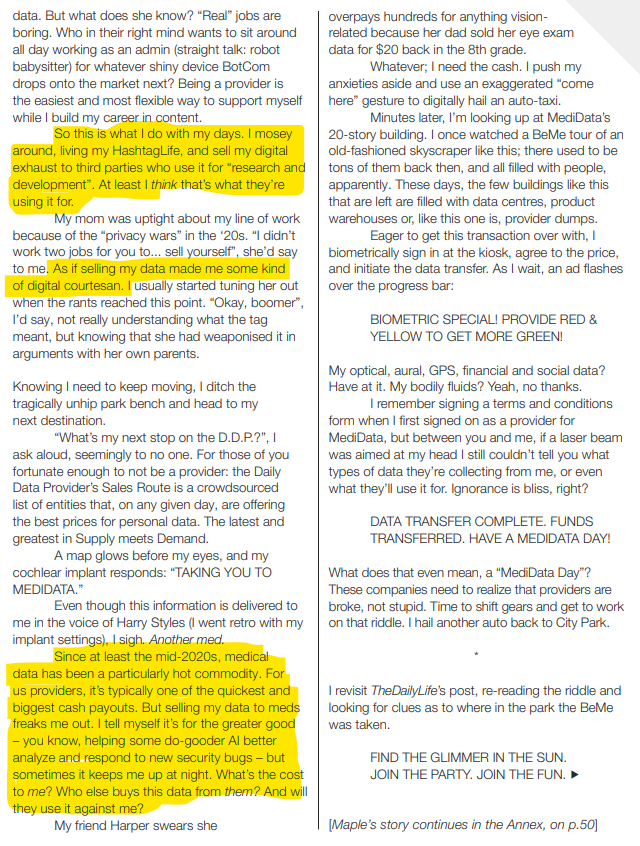
“Since at least the mid-2020s, medical data has been a particularly hot commodity. For us providers, it’s typically one of the quickest and biggest cash payouts.
WEF, Technology Futures: Projecting the Possible, Navigating What’s Next, April 2021
But selling my data to meds freaks me out.
I tell myself it’s for the greater good – you know, helping some do-gooder AI better analyze and respond to new security bugs – but sometimes it keeps me up at night.
What’s the cost to me? Who else buys this data from them? And will they use it against me?”
“Maple’s Story” talks about “privacy wars” that took place in the 2020s, and it appears that the privacy advocates lost.
People like Maple became “some sort of digital courtesan” whose entire income depended on selling their personal data to third parties:
“Sure, I’m trying to be a professional content creator, but until I make it, I need money. And we all know the easiest way to make money these days is by becoming a data provider (‘provider’ for short) […] Being a provider is the easiest and most flexible way to support myself while I build my career in content.
“So this is what I do with my days. I mosey around, living my HashtagLife, and sell my digital exhaust to third parties who use it for ‘research and development.’ At least I think that’s what they’re using it for.
“My mom was uptight about my line of work because of the ‘privacy wars’ in the ‘20s. ‘I didn’t work two jobs for you to… sell yourself,’ she’d say to me. As if selling my data made me some kind of digital courtesan.”
Sometimes the warnings are right there in front of you.
“Crucially, this is intended as a value-sharing model: access to essential healthcare should not depend on agreeing to research use of personal health information. Nor is research income assumed to finance the system on its own.
WEF Stories, Paying with data, not cash, August 2026
It remains unproven whether such income will be large enough to meaningfully subsidize care, and the wider model also envisages contractual revenue from healthcare providers, county governments and other partners“
The Europeans behind the experiment in Kenya want people’s “anonymized” medical data.
They say it is intended for research to bring about better healthcare.
But wait! There’s more!
The People’s Wallet was also designed to go hand-in-hand with the European Union Digital Identity Wallet.
And it just keeps getting better!
The wallet pulls and combines data from big tech companies, which of course, always value your privacy over your data.
With the “People’s Wallet,” you can “import from Apple Health, Oura, Whoop and lab platforms. One timeline across your devices.”
If the test run in Kenya is successful, paying for healthcare will be more like adding up frequent flyer miles to use for your next visit.
All you have to do is consent.
Image source: AI generated with ChatGPT