


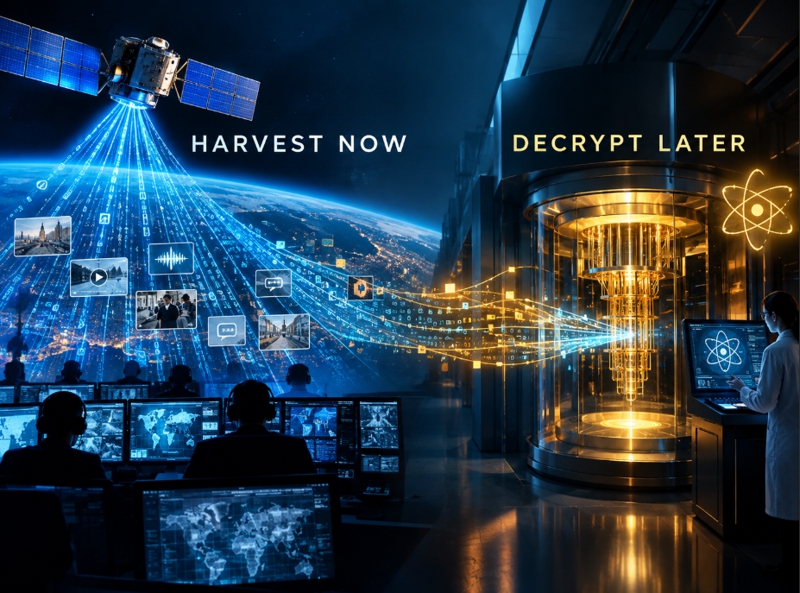


Somewhere right now, an intelligence agency, a criminal syndicate, or a well funded research team is quietly copying encrypted traffic off the internet.
Bank transfers. Government cables. Pharmaceutical research shipped across borders. They can’t read any of it today. They’re betting they won’t need to wait forever.
Security researchers have a name for this: harvest now, decrypt later.
The US National Institute of Standards and Technology (NIST) has confirmed that adversaries have already been capturing encrypted data with exactly this strategy in mind, banking on a future quantum computer to finish the job.
The machine capable of doing that doesn’t exist yet, and nobody can say for certain when it will. But the theft already happened. The clock started the moment someone hit copy.
That’s the part most coverage of this topic gets wrong. The story isn’t “quantum computers might break encryption some day.” The real story is much less abstract: organizations are running out of time to replace cryptography that took decades to embed everywhere, and most of them haven’t started.
RSA and elliptic curve cryptography, the math underneath nearly every digital signature, every key exchange, every certificate on the web, was built to resist classical computers.
A sufficiently powerful quantum machine changes that math entirely. And this isn’t one system sitting in one place that a security team can swap out over a weekend. It’s threaded through applications, network hardware, cloud services, and code nobody has looked at in a decade. Nobody installs a patch for that. They rebuild around it.
NIST stopped treating this as theoretical in August 2024, when it finalized three post quantum standards: FIPS 203, FIPS 204, and FIPS 205, covering key establishment and digital signatures under the names ML-KEM, ML-DSA, and SLH-DSA.
What matters isn’t the acronyms. It’s that the excuse of “there’s no standard yet” is gone. A fourth algorithm, HQC, got the nod for standardization in 2025, which tells you something, too: this isn’t a one time swap. It’s an ongoing project with a moving target.
And that project has a harder problem sitting underneath the algorithm choice. Before anyone replaces RSA, they have to find it. Cryptography lives inside APIs, TLS handshakes, VPN tunnels, certificate chains, identity platforms, cloud infrastructure, mobile apps, embedded hardware, and legacy systems that predate the people currently responsible for securing them.
NIST’s own migration guidance is built around this exact gap, pushing organizations to inventory vulnerable systems before they touch a single algorithm. Most security teams genuinely don’t know every place their own RSA keys are running. That’s the uncomfortable starting point, which is why the smarter organizations aren’t asking which post quantum algorithm to pick first.
Instead, they’re asking how to avoid being stuck in this position again. That’s crypto agility: building systems so cryptographic mechanisms can be swapped without tearing the architecture apart. Hard code an algorithm today and you’re setting up the next migration to be just as painful.
NIST finalized its own guidance on this in December 2025, with an update in June 2026, which should tell you how unsettled this whole area still is.
Somebody pays for all of this, and it’s not a small club. Banks, cloud providers, governments, hospitals, telecoms, and software vendors are all sitting on encrypted data with a shelf life measured in decades. The expensive part was never the algorithm. It’s the audit, the testing, the validation, and the years of monitoring that come after.
There’s no confirmed date for when a quantum computer capable of breaking today’s encryption arrives. Nobody serious is pretending otherwise. But the migration timeline is already known, and it’s measured in years.
The real deadline isn’t the day the quantum computer shows up. It’s the day organizations find out whether they finished the job before it did.
Image source: AI generated with ChatGPT