

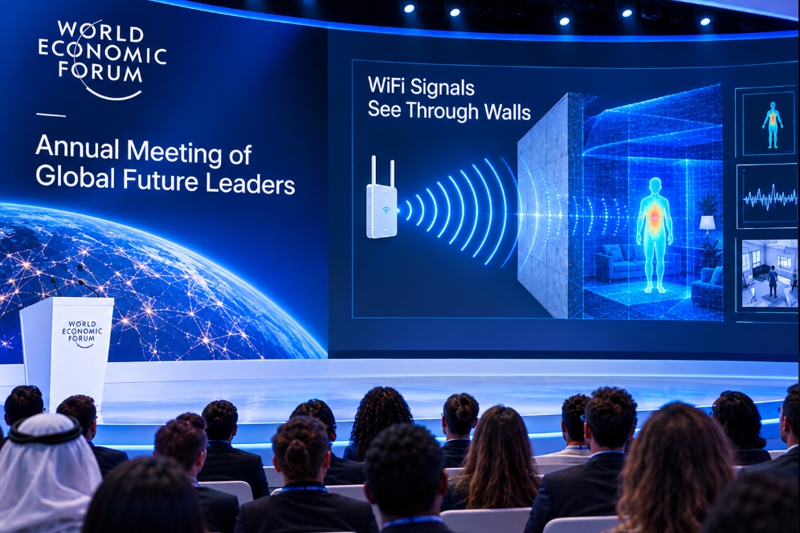


The World Economic Forum (WEF) will hold its first-ever Annual Meeting of Global Future Leaders (AMGFL) in Dubai, UAE from October 13-15, and is slated to include a presentation from the researcher behind the technology to detect people and objects through walls using WiFi and radio signals.
Not to be confused with the Annual Meeting of the Global Future Councils, which used to be held in the same place during the same week, the inaugural AMGFL describes itself as “the premier next-generation leadership platform” bringing together “emerging pioneers under 40 alongside established global leaders, innovators, scientists, entrepreneurs, policymakers, and cultural voices.”
This year’s meeting will debut two specific formats: Unknown Tomorrows, which deals with simulating possible futures, and Opportunity Labs, which are collaborative working sessions.
At the time of this publication, there are only nine sessions scheduled for public viewing between October 14 and 15.
- Trust Test for Agentic AI
- The Human-Machine Line
- Opening Plenary
- Trade In a Changing World
- Fair by Design
- Economics after Certainty
- Reading the Youth Pulse
- Sensing the Invisible
- Closing Plenary
One session of particular interest to The Sociable is a talk by Cartesian Systems co-founder and MIT Signal Kinetics Research Lab founding director Dr. Fadel Adib called “Sensing the Invisible,” which is about wireless sensing and how it can read “biological signals beneath our skin and information moving through the ocean.”
Apart from being a WEF Young Global Leader, Dr. Adib is one of the first researchers to develop technology to sense, detect, and track people and objects through walls using radio and WiFi signals.
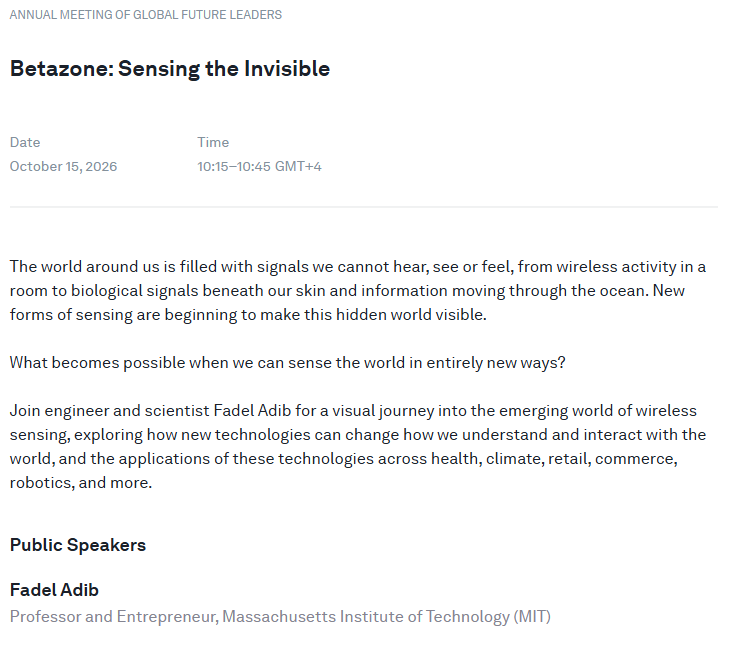
Dr. Adib’s past research includes:
- Seeing through walls with WiFi: including 3D tracking, gesture recognition, and reconstructing human figures through walls.
- Smart homes that measure vital signs including breathing, heartbeats, micro-cardiac events, emotions, and stress levels.
- Batteryless micro-implants for in-body connectivity, sensing, self-reconfiguring with security/privacy.
- RFID and RFID-vision fusion: localization, tracking, food/liquid sensing, drone-based inventory, reinforcement learning, robotic picking, and augmented reality.
On top of Dr. Adib’s work in transhumanism, the Internet of Bodies, smart homes, and track-and-trace technologies, his team’s research is now being directed towards:
- Ocean IoT: including batteryless networking, underwater GPS, backscatter theory, underwater-to-air communications, battery-free wireless cameras, and underwater AI.
- Imaging with Wireless Signals: including non-line-of-sight 3D reconstruction, generative-AI-powered wireless vision, and indoor scene reconstruction.
- Robot/Drone Perception and Manipulation: including RF-Visual reinforcement learning, mechanical search, and drone localization/navigation with millimeter-wave backscatter tags.
Another AMGFL session of interest is a presentation by Atonaton founder and principal researcher Madeline Gannon called “The Human-Machine Line.”
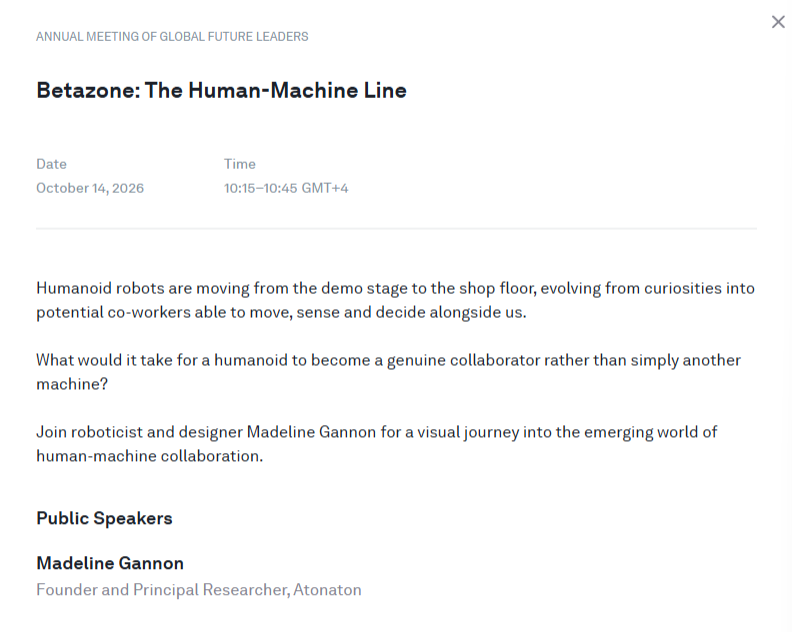
Last June Gannon gave a presentation at the WEF’s Annual Meeting of the New Champions, aka Summer Davos, in China where she said that our acceptance of robots will be based on our feelings towards them rather than their actual functions.
“What I think we’re missing in the robotics world, and in the technology world in general, is that the future is not really going to be about function — what the robots do — it’s really going to be about feeling the experience of these machines”
Madeline Gannon, WEF Annual Meeting of the New Champions, June 2026
“For mass adoption, for mass acceptance, how they make us feel is going to be more important,” said Gannon.
“As the hardware gets commoditized, as the models get commoditized, the only differentiating factor is going to be the experience of these machines.”
In other words, it’s not about what these soulless, empathy-lacking lackeys do or don’t do for us, but rather how we feel about them.
For more on that, check out our story, “Accepting robots will be about human feelings, not machine functions: WEF ‘Summer Davos’ in China” here.
Although sessions, speakers, and times are subject to change, there is no sign of WEF interim co-chairs Larry Fink and Andre Hoffmann on the program schedule.
However, the newly-appointed WEF president and CEO Alois Zwinggi is slated to speak during the opening plenary.
Zwinggi assumed his role when former president and CEO Borge Brende left the WEF in disgrace following the partial release of the so-called Epstein Files.
Meanwhile, WEF founder Klaus Schwab, who also resigned after 53-years at the helm, has gone on record to say that he was still exploring avenues to choose his successor.
The only other full-time WEF employee on the schedule is Managing Director Sebastian Buckup, who is to speak on both the opening and closing plenaries.
As far as events go, the WEF has cut back considerably on the scale of its offerings.
Every year in September, the WEF holds its Sustainable Development Impact Meetings to coincide with the UN General Assembly in New York.
Whereas in the past, multiple sessions were broadcast over several days, this year’s Sustainable Development Impact Meeting consisted of only a single session: The Chief Economists Outlook.
Previously, the Sustainable Development Impact Meetings gave us such gems as “We Own The Science” from UN Under-Secretary-General for Global Communications Melissa Fleming in 2022, and “Our First Amendment stands as a major block to the ability to just hammer [disinformation] out of existence” from John Kerry in 2024.
This year, the WEF’s Annual Meeting on Cybersecurity has also disappeared from the meetings schedule, along with the Annual Meeting of the Global Futures Council, which were both combined into one event last year in October.
This year’s inaugural Annual Meeting of Global Future Leaders will focus on six thematic pillars:
- AI, technology and human agency
- Science, discovery and innovation
- Economic growth
- Geopolitics, security and trade
- Leadership, business innovation and human flourishing
- Climate and nature
Its stated purpose is “to shape the future by jointly creating bold opportunities in a volatile world, while building the capacity to withstand setbacks and respond to the unthinkable.”
Image Source: AI generated with ChatGPT