


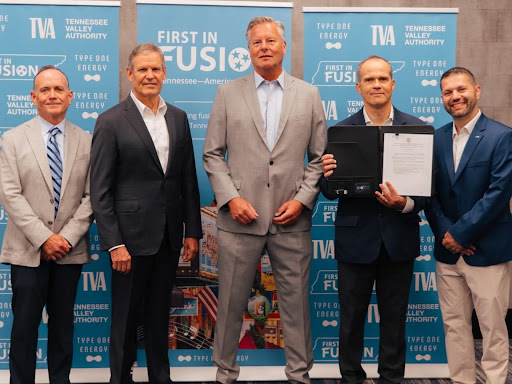


Tennessee has issued the first fusion-specific operating license in the United States, clearing the way for Type One Energy to move forward on a commercial fusion project at the Tennessee Valley Authority’s Bull Run site in Clinton.
The Knoxville-based company received the license from the Tennessee Department of Environment and Conservation (TDEC), making it the first fusion machine license granted anywhere in the country under a dedicated regulatory framework.
Governor Bill Lee presented the license at the annual meeting of the Organization of Agreement States in Nashville, an event that gathers state radiation control directors from across the U.S.
The license also clears Type One Energy to operate a fusion machine as part of Project Infinity, a development effort based at TVA’s Bull Run Energy Complex, a coal site retired in December 2023. The company plans to break ground on the first phase of the project this year and is targeting a full startup by 2034.
“For the first time, a fusion power plant-specific licensing process has been developed and then used to grant a fusion-specific license to operate a fusion machine, consistent with a national regulatory framework for fusion energy,” said Christopher Mowry, CEO of Type One Energy, in a statement.
The milestone follows a 2023 decision by the Nuclear Regulatory Commission to delegate regulation of fusion energy production to individual states. Tennessee’s Division of Radiological Health, part of TDEC, built its licensing program for fusion machines and related activities from scratch to respond to that shift, and this license is the first test of that framework on an actual commercial project.
TDEC Commissioner David Salyers framed the license as evidence that the state is positioning itself as a hub for the technology, and Mowry said the process could serve as a model other states and regulators look to as they set up their own fusion-specific rules.
“Issuing this license is a significant milestone that solidifies Tennessee’s reputation as the global hub for nuclear innovation,” noted Salyers.
Project Infinity is expected to double as a research campus, with Type One Energy working alongside Oak Ridge National Laboratory, TVA, and the University of Tennessee. The first phase is Infinity One, a prototype and workforce training facility scheduled for commissioning in 2029. If that goes to plan, Type One will move on to Infinity Two, a stellarator built to generate 400 megawatts once it’s running.
Fusion works by combining light atomic nuclei into heavier ones, which is the same reaction that powers the sun, releasing large amounts of energy without the long-lived radioactive waste associated with nuclear fission.
Tennessee’s framework takes a fairly broad view of what counts as a fusion machine, defining it as any device that turns atomic nuclei into different elements or particles and then puts the heat, particles, or radiation that comes out of that reaction to use.
Several fusion companies have announced ambitious construction and demonstration timelines in recent years, but regulatory approval has remained one of the industry’s biggest open questions, since no U.S. framework existed to license commercial fusion machines until now.
Tennessee’s move gives Type One Energy, and by extension the wider industry, its first real answer to how that approval process will actually work.
Featured image: courtesy of Type One Energy

Disclosure: This article mentions a client of an Espacio portfolio company.