





Artificial intelligence is becoming part of the insurance industry’s operating infrastructure, supporting everything from regulatory reporting and risk assessment to customer service and fraud detection. Yet widespread adoption does not necessarily mean insurers are ready to let AI make decisions independently.
A new report by GFT Technologies, The Canadian Insurance Disruption Index 2026, highlights this gap. Based on a survey of 200 IT decision-makers at insurance firms across Canada, the study found that every respondent reported AI use somewhere in their organization. However, autonomous execution with minimal human oversight remains at 7% or below across every business function measured.
The findings point to an industry moving beyond initial experimentation, but still working out how much authority to give AI as it becomes more deeply embedded in insurance operations.
From AI-assisted processes to agentic decision-making
AI adoption is already distributed across several parts of the insurance value chain. Compliance and regulatory reporting leads at 35%, followed by pricing and risk assessment at 33%, and data analysis and forecasting at 32%. Customer service and policy administration, as well as fraud detection and prevention, each account for 30%.
The relatively narrow gap between these applications suggests that insurers are not concentrating their AI efforts on a single use case. Instead, the technology is finding a place across analytical, operational and customer-facing processes.
The next step, however, involves moving from systems that provide recommendations to those capable of executing decisions.
According to GFT, AI is currently more commonly used to inform or support human decisions than to act independently. In its assessment, “supervised execution is currently a more established model than full autonomy” across the insurance functions surveyed.
Agentic AI is nevertheless gaining ground. The report found that 61% of respondents are already running pilots or implementing agentic AI, either in selected decision areas or more broadly. These applications include underwriting, claims triage, claims adjudication, fraud detection, pricing and risk modelling.
That progress does not mean insurers are ready to remove people from the decision-making process. Human oversight remains a central part of how organizations are approaching the technology.
The report identifies human-in-the-loop review as the leading safeguard, selected by 40% of respondents. Real-time monitoring follows at 38%, while explainability requirements and model validation each received 34%.
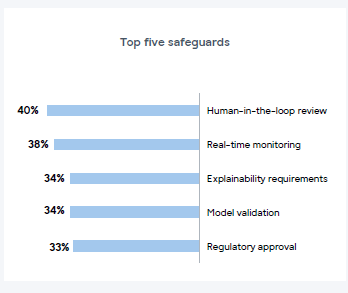
This suggests that the industry’s transition toward agentic systems is being shaped not only by what AI can do, but also by how insurers can monitor, validate and account for its decisions.
Data and legacy infrastructure remain obstacles
The challenge is not simply deploying more advanced models. Insurers also need the underlying data, technology infrastructure and organizational processes to support systems that can act with greater independence.
GFT found that data quality or availability was the most frequently cited barrier to agentic AI adoption, selected by 29% of respondents. Organizational and process changes followed at 28%, while ongoing investment costs, regulatory uncertainty and legacy IT infrastructure each stood at 27%.
These obstacles illustrate why the shift from AI-assisted workflows to autonomous execution is not just a software upgrade. It can require insurers to redesign internal processes, establish accountability for AI-driven decisions and modernize systems that were not originally built for this level of automation.
Investment plans indicate that organizations expect this transformation to continue. Seventy percent of respondents anticipate increasing their annual AI investment over the next five years. The leading priorities include improving data quality and engineering capabilities, selected by 27.5%, followed by automated underwriting decisions and workflow automation, both at 27%.
The business case also extends beyond cost reduction. Faster processing and reduced turnaround times, as well as operational efficiency, were each selected by 38% of respondents as drivers of AI investment. Improved decision accuracy and greater revenue or pricing precision followed at 37.5% each.
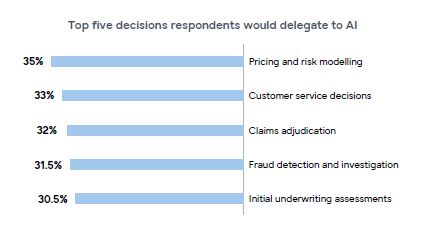
The report captures the industry’s broader direction: “The next phase of AI implementation is taking shape around operational priorities”.
For insurers, that means connecting AI investment to measurable improvements in how policies are assessed, claims are handled and risks are priced, rather than treating automation as an objective in itself.
As AI takes on a more active role in these processes, governance will become increasingly important. The survey found that 48% of respondents prefer a comprehensive, legally binding national AI regulatory framework, while 36% favour a flexible voluntary approach and 16% support a hybrid model.
The findings offer a snapshot of an industry in transition. Canadian insurers have moved beyond isolated AI experiments, and agentic systems are entering practical testing and implementation. But the limited level of autonomous execution shows that the shift toward AI-led insurance is still taking shape.
The next phase will depend on whether insurers can align their data, legacy infrastructure and governance frameworks with systems that are increasingly expected to do more than generate recommendations.

Disclosure: This article mentions a client of an Espacio portfolio company.