


The H-1B story took another sharp turn this week. On October 8th, the Trump administration barred Microsoft, Adobe and six major IT firms, including Infosys, Tata and Wipro, from the labor certification program that companies use to sponsor foreign workers for green cards, alleging fraud. The same week, the Department of Homeland Security proposed a $70,000 fee that schools would pay for each international student approved for OPT. Add that to months of stories about skilled workers who studied in the US, built careers there, and felt they had no choice but to leave, and the H-1B story can look like a one-way exit.
Those stories are real. But on this episode of Brains Byte Back, host Erick Espinosa asks a different question: where are the stories of hope? Aren’t there other ways in?
The fear began in September 2025, when the White House imposed a $100,000 payment on new H-1B petitions, and H-1B lottery registrations then fell 38.5%. A federal judge struck the fee down in June 2026, but the government has since proposed a new $103,265 fee on every lottery (cap-subject) petition, which is not final.
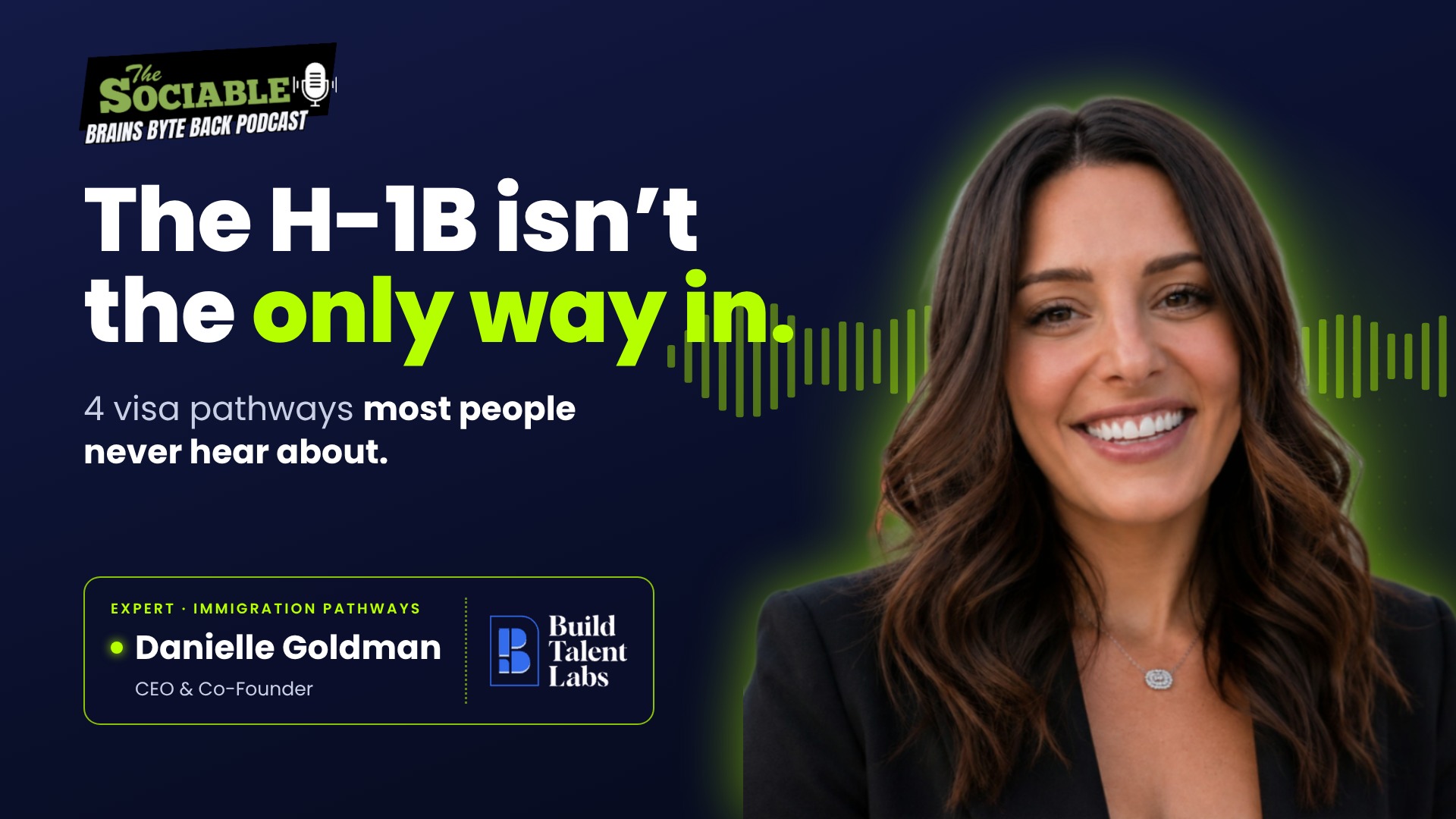
To find out what still works, Erick spoke with Danielle Goldman, CEO and co-founder of Build Talent Labs, which builds visa pathways for international talent.
The episode walks through four doors:
- Cap-exempt H-1B: universities, nonprofit research institutions, government research institutions and university-affiliated nonprofits can sponsor H-1Bs without the lottery. Danielle explains how part-time teaching roles, about five hours a week, can open this door through the Build Fellowship, including the story of an MIT startup engineer who lost the lottery and got an H-1B within weeks.
- OPT: a work permit for international students that can run up to three years for STEM graduates. Danielle’s advice is to start building employer relationships while still in school. Heads up: this interview was recorded before DHS proposed new OPT fees on Oct. 8, 2026. Schools would pay $70,000 for a student’s first OPT approval and $30,000 for each one after, including STEM extensions, and could pass the cost on to students or employers. The rule is only proposed and not in effect; public comments are open until Nov. 9.
- Founding a company: launching a startup during OPT, raising money and earning press can build the track record for the next door.
- O-1: not just for Nobel winners. Applicants usually need proof in at least three of eight areas, such as awards, published work, judging others’ work or high pay. Build Talent Labs can act as the US agent that files an O-1.
More doors worth knowing
The four above aren’t the only options. Others mentioned in the episode:
- J-1 trainee or scholar: for hands-on training or research at a US company. Build Talent Labs runs a managed J-1 program.
- L-1: for people who already work for a company abroad and transfer to its US office (USCIS: L-1A).
- Green cards without an employer: researchers and others with a strong record can self-petition through the EB-1A or the EB-2 National Interest Waiver.
- TN: for Canadian and Mexican professionals under the USMCA (USCIS: TN).
For a deeper look at H-1B alternatives, including more from Danielle, read The Sociable’s guide to other visas US companies can use to hire and retain international talent.
Why don’t more people know about these options? As Danielle puts it, you have to ask specifically about cap-exempt H-1Bs for them to come up. Her advice is to talk to an immigration attorney or a team like hers to find the door that fits your situation.
*This episode is for information only and is not legal advice.
Find out more about Danielle Goldman
Learn more about https://www.buildtalentlabs.com/
Reach out to today’s host Erick Espinosa
Erick Espinosa: Guys, I don’t know about you. I don’t think it could just be me, but lately my feed has been riddled with stories related to the H-1B visa. At first I thought it was maybe my algorithm, because these are stories that I’ve covered before. But this is all over mainstream media: reporters talking to people who have studied in the US, built careers there, and felt that they had no choice but to leave, ending up in places like Canada or the UK. And those stories are real, don’t get me wrong, but where are the stories of hope?
So it made me wonder: isn’t there another way in? There has to be. So I reached out to an expert, someone who has spent years helping international talent stay in the US. And she told me there are doors most people have never even heard about.
So if you’re somebody who stumbled across this video because you’re looking for a way into the US, whether you want to study, work or stay, this one’s for you. Or if you’re a founder trying to keep someone great on your team, then stick around. I’m going to show you four of those doors, four ways to enter the US, with real examples directly from an expert.
Let’s start with why this looks so bad. As you recall, last year the White House tried to implement a $100,000 fee on the H-1B visa. It made global headlines, and the impact resulted in fear and uncertainty. A number of people decided not to apply. H-1B lottery registrations fell by more than a third. But this year, the court blocked it. Now the government is trying again with a new proposed fee of more than $100,000 on every lottery petition. And it isn’t final yet.
And this matters, big time. Temporary visa holders earned 42% of the science and engineering master’s degrees in the US in 2024. When they leave, that talent goes with them.
Danielle Goldman has been following this closely. She co-founded Build Talent Labs and spent years building visa pathways for international talent. So I asked her: is it really as bad as it looks?
Erick Espinosa: Have you really seen a drastic change in terms of what’s happening now in comparison to 10 years ago? Like that sense of uncertainty?
Danielle Goldman: Yeah, it’s a really good question, Erick. I just hosted a roundtable last week with 10 of the top immigration attorneys in the country. And what we discussed was a prompt: are things as bad as they seem right now? Because the news outlets are making it seem like immigration is no more, there is no pathway, things are completely shut down. And there is a lot of fear and anxiety in the ecosystem, but these attorneys, these top attorneys, were there to say things are still working for us.
Erick Espinosa: So what is still working to get you in? Well, it really depends on who you are, exactly. Let’s take a look at them one at a time.
So let’s start with door one. It’s one that most people have never heard of. It’s still an H-1B, but some employers don’t have to enter the lottery at all.
Danielle Goldman: It’s called a cap-exempt H-1B, which is an H-1B without the lottery. These are reserved for four types of organizations in the United States: universities, nonprofit research institutions, government research institutions, and nonprofits affiliated with colleges and universities.
Erick Espinosa: Danielle and her father turned that rule into a program. Here’s how it works. Step one: a nonprofit linked to a US university hires you part-time, about five hours a week, teaching American college students. Then you have step two: that nonprofit sponsors your H-1B. No lottery involved. Step three: your full-time employer adds its own H-1B on top. Also no lottery. So you end up with two jobs: your full-time one, and five hours a week teaching.
I know you might be asking, what do I teach? I’ve never taught before. But it’s easy to teach something that you’re passionate about, something directly from your field. And that’s what Build Talent Labs does with their students. They’ve connected, for example, an engineer who teaches students to design a solar microgrid. They also have a finance analyst who shows students how to value a company. In one case on their website, they mentioned that one teacher’s company hired a student as an engineer without even interviewing.
Erick Espinosa: I’m really curious if there’s a specific conversation or a success story that you’ve had with a client.
Danielle Goldman: Totally. I mean, this happens every day. Everyone who we have a partnership call with, their response to us is, “This is too good to be true.”
Erick Espinosa: Here’s one example Danielle shared. During COVID, a 3D printing startup out of MIT was making testing swabs for Boston hospitals. Its lead engineer was from Germany, and he’d lost the H-1B lottery.
Danielle Goldman: And what we were able to do is employ this engineer. His name was Yannick. We employed him for five hours a week in our fellowship program. He spent those five hours a week actually training US students in mechanical engineering, which was helping them get jobs. And he was then able to get an H-1B with us without the lottery, immediately, within weeks. The company is still active, has raised multiple rounds, and has hired tens and maybe hundreds of people at this point. And that’s because that founding engineer was able to stay.
Erick Espinosa: But one thing to know before you get excited: if that teaching job ends, your main visa can be put at risk. So the teaching has to be real, and it has to keep going. And Danielle’s company is one route to get in. Universities and research nonprofits can also sponsor cap-exempt H-1Bs.
If you’re a student, door two is OPT, Optional Practical Training. It’s basically a work permit for international students.
Danielle Goldman: Today it is still working and intact. OPT is Optional Practical Training. It’s available for one to three years for foreign nationals, foreign students, to be able to work for either a US company or for their own company, which is very important, after graduation.
Erick Espinosa: So here is what that looks like. Say you finish a data science master’s in May. If you apply early, you could start working that summer. And if your degree is on the STEM list, then you could basically be working for the next three years. That’s more than one shot at the H-1B lottery, or just more time to qualify for another door. But Danielle says that the clock really starts earlier than that.
Danielle Goldman: They won’t, potentially, in the next few years in this administration, have the same luxury of having time after graduation to prove themselves to a company and then have someone champion them and sponsor them. It’s got to happen when you’re in school.
Erick Espinosa: So that could be everything from internships, projects, real relationships built with employers, all while you’re still a student.
Erick Espinosa: What’s a realistic pathway right now? Say somebody reaches out to you and they’re like, “Hey, I got into this top university.” What are my options if I want to stick around after that?
Danielle Goldman: Yeah, the pathway that I think has the most optionality and autonomy for a foreign national to succeed in the United States is founding a company, becoming a founder and taking control of their own immigration status.
Erick Espinosa: For example, you launch a startup during your first year of OPT. You raise some money. You get some customers, and maybe even some press. You’re building your own track record, and that track record can open the next door.
Danielle Goldman: Foreign talent that gets shut out of jobs at these larger tech companies, the more the foreign nationals are forced to potentially start their own initiatives and companies. That means that potentially we’re pushing people into the startup ecosystem at a rate that maybe we haven’t before.
Erick Espinosa: Door four is the O-1. A lot of people think that it’s only for Nobel Prize winners and Olympic athletes, but it’s not. It’s for people with what the government calls extraordinary ability in science, business, education or sports. To qualify, you usually need proof in at least three out of eight areas. In plain English, we’re talking about awards, memberships you’ve earned, press about you, judging other people’s work, original work that moved your field, published articles, a key role at a respected company, or even just high pay.
One example: let’s say Megan, a machine learning engineer. She published research. She’s reviewed papers for big AI conferences, and she’s paid well above average. That’s three out of the eight. She’d still need to show the evidence is strong.
Now a second example: a founder, let’s call him David. His startup got into a top accelerator. He raised money. He got written up in tech press. That can start to count too.
Basically, this means that there’s no lottery and no cap. What you do need is a US employer, or an agent like Build Talent Labs, to file for you.
There are a few more doors, too many to mention: one for people who work for a company abroad, another for people like researchers who want a green card without an employer, one strictly for Canadians and Mexicans, and also one for trainees. If you’d like to learn more about those, I put that information in the link below.
If you’ve spent hours researching this and never come across some of this info, there’s a reason.
Erick Espinosa: Do you find that at all? Do people come at you in these conversations like, “Hey, I saw that it said this online”?
Danielle Goldman: A hundred percent. You have to ask specifically about cap-exempt H-1Bs for this to come up as a solution. It’s really niche, and it’s not talked about widely. And so it’s not going to come up as a solution for many people. Despite all the barriers right now, and there are so many, and they are very challenging and they are making work harder, there are still pathways that are open, and things are still working for many people.
Erick Espinosa: So if you clicked on this video because you’re looking for another way in, find a door that matches you. If you’re a student, start building those relationships now, not at graduation. And before you give up, talk to someone who knows the system. I’m not talking about a headline. I’m not talking about a search bar. Talk to an immigration attorney, or people like Danielle and her team, who can help you figure out which door fits your situation. Her details are also there in the description.
In the meantime, don’t give up on your dreams. I know I didn’t. For The Sociable’s Brains Byte Back podcast, I’m Erick Espinosa.

Disclosure: This article mentions a client of an Espacio portfolio company.