




Earlier this year, Miami cracked the top 20 of global startup ecosystems as ranked by business intelligence firm Dealroom.
Buoyed by its access to foreign markets, including Latin America and European countries like Spain, as well as competitively low tax rates, the estimated enterprise value (EV) of Miami’s companies is over $670 billion, fourth in the nation.
A high concentration of angel investors, as well as some of the country’s leading technology accelerators, including Techstars and Endeavor, coupled with business-friendly government policies, have helped draw startup founders to South Florida in droves.
As compared to other startup hubs like San Francisco and Austin, Miami tends to do well in attracting early-stage investors as well.
One such vehicle for early stage investment was born inside the University of Miami.
USTAAR is the student accelerator program led by the University of Miami’s Office of the Vice Provost for Research and Scholarship.
The program works in two phases. In the first phase, startup founders receive up to $10,000 in non-dilutive funding to validate their idea and build a minimal viable product (MVP).
In the second phase, validated startups have access to up to $100,000 in equity investment to scale their companies.
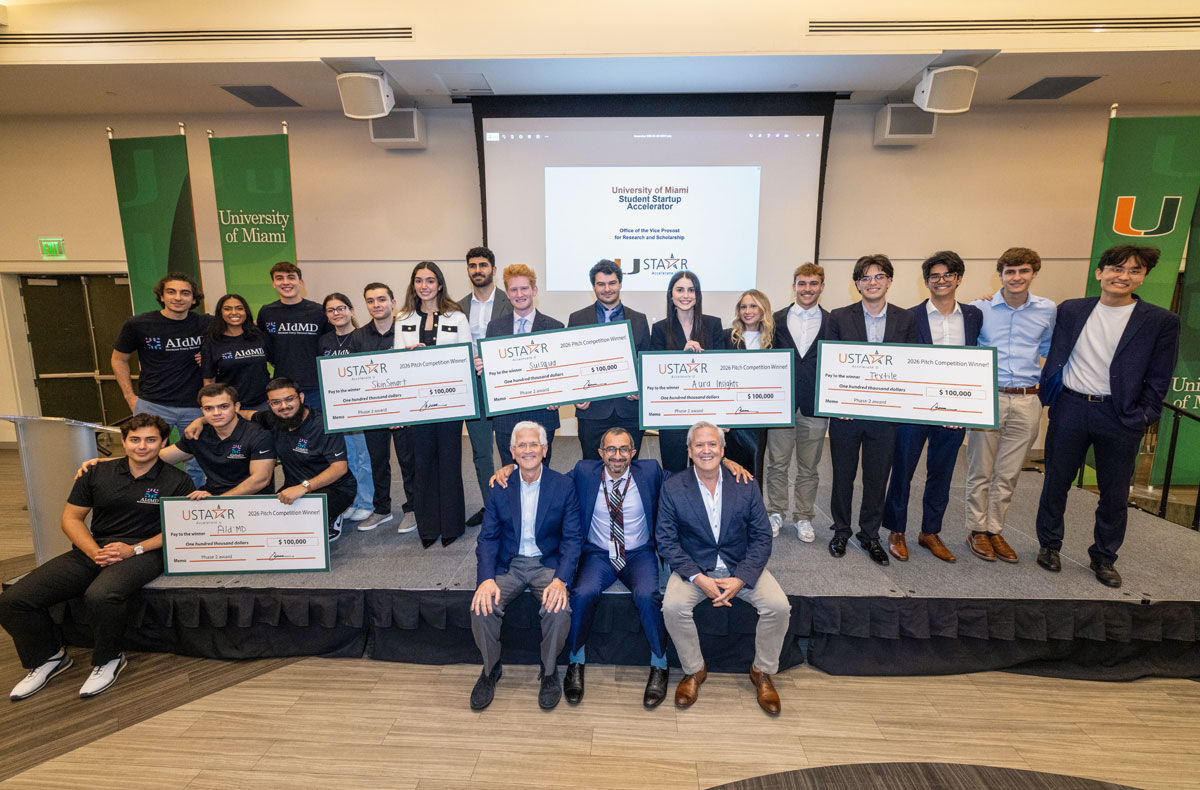
USTAAR held its third annual pitch competition in April where the program awarded five startups with $100,000 investments, bringing the total number of equity investments the accelerator has made since its inception to 14, according to the University of Miami’s student newspaper.
The most recent recipients of USTAAR investment include Aura Insights, an app that detects mental health issues in at-risk students before they reach crisis; Suisqua, the world’s first AI-powered, automated fish tank; SkinSmart, a platform that uses AI to analyze images of skin to help detect melanoma and other concerning skin lesions; Textile, which allows users to store sensitive documents on device, rather than in the cloud, but still provides for powerful search capabilities; and AIdMD, an AI-powered workspace for clinicians.
“As a founder myself, I’ve gone through many of the struggles that these startups have. So we have built a program that provides hands-on mentoring, community partnerships, networking opportunities, and seed funding,” Suhrud Rajguru, USTAAR’s director, told the student newspaper at the time.
The accelerator program was founded in 2024 with a $5 million pledge from Angel Alvarez, a university alumnus and entrepreneur who founded one of the country’s largest distributors of optical products, ABB Optical, and his brother Victor Alvarez, who is a retired corporate finance and capital markets partner at White & Case LLP.
“Our vision is to be a catalyst that allows students to see how they can change the world,” Angel Alvarez told the student paper upon announcing the accelerator.
The program is open to all students and trainees at the University of Miami, and aims to help “enhance socioeconomic development in South Florida and beyond,” Rajguru said.
As part of a broader South Florida startup ecosystem, USTAAR helps commercialize some of the university’s most innovative research. Founders often come from biomedical, engineering, data science, and finance backgrounds.
The accelerator could help solve one of Dealroom’s biggest criticisms of the Miami startup ecosystem. It’s a “destination ecosystem” rather than a “university-driven one,” Aoife Morrin, Dealroom’s Head of Ecosystem Growth, told Refresh Miami.
The biggest startup hubs like San Francisco and Boston are anchored by the world’s top universities, including Stanford and MIT, and to date, Miami has not reached the same level in university-led startup creation. But it’s getting there.
In Miami, these types of initiatives are starting to take hold. Other student incubator programs in South Florida include the Future Founders Accelerator, hosted by the University of Miami’s Launch Pad entrepreneurship center; StartUP FIU at Florida International University; and Build Up, a business training program at The Idea Center at Miami Dade College.
The city’s role as a bridge to other markets, especially in Latin America, also means that enterprising entrepreneurs from around the world land at the city’s universities and look for ways to break into the U.S. market.
Reynaldo Pineda, a lawyer from Honduras, founded ULaw, an app that connects people with licensed attorneys to answer specific queries. Pineda, a Doctoral of Juridical Science student at the University of Miami School of Law, is also part of USTAAR’s cohort of portfolio companies. He’s working on expanding into the U.S. legal market.
Last year, he gave a talk to Honduran law professionals about the challenges and opportunities about entering the U.S. legal marketplace, emphasizing building connections, reinventing themselves in a new ecosystem, and understanding the local and international market demands.
According to the Inter-American Development bank, Miami can play an “important role” in accelerating the growth of the venture capital (VC) and startup ecosystem in Latin America, by “connecting U.S. resources with [Latin America and Caribbean] LAC opportunities.”
By providing founders from abroad with access to early-stage support, including mentorship, investment, access to business networks, and more, Miami-based accelerators and VCs are helping to fuel the expansion of the ecosystem with some of the best minds from abroad as well.