


According to a recent report by McKinsey, most organizations today are already experimenting with or piloting AI.
While the technology is being applied to many industries, education is, frankly, being placed squarely at the heart of this adoption.
When OpenAI released ChatGPT 4 years ago, the response in classrooms was immediate and disruptive. Forbes reported that most students had used the chatbot for homework assignments, igniting debates about plagiarism, cheating, ethics and what authentic learning should look like in an AI-forward world.
Yet the narrative is not purely cautionary. For instance, Harvard University Assistant Professor Ying Xu found that when AI companions are thoughtfully integrated into curricula, children can improve reading comprehension and expand vocabulary. Other academics have pointed to AI’s potential for personalized learning experiences and enhanced administrative support.
The reality is that children, teenagers and young adults are already interacting with AI every day, not only as users, but aso increasingly as builders.
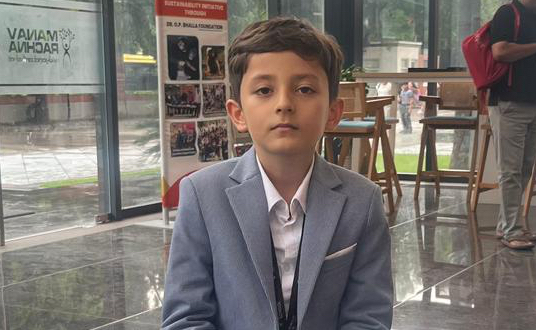
Few examples capture that shift more vividly than Bob Chopra, who co-founded IvySchool.ai at the age of eight.
IvySchool.ai positions itself as an online platform designed to help young learners build high-demand tech and business skills through expert-led courses and recognized certificates. Its offerings span AI, computer science, data science, entrepreneurship and business, all aimed at preparing students for what Chopra calls an “AI-powered future they will surely inherit.”
Chopra’s own journey began not with a business plan, but with curiosity. “When I was seven, I was just curious. I played around with Hopscotch the way other kids play games – experimenting, breaking things, and having fun. I wasn’t trying to build a company.”
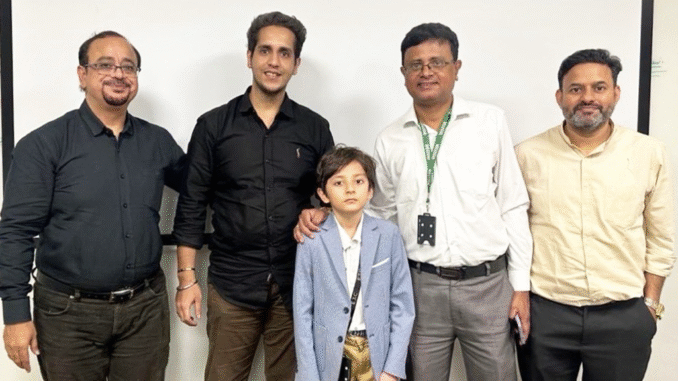
What began as playful experimentation gradually evolved into something more intentional as he took formal courses in computer science and entrepreneurship.
“Coding stopped being just play and became a way to turn ideas into real projects,” he explains. As IvySchool.ai began attracting other students, his mindset shifted. “I stopped thinking only about what interested me and started thinking about responsibility, impact, and whether what I was building actually worked for others,” added the entrepreneur.
A key inflection point came during his time at Gulliver in Miami, which is one of the country’s leading schools. While coding tools such as Kodable were part of the curriculum, Chopra felt the exposure wasn’t as deep as he wanted.
“There was no real entrepreneurship or AI-era thinking – not because the school didn’t care, but because that wasn’t the teachers’ expertise.” Around the same period, he found himself building projects on Hopscotch rather than consuming online entertainment. Encouraged by his parents, he began studying other entrepreneurs and eventually enrolled in programs from top universities.
When presented with a choice between boarding school and building something of his own, he chose the latter. “If these courses could prepare me for an AI-first world, they could prepare other kids too,” he says. “IvySchool.ai started as a simple idea: give students access to the kind of future-ready education I had to search for on my own.”
Central to the platform’s identity is its claim of being “designed by children for children.” Chopra insists this is more than branding. “When we say IvySchool is ‘designed by children for children,’ it means we don’t guess what kids need – we build from how we actually learn.” He personally tests features and lessons, adjusting anything that feels dull or confusing. “If something feels boring, confusing, or too slow, we change it.”
While IvySchool.ai draws inspiration from elite institutions, its approach is intentionally adapted for younger learners. “The challenge is translating that level of thinking for younger learners,” Chopra says. “We do that by breaking big ideas into small, hands-on steps.” Rather than beginning with theory, students start by building. “Instead of starting with theory, we start with building projects, experiments, and real problems kids care about.”
When looking at the years ahead, Chopra envisions a reimagining of the school day. For example, “By 2030, a 10-year-old’s school day will feel less like assembly lines and more like studios.” Memorization will give way to design, experimentation and collaboration with AI agents. “Subjects will blur: math will show up in robotics; language will show up in interface design; ethics will show up in AI decision-making.”
As for his own future, Chopra hopes to evolve as both an innovator and advocate. “I hope to be both a builder and an amplifier; builder, as someone who continues to invent new learning infrastructures; amplifier, as someone who opens doors for millions of kids who are just as curious, but never had access.”
Ultimately, he believes the story is bigger than any individual founder. “If IvySchool.ai succeeds, the real headline in 2030 won’t be that a kid became a CEO. It will be that childhood became a time for creation, not just preparation,” concluded the entrepreneur.