


Small businesses and founders are using AI to write copy, brainstorm and even design products. But for patents and copyrights, the law protects only what a human contributed, and according to two lawyers who specialize in AI and IP, how you use the tool today could one day cost a founder the right to protect what they make.
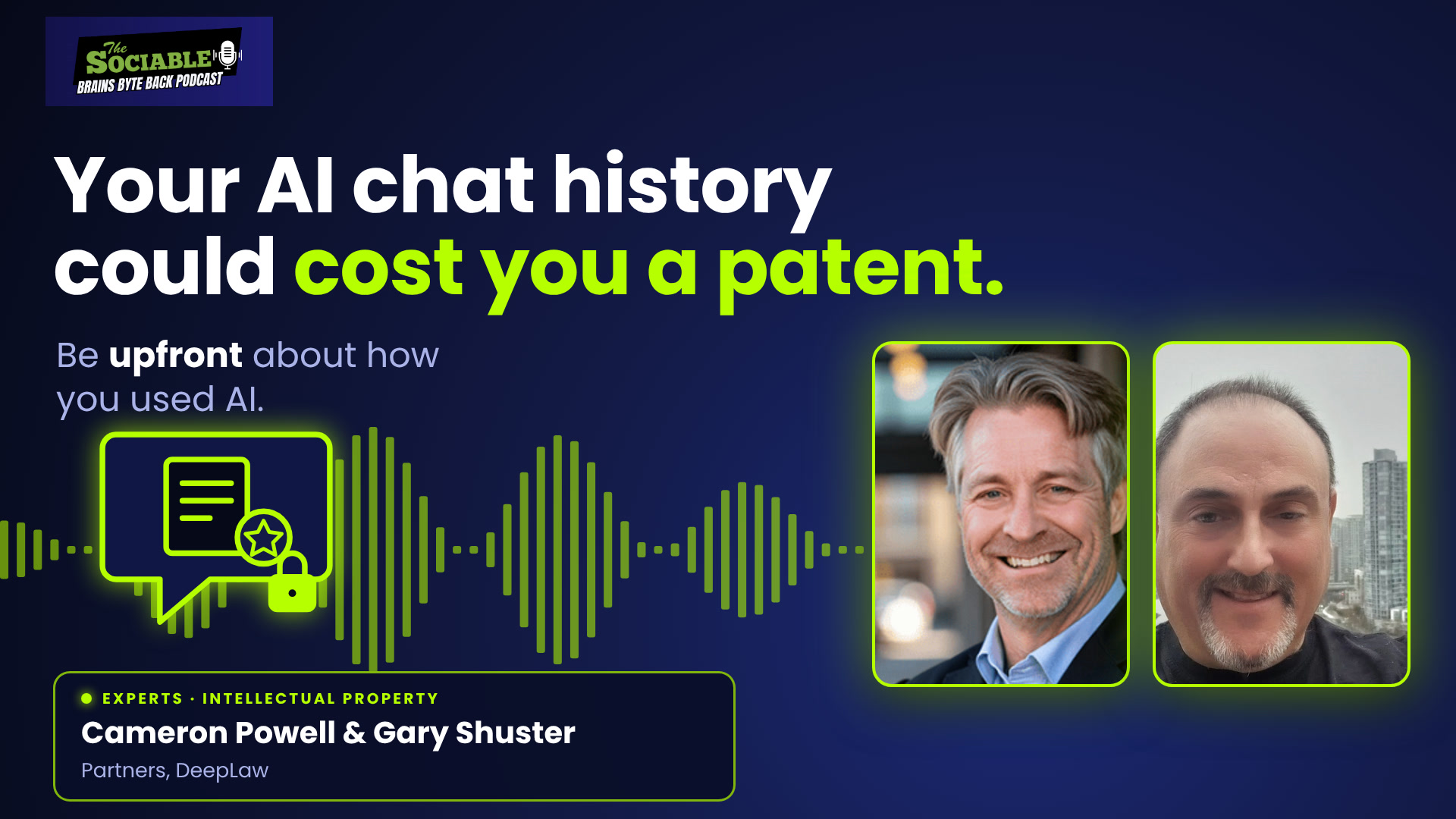
So how do you use AI without losing that right? Brains Byte Back host Erick Espinosa sat down with Gary Shuster and Cameron Powell, partners at the law firm DeepLaw, to find out where the line sits for patents, copyrights and trademarks.
Here what you’ll learm:
- Patents. Only a human can be named as an inventor, and AI is a tool used by human inventors. Shuster says AI can help organize sections or turn a rough sketch into a patent drawing, but he warns against letting it supply the idea. A useful rule: ask the AI where the gaps are, not how to fill them.
- Timing. Shuster knows of no published cases where a patent was thrown out for being written by AI, but patents take years to be granted and challenged, so any AI-suggested inventions could surface in discovery long after the fact. Both lawyers say to be upfront with the patent office about what came from a machine.
- Copyrights. A copyright also requires a human, and a prompt alone is not enough to make you the author. Shuster expects U.S. courts, not Congress, to decide how much human input is enough. Powell’s advice for businesses: keep a paper trail and compare the first draft to the last with a redline.
- Trademarks. Trademark law is a consumer-protection statute about avoiding confusion over who makes a product, so it does not care who came up with the name. The name still has to be distinctive.
The common thread across all three: let the tool point at the problem, polish the draft, make the logo, and keep the idea and the shaping of the work in your own hands.
This episode is for information only and is not legal advice.
Transcription:
Erick Espinosa: It’s clear that AI is a fantastic tool to help people jumpstart ideas. Small businesses, maybe micro entrepreneurs, and we’re seeing more founders are using AI to write copy, brainstorm, maybe design some products. But for patents and copyright, the law only protects what a human contributed. And how you use AI today decides what you can protect later. To show you where that line is, here’s a story that may help.
Gary Shuster: An example is, this tells you how old I am, I had an iPod video, one of the first ones that had, I think, that big a screen. And so I was sitting on an airplane trying to watch video with, like, I needed a microscope almost. And I thought, well, there’s this whole tray table in front of me. Why can’t we just project the image onto that?
Erick Espinosa: So he designed a portable device with a short throw projector. Unfortunately, someone had beaten him to the idea, had filed it just a few months before, so he decided to drop the patent process. But what did stay with him was how his patent lawyer had handled the review. When the optics didn’t quite add up, the lawyer didn’t offer a fix. He just asked how a device that small could throw an image from so close.
Gary Shuster: So he didn’t become an inventor. He just told me, “Your invention’s flawed this way,” and then I fixed it. So that’s a perfectly legitimate use for AI too, which is, you know, tell me where I missed something, but don’t tell me exactly how to put it in. Just say, “You missed this component.”
Erick Espinosa: So the idea essentially remained Gary’s. Had he supplied it, he could have counted as a co-inventor. And Shuster says leaving an inventor off of a patent can invalidate it. But this is where it gets tricky. Because a lawyer can be named an inventor. A chatbot can’t, and chatbots are designed to provide you with answers to your questions that you’re asking. And according to these experts, this could one day potentially cost the founder a patent. So here’s the question that we’re asking today. How do you use AI without losing the right to protect what you make? So I sat down with two lawyers from the firm DeepLaw, Gary Shuster and Cameron Powell. They specialize in IP, AI, anything to do with innovation. And they tell me what counts as too much AI really depends on what you are trying to protect, because patents protect an invention and copyrights protect creative work like writing or images or code even. Trademarks protect names and logos, and the law treats AI differently for each one. So let’s start with patents because I think this is the most important one. In November of 2025, the patent office updated its guidance. Only a human can be named as an inventor. And AI systems are tools used by human inventors. So using AI that way is completely fine. But Shuster warns against letting it supply the idea you’re trying to patent.
Gary Shuster: But there’s no reason that AI can’t help you organize the sections, can’t actually draw the— I mean, if you give it a really bad handwritten drawing of something, it can generate the actual patent drawing. I mean, all of those things it can do. But if you want patentable weight attached to something, it has to be human for now.
Erick Espinosa: The idea is where it stops. Shuster says spotting the problem is the hard part of an invention. But in patent law, they often look at the solution.
Gary Shuster: Now that’s in conflict with one of my observations, which is it’s usually pretty easy to solve a problem, but very hard to discover a problem and then state it in a way that can be solved. So people don’t realize it’s a problem. They’re not going to invent something to solve it. But the minute you say the following are the bounds of the problem,
Erick Espinosa: And that’s the catch with AI. Describe a problem and it’s often just going to volunteer a solution. So you have to focus on a prompt. The rule is to ask it where the gaps are, not how to fill it.
Gary Shuster: The standard is, is the solution obvious? Is it novel? Under those tests, just don’t suggest the answer.
Erick Espinosa: So realistically, if anyone lost a patent over this, Shuster says that he knows of no published cases where a patent was thrown out for being written by AI. But the timing may be why.
Gary Shuster: Typically, I mean, if you fast track it, you could sometimes get it within a year, but typically it’s like three to five years, then you get your patents. So the ones coming through the pipeline now are largely pre-AI, or pre-AI that you can rely on.
Cameron Powell: What Gary’s talking about is if people are using AI now to assist in their patent applications, in drafting the actual idea, that information will not come to light for several years from now because it’ll be several years before the patent is granted. And then maybe more years after that before somebody challenges the patent, like a competitor, and in discovery, if this information is still even available, either on the person’s computer or at the LLM, then we would discover that the things that were claimed as inventions had been suggested by the LLM.
Erick Espinosa: An inventor can disclose an AI’s role, and that part of the invention may not be protectable, but Shuster warns hiding it is riskier.
Gary Shuster: So you want to be fully upfront, honest with the patent office about what part came out of a machine and what part came out of you.
Erick Espinosa: Next is copyrights. A copyright also requires a human. In March of 2026, the Supreme Court declined to hear a challenge to that rule, which leaves an appeals court ruling in place. The Copyright Office has also said that with today’s technology, a prompt alone isn’t enough to make you the author. The harder question is how much you have to add before the work is yours, and nobody has drawn that line yet.
Gary Shuster: So if I did a thousand rounds with an AI that had written a short story for me, reshaping the story, I’m pretty sure I have a copyright interest in it. If I did zero rounds and just said, write a good short story, I don’t have any copyright. So somewhere in between those two points is where copyright arises.
Erick Espinosa: Shuster expects U.S. courts, not Congress, to decide where it falls. Until then, Powell’s advice for a business is to keep a paper trail instead of banning the tool.
Cameron Powell: Right? So it’s better to say if you’re going to use AI, we want to see your first draft along with your last draft. And please do us a favor of running a redline in between. And this is where I always say, as an easy rule of thumb, you have copyright in the redlines as the employer.
Erick Espinosa: The untouched draft earns no protection, and the same goes if you pay someone else to make the work.
Cameron Powell: […] copied verbatim what they’ve done, whether it’s the computer code or the series of, you know, [characters] and whatnot. And then it comes out in discovery of the contractor that they wrote it with AI and there is no copyright to transfer. Now the company looks silly. They’ve wasted lots of money.
Erick Espinosa: Finally, trademarks. A trademark identifies who makes a product, and trademark law doesn’t care who came up with the name. That gives AI more flexibility here. And Shuster says the reason is simple.
Gary Shuster: Your trademark is really a consumer protection statute that prevents consumers from being confused as to the origin of goods and services. So yeah, have it do whatever it needs with trademarks.
Erick Espinosa: And that works both ways, because the point is to keep shoppers from being confused. A name or a logo that’s too close to someone else’s is a problem, and that’s a problem for whoever comes up with it. And the name has to be distinctive. One that merely describes the product generally can’t be protected. And Shuster’s example is a game that we all know.
Gary Shuster: If we imagine, my greatest example when you could still patent games, because you really largely can’t in the US, was the game Monopoly. Because it was named Monopoly and it had three different monopolies in it. It was a patent on the gameplay mechanic. There was a trademark on the word Monopoly and probably some of the property names, I don’t know, maybe. And there was a copyright to the design of the board.
Erick Espinosa: For now, the rule across all three is the one Shuster’s patent lawyer modeled years ago. Let the tool point at the problem. Polish the draft and make the logo. And keep the idea and the shaping of the work in your own hands. If after watching this episode you’re still left with questions about how to protect your idea, your invention, reach out to the team at DeepLaw. I’ve left their information here below. And as always, we appreciate your support on this channel to help it grow. Give us a like, give us a follow. You could always reach out to me as well if you have an idea for an episode or would like to come and join me for an episode. Reach out to [email protected]. I’m Erick Espinosa for The Sociable’s Brains Byte Back podcast.