


A new blockchain-based financial system targeting African economic development is set to to launch at the inaugural Africa Digital Assets Summit (ADAS) in Nairobi on April 30, with the pairing of Kenya Token and Catholic USD on the Solana network.
The initiative is led by Crescite Innovation Corporation in collaboration with Solana Spaces, and marks one of the more ambitious attempts yet to build blockchain financial infrastructure designed from the ground up for African markets – rather than adapting models imported from Western financial systems.
What is Kenya Token?
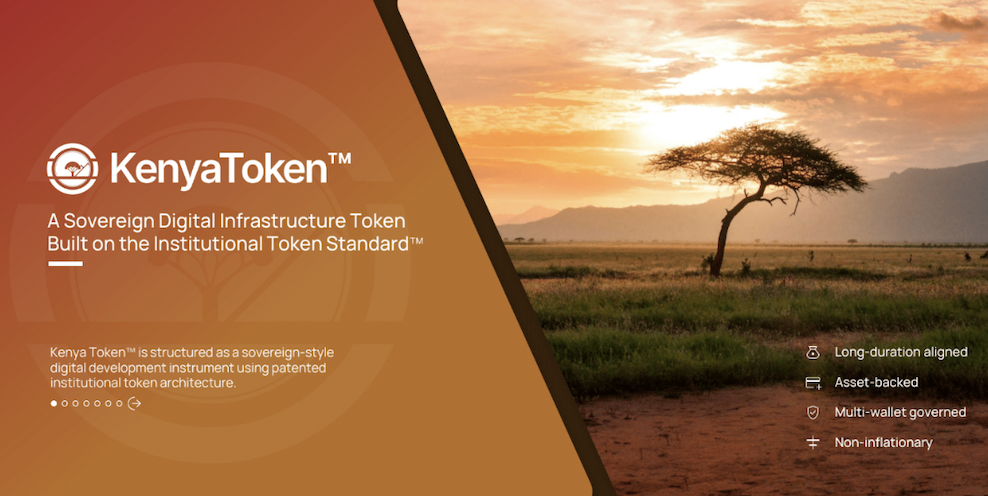
Kenya Token is structured as a real-world asset (RWA) token – a category of digital asset that represents ownership or economic interest in tangible, off-chain assets. In this case, the token is designed to channel capital into infrastructure, education, trade, and innovation projects across Kenya.
RWA tokenization has emerged as one of the more closely watched trends in blockchain finance over the past two years, with institutions ranging from BlackroCK to JP Morgan exploring how traditional assets can be brought on-chain.
Kenya Token applies that same logic to development finance, with the stated goal of connecting institutional capital directly to real world economic activity on the continent.
Its exclusive pairing with Catholic USD is the more unusual element of the announcement: Catholic USD is structured as a public-benefit stablecoin – pegged to the U.S. dollar but designed so that 100% of reserve yield is directed toward charitable and social impact initiatives. The combination is intended to create what Crescite describes as a unified on-chain financial system with both stability and social mission baked into its architecture.
Why Africa? Why now?
Africa’s digital asset markets have grown steadily, driven in part by high mobile penetration, large unbanked populations and currencies in several nations that have experienced significant volatility. Stablecoins in particular have found real utility across the continent as a store of value and a tool for cross-border payments.
Yet much of the infrastructure underpinning that growth has been built elsewhere, but organizations with limited direct stake in African outcomes. That’s the gap that Crescite and the Africa Digital Assets Summit say they are trying to close.
“The untapped opportunity and new reserve lies in the programmable African value,” said Fred Ogola, founder of Africa Digital Assets.
“The continent has enormous amount of economic activity and, now more than ever, Africa needs the equitable economic infrastructure to make its potential prosperity a reality,”
Meanwhile, Eddie Cullen, CEO of Crescite and co-convener of the summit, was more direct about the problem the initiative is responding to. “For too long, the region has pursued ill-suited models that fail to tap into the potential and meet local government and social needs,” he said.
The argument being made here is less about blockchain technology itself and more about ownership and design philosophy – who builds financial infrastructure, for whom, and with what incentives in mind.
The Solana connection
The choice of Solana Spaces as the underlying network is notable. As the world’s first retail and educational space dedicated to Web3 and Solana, it has positioned itself as a high-throughput, low-cost alternative to Ethereum, making it more practical for applications that require frequent, small-value transactions – exactly the kind of activity that characterizes everyday economic life in emerging markets.
Solana Spaces, which will support ecosystem growth through institutional engagement and community onboarding, sees the pairing as emblematic of a broader potential for the technology.
“Collaboration like this demonstrate the power of blockchain to drive meaningful impact that transcends financial gain. Kenya token and Catholic USD represent a new future where finance, faith, and blockchain innovation can actually intersect to level the digital finance playing field,” noted Amol Gharte, co-founder of Solana Spaces.
Questions that remain
The announcement, however, raises as manu questions as it answers. Public-benefit stablecoins and faith-aligned financial products are still largely unproven at scale, and the mechanics of how Catholic USD’s reserve yield is governed and distributed will matter enormously to whether the model holds up under scrutiny.
Similarly, RWA tokenization projects have mixed track records when it comes to bridging the gap between on-chain capital and genuine off-chain impact; the technology works, but execution, local partnerships, and regulatory relationships tend to determine outcomes more than architecture does.
The Africa Digital Assets Summit itself is a new event, convening for the first time this April. How much institutional weight it carries – and whether it can draw the kind of policy and capital relationships that would give Kenya Token a real runway – remains to be seen.
What is clear, however, is that there is genuine demand for financial infrastructure built with African realities in mind. Whether this particular model can deliver on that demand will be worth watching as the project moves beyond its launch announcement and into implementation.
Featured image: Courtesy of Kenya Token

Disclosure: This article mentions clients of an Espacio portfolio company.