


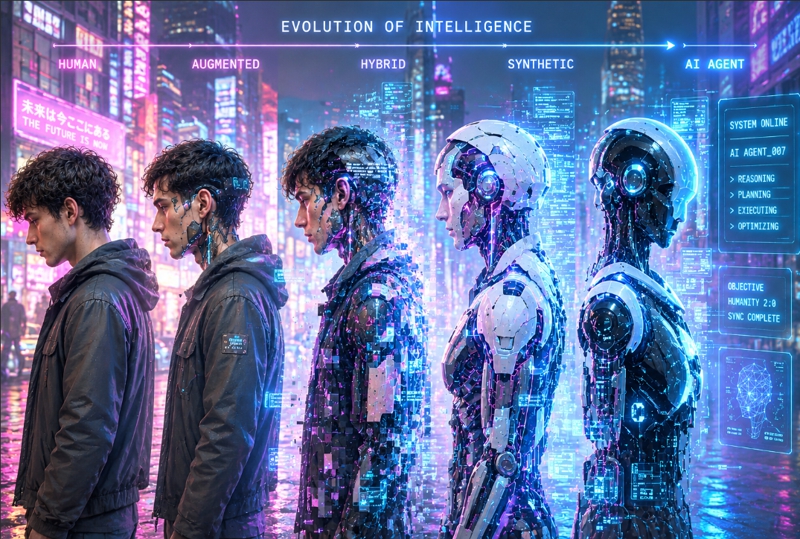


AI agents will continue to improve until most humans are kicked out of the loop while a select few are given superhuman capabilities: perspective
The World Economic Forum (WEF) compares onboarding AI agents to onboarding new employees in a new playbook for organizations — for which many have already replaced humans with AI.
Starting with the question, “how can an organization, in concrete terms, delegate authority to an automated system while remaining fully accountable for its actions?” the report, “AI Agents in Action: A Playbook for Trusted Adoption, Authorization and Scaling,” likens the onboarding of AI agents as comparable to that of onboarding human employees.
“Onboarding an agent can, in some ways, be compared to onboarding a new employee. The process involves assessing capabilities, assigning responsibilities, granting access, defining supervision and adjusting the scope of action as performance and trust evolve”
WEF, AI Agents in Action: A Playbook for Trusted Adoption, Authorization and Scaling, May 2026
As far as comparing AI agents to humans in the onboarding process, the authors go on to clarify, “This is a structural comparison only, as agents lack clear legal status, moral responsibility and reputational incentive – governance is built to offset these gaps.
“The comparison is useful because the term ‘agent’ has long referred to a person who acts on behalf of an organization within defined bounds. Real estate agents, call center agents and public sector agents operate with delegated authority, clear procedures and escalation when exceptions arise.”
So, already, we are seeing language that puts the AI agents on a similar level as the human workers they are replacing.
“Agent guidelines define how agents are introduced as actors that reshape work. Successful adoption goes beyond technical capabilities and depends on effective change management and clear supervision”
WEF, AI Agents in Action: A Playbook for Trusted Adoption, Authorization and Scaling, May 2026
Big tech employees across the board have been training their own replacements.
This year alone, some 152 tech companies laid off 115,430 employees, according to the latest numbers from the Layoffs.fyi tracker.
The irony now is that some big tech companies this have already blown their budgets on AI this year, and the licenses are becoming more expensive than the salaries of the employees they laid off.
The WEF playbook places an emphasis on the need for human supervisors over AI agents, but even then, the authors admit that supervision has its limits — they are human supervisors afterall. They get tired; they need to eat, sleep, take breaks, etc.
But going beyond their physical limitations, the report says that humans may not be able to comprehend what the AI agents are doing because the agents would be operating at a scale of great complexity — way beyond the scope and speed of human cognition.
“Supervision has clear limits. Humans may struggle to evaluate agent actions accurately when complexity exceeds their capacity, creating a supervision paradox”
WEF, AI Agents in Action: A Playbook for Trusted Adoption, Authorization and Scaling, May 2026
Over time, human supervisors may get overwhelmed and simply delegate their assessments to the AI agents’ recommendations, which is the complete opposite of what they should be doing.
Therefore, the report authors recommend, “Governance frameworks should therefore design supervision mechanisms that preserve the quality of human judgement, for example, by prioritizing review for consequential events, surfacing uncertainty signals and ensuring that checkpoints remain targeted and manageable as agent activity increases.”
In order to deploy AI agents at scale in a way that ticks all the corporate boxes, the WEF came up with the Agent Capability and Authorization Profile (ACAP), which incorporates: system design and assessment, preparation and deployment, and monitoring and improvement.
“The Agent Capability and Authorization Profile (ACAP) is the organization’s authorization for an AI agent to act in a specific workflow, defining permissions, checkpoints, owners and evidence”
WEF, AI Agents in Action: A Playbook for Trusted Adoption, Authorization and Scaling, May 2026
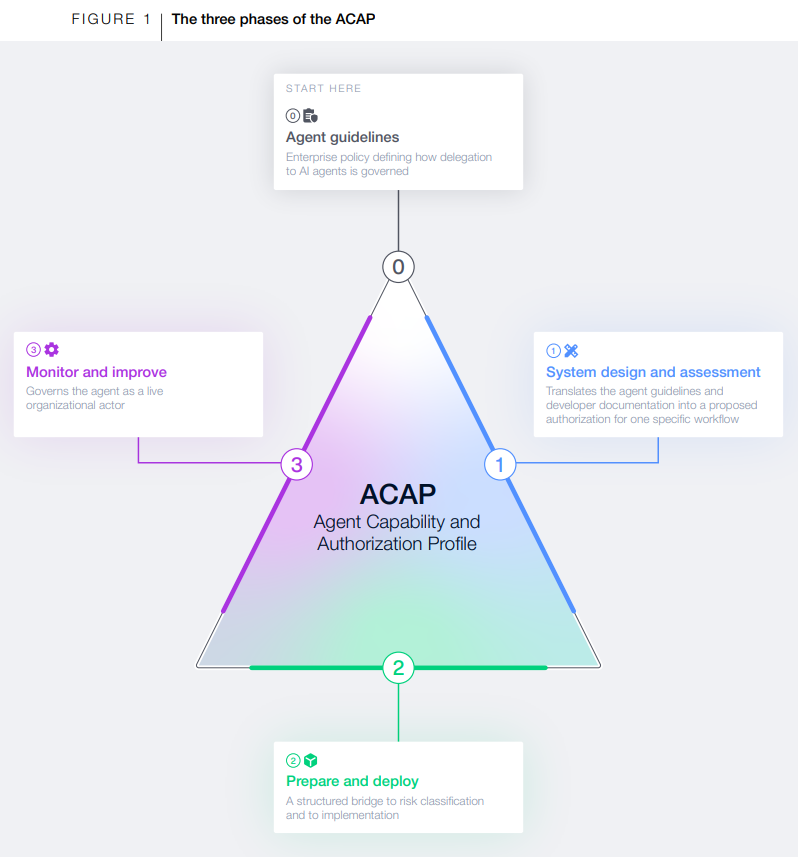
“Monitor and improve” means exactly that.
The idea is to monitor and improve upon the AI agent, so that with each iteration it gets better and better.
We also see another personification of AI agents — as “live organizational actors.” Once again, the language implies that AI is to be treated like a human employee.
But what does that mean for the humans who monitor and improve AI agents?
In big tech CEO-speak, the answer is dual; it means the human employees will either become redundant or will have superhuman powers — provided the humans know how to effectively wield their AI agents.
At least, that’s what Circle CEO Jeremy Allaire tells his employees.
“AI agents will replace a huge percentage of work that’s currently performed by humans on a massive scale. And I think it’s going to be most dramatic in white-collar work […] If you actually embrace these agentic capabilities, you as a person have new superpowers, and your ability to have impact grows dramatically”
Circle CEO Jeremy Allaire, The Economic Club of New York, March 2026
Agentic AI is part of what the WEF calls a “New Cyber Order,” which was the topic of one of the discussions that took place at the WEF Annual Meetings of the Global Futures Councils and Cybersecurity that took place in Dubai, UAE on October 14, 2025.
There, Palo Alto Networks CEO for Europe, Middle East, and Africa Helmut Reisinger said that the new cyber order was already here and that for every human identity, there would be 80 AI agents.
“With AI comes another term of machine, which is called the agent who will create an outcome for you, to whom you delegate,” said Reisinger.
“In the future, there will be for every human identity, there will be about 80 machine-based identities, so that’s a whole new plethora for potential inroads“
Helmut Reisinger, WEF Annual Meetings of the Global Future Councils and Cybersecurity, October 2025
Big tech is telling us that AI agents will not only outperform human cabalities, but there will be far more agents than humans.
Speaking at the WEF Annual Meeting in Davos in January this year, Elon Musk said that AI will be smarter than any human alive by the end of this year or the next.
By 2031, Musk predicted that AI would surpass the collective intelligence of all humanity.
“The rate at which AI is progressing I think we might have AI that is smarter than any human by the end of this year, and I would say no later than next year […] Probably by 2030 or 2031 — call it five years from now — AI will be smarter than all of humanity collectively”
Elon Musk, WEF Annual Meeting, January 2026
Then comes robotics.
“We’ll actually make so many robots and AI that they will actually saturate all human needs […] My prediction is that there will be more robots than people”
Elon Musk, WEF Annual Meeting, January 2026
In keeping with the theme of replacing humans with AI while personifying the technology itself, Musk predicted that there would soon be more “humanoid” robots than people.
These robots would saturate all human needs — from babysitters to caregivers, doctors and lawyers, maybe even the clergy as historian Yuval Noah Harari hinted at the same WEF Annual Meeting this year.
“Anything made of words will be taken over by AI. If laws are made of words, then AI will take over the legal system […] If religion is built from words, then AI will take over religion”
Yuval Noah Harari, WEF Annual Meeting, January 2026
The WEF playbook for AI agents places heavy emphasis on governance to ensure that the agents have accountability and do what they are authorized to do without handing over the metaphorical keys to the kingdom where they have access to everything and permissions to behave fully autonomously.
At the same time, the authors say that AI agents are to be treated more and more like humans with personifying language like “live organizational actors” and “employees.”
And let’s not forget the infrastructure that makes all of this possible.
Earlier this month, the WEF put out a report saying that all the land, energy, and water needed to run data centers as part of the overall AI infrastructure were “non-negotiable prerequisites.”
Resources that humans rely on for their survival are being redirected to serve the machines and their masters.
In the end, the goal is for AI agents to continue to improve with human guidance and evaluation until most humans are made redundant and kicked out of the loop while select few humans are given superhuman powers.
Image Source: AI generated with ChatGPT