


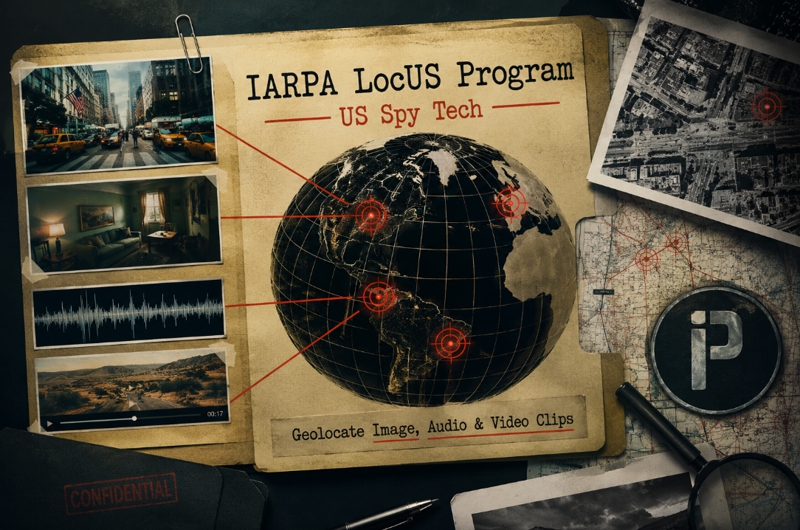


IARPA, the US spy community’s research and development funding arm, is attempting to geolocate image, audio, and video clips, both indoors and outdoors, through a program called Locations Using Sound (LocUS).
With stated use applications for law enforcement, hostage recovery, and human trafficking interdiction, the US Intelligence Advanced Research Projects Activity’s (IARPA’s) program title is a bit misleading because it goes way beyond just sound clips and stretches into image and video content as well.
“The LocUS program aims to develop technology that can automatically and accurately geolocate an indoor or outdoor image, video, or audio clip taken anywhere in the world”
IARPA, LocUS Program, April 2026
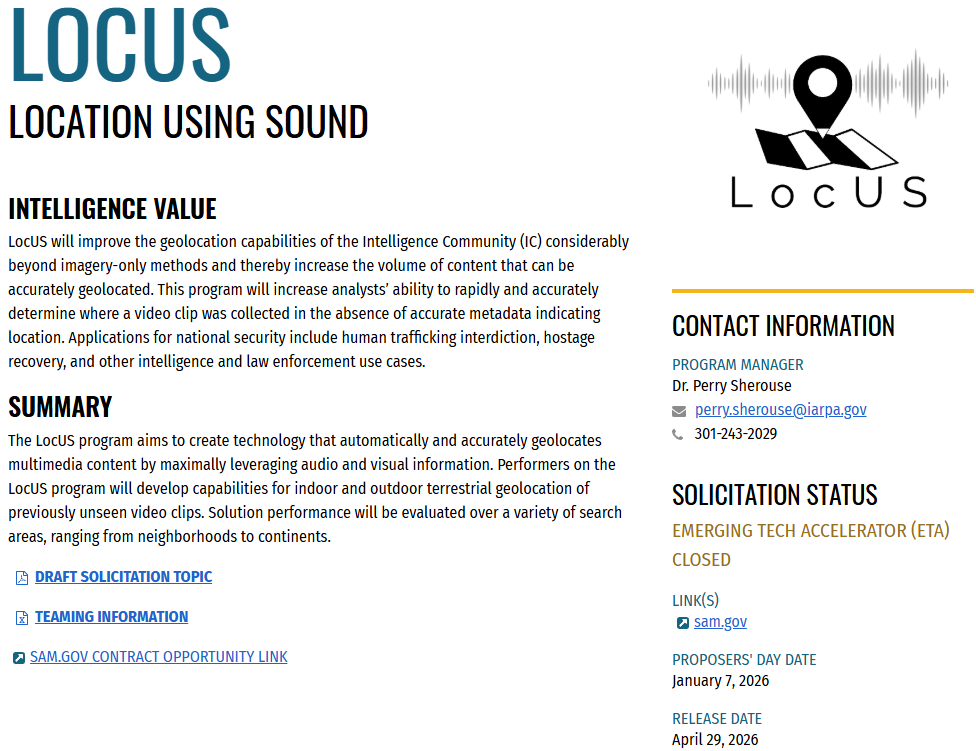
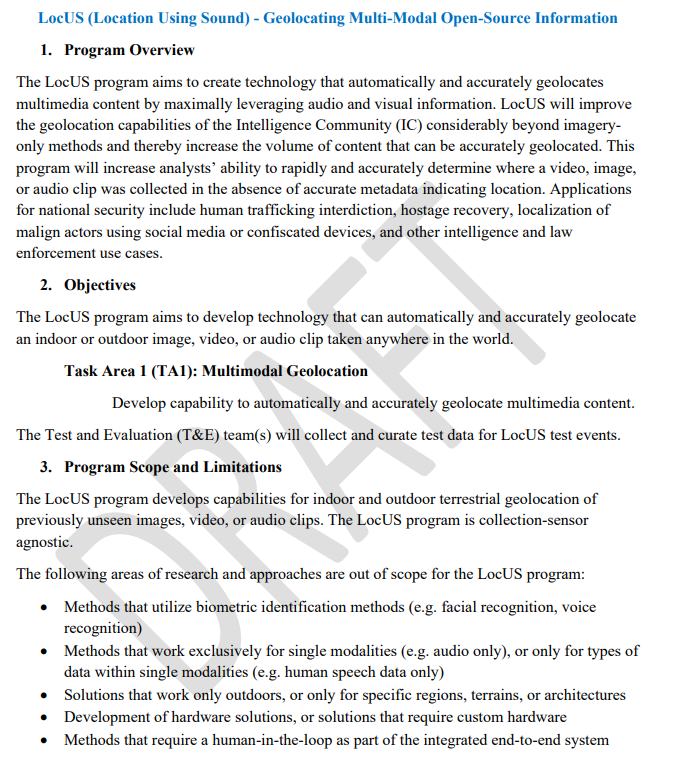
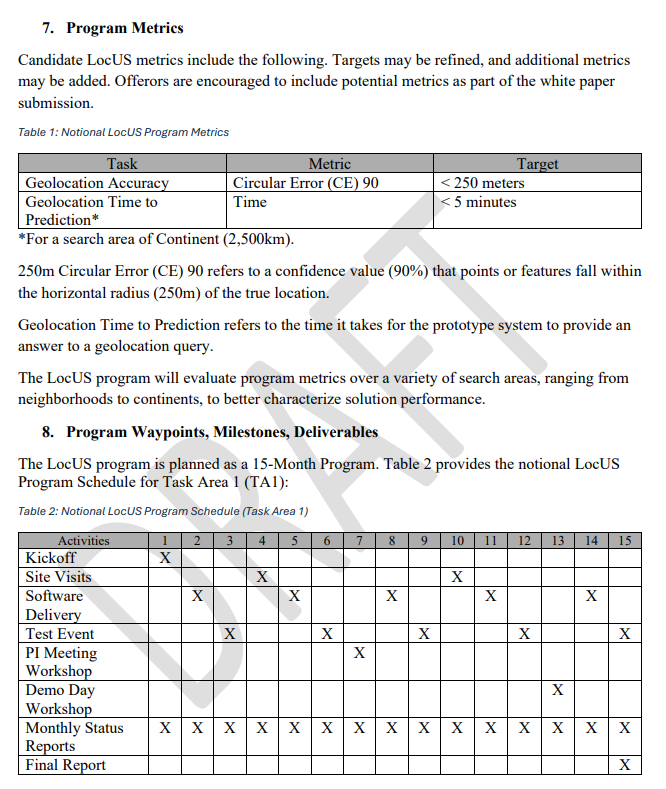
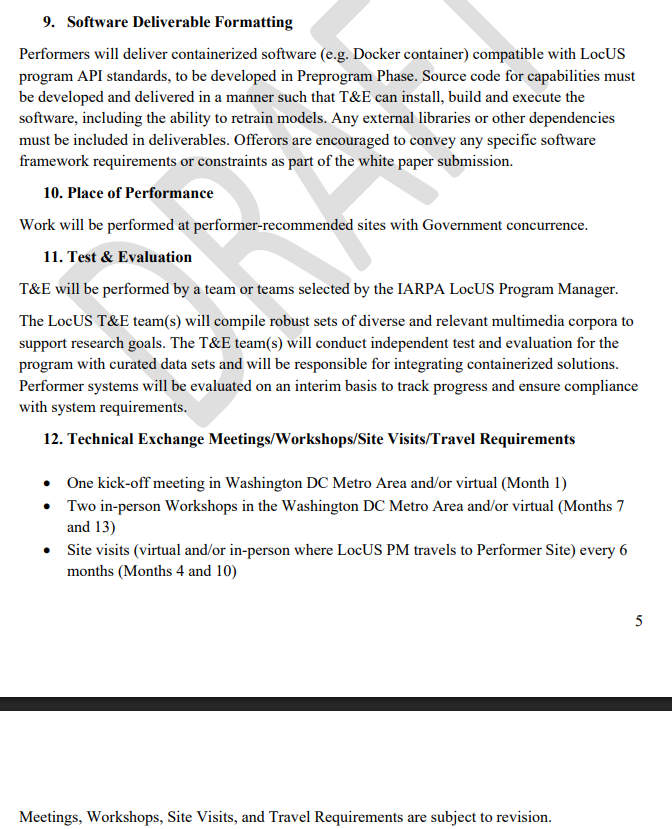
Any image, audio, or video clip, whether recorded indoors or outdoors, is to be accurately geolocated within 250 meters of the target, with 90 percent confidence, according to the LocUS draft program overview.
And this is without using biometric identification methods like face recognition or voice recognition.
With the LocUS program, IARPA wants to “increase analysts’ ability to rapidly and accurately determine where a video, image, or audio clip was collected in the absence of accurate metadata indicating location.”
“The LocUS program aims to create technology that automatically and accurately geolocates multimedia content by maximally leveraging audio and visual information“
IARPA, LocUS Program, April 2026
Efforts to geolocate multimedia without embedded metadata have already been well underway, including a method that looks into Electric Network Frequency location-based signatures coming from the interactions between smartphones and the grid.
For example, Australia’s University of the Sunshine Coast (UniSC) recently announced it was seeking a commercialization partner for the development and deployment of a “patented technology relates to a method and system for determining geolocation data derived from a video recording where GPS coordinates and other metadata have been removed to conceal the location where the video was captured.”
“The method uses an almost undetectable Electric Network Frequency (ENF) location-based signature that is naturally embedded in a video and/or audio that can identify the location of videos captured with a smartphone at intra-grid level”
University of the Sunshine Coast, Geolocation of videos captured with smartphone cameras, January 2026
According to UniSC, “The ENF represents the frequency of the electrical power grid, fluctuating around its standard value of 60 Hz in North America and 50 Hz in Europe, Australia, and many other parts of the world. The intrinsic fluctuation characteristic of the ENF stems from the variations in the load on the power grid and are essentially random.
“The mains frequency, and hence the ENF, may influence internal components of a recording device such as the sensor readout, clock signals, or frame timing. An ENF signal may therefore be embedded in video and/or audio files generated by devices connected to the mains power or situated in surroundings where electromagnetic interference or acoustic mains hum is detectable.”
And just like with the LocUS program, the UniSC announcement also refers to law enforcement as the principal recipient of this type of geolocation methodology.
The ENF technique was also featured in the journal Nature in June, 2025 under the title, “Intra-grid location estimation of smartphone videos using ENF extraction and an improved super-pixel technique.”
And once again, it says the use of ENF for geolocated video from smartphones is “crucial for law enforcement and national security.”
“While outdoor videos can use landmarks or geolocation techniques, indoor videos present a greater challenge due to the lack of visible landmarks. Recently, researchers have explored using the electrical network frequency (ENF), naturally embedded in audio and video sources, for this purpose”
Nature, Intra-grid location estimation of smartphone videos using ENF extraction and an improved super-pixel technique, June 2025
According to the Nature study, “The application of the ENF in determining the location of multimedia recordings, both at inter-grid and intra-grid levels is highly significant for recordings made in indoor environments.
“The unique ENF characteristics of distinct power grids are leveraged at inter-grid localization, enabling the identification of a recording’s broader geographical region or grid of origin.
“At this level, it is feasible to distinguish between recordings made across different grids, as the ENF signal fluctuations typically vary across independently operated grids.”
“Images, videos, and audio clips will be highly varied in content, location, and in the quality of the query (e.g. length, blur, resolution, audio bit rate, bit depth, and sample rate). The queries will be provided in a file format that is widely available. Offerors should assume that the metadata will be removed from all queries”
IARPA, LocUS Program, April 2026
For LocUS, one the capabilities that IARPA is looking for is something called “Geolocation Explainability,” which is “the ability of an automated system to provide plain language descriptions of features relevant to geolocation of the query.”
The intention of Geolocation Explainability is to extract potentially meaningful features from image, video, or audio that would:
- Assist analysts to accurately geolocate the query
- Increase analyst confidence in automated system outputs
“Dr. Sherouse focuses on areas of scientific research at the intersection of technology and human systems, including topics such as social influence, behavior change, and decision-making”
IARPA
Heading up the LocUS program is Dr. Perry Sherouse, who according to his bio, joined IARPA in November 2023.
Prior to joining IARPA, Dr. Sherouse worked at a Federally Funded Research and Development Center (FFRDC), MITRE, from 2020 to 2023, “where he served as lead human factors engineer supporting research for national security and civilian government agencies.”
According to his LinkedIn account, Dr. Sherouse manages at least four IARPA programs:
- LocUS (Location Using Sound) – Accurately geolocate multimedia (video, image, and audio)
- DECIPHER – Automatically detect and define specialized terminology
- HIATUS (Human Interpretable Attribution of Text Using Underlying Structure) – Advance multilingual stylistic fingerprinting for author attribution and author privacy
- ReSCIND (Reimagining Security with Cyberpsychology-Informed Network Defenses) – Create novel defenses to make cyberattackers less effective by leveraging cognitive limitations and biases
“While image-only and audio-only performance will be evaluated at each test event to better characterize the contributions that individual modalities provide to overall geolocation capabilities, the goal of the program is improved geolocation using all available multimodal information”
IARPA, LocUS Program, April 2026
The Intelligence Community seeks “to leverage a data co-op model to reduce the aggregate cost of Commercially Available Information (CAI) and Publicly Available Information (PAI) and accelerate and improve the IC’s acquisition of and access to CAI and PAI“
ODNI, ICDC Request for Information, August 2024
IARPA operates under the US Office of the Director of National Intelligence (ODNI).
With its “Intelligence Community Data Consortium (ICDC),” previously known as the “IC Data Co-op,” ODNI has been creating an online portal and marketplace to make buying access to your data quicker, easier, and cheaper than ever before.
This initiative seeks “to leverage a data co-op model to reduce the aggregate cost of Commercially Available Information (CAI) and Publicly Available Information (PAI) and accelerate and improve the IC’s acquisition of and access to CAI and PAI, while providing quality data management and maintaining adherence to legal and policy requirements for the acquisition and handling of that data.”
If you were to combine ICDC with LocUS, you could imagine a trail where the US spy community would purchase access to commercially and publicly available information via ICDC, which would include image, sound, and video content, and then apply LocUS technologies to geolocate everything.
Time will tell.
The LocUS program was disclosed to the public on the IARPA website on April 29, 2026, with an announcement titled, “IARPA Releases Five New Innovation Programs to Enhance National Security Capabilities.”
The Sociable will be publishing more on the other four programs, so stay tuned!
Image Source: AI generated with ChatGPT