



With full spectrum intelligence, nothing will remain hidden; everyone and everything will be detectable anywhere: perspective
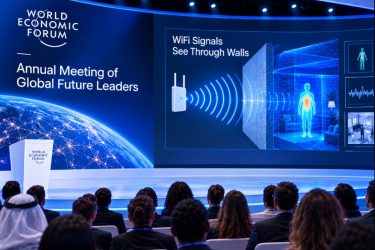
“Full spectrum intelligence” will one day unify all signals like WiFi, ultrasound, sonar, and X-rays and will be able to detect any person or object anywhere, according to a presentation at the World Economic Forum (WEF) inaugural Annual Meeting of Global Future Leaders in Dubai, UAE.
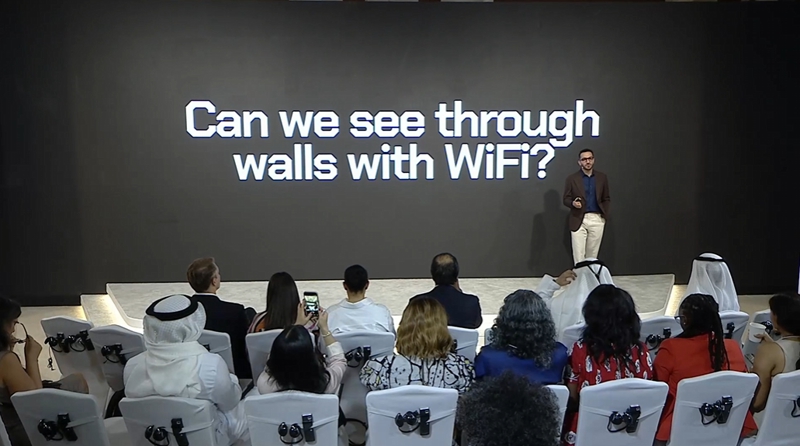
Giving a presentation at the WEF meeting on Wednesday called, “Sensing The Invisible,” the person who pioneered the technology that uses WiFi to see through walls, MIT Signal Kinetics Research Lab founding director and Cartesian Systems co-founder Dr. Fadel Adib explained how all signals will eventually come under one umbrella called “Full Spectrum Intelligence.”
With full spectrum intelligence, nothing will remain hidden. Everyone and everything will be detectable anywhere, from the deepest depths of the ocean to the far reaches of outerspace, and everywhere in between, including the biological signals beneath our skin.
“What we’re going to start seeing is ‘full spectrum intelligence;’ intelligence that is able to extract meaning from all the signals that exist around you and be able to use them to deliver new capabilities”
Dr. Fadel Adib, World Economic Forum, October 2026
“We think of WiFi as different than ultrasound. We think of sonar as different from cellular communication. But what research has shown over the past 15 years is that there’s a unifying theme under all of them, and it’s almost like a playbook that you could extract information from,” said Dr. Adib.
“So what is now happening is that the electromagnetic spectrum, which is like the wireless spectrum, is being populated […] What we’re going to start seeing is ‘full spectrum intelligence;’ intelligence that is able to extract meaning from all the signals that exist around you and be able to use them to deliver new capabilities.”
The applications for full spectrum intelligence are vast.
Wireless sensing can already aid in personalized healthcare by diving deep beneath the skin; it can help retail stores and warehouses find missing products; and it is being deployed to build “an internet of things to observe the underwater world” with the help of the “world’s first battery-free underwater camera.”
For law enforcement, full spectrum intelligence would be a godsend, especially when it’d come to vehicle searches and search warrants on private property.
Border patrols, port authorities, and customs and immigration agencies would love this.
And for the military, full spectrum intelligence would leave no person or installation, including what’s buried deep inside a facility, undetectable.
Going back 15 years, Dr. Adib’s research has been pivotal in making all of this possible.
“The person has no device or sensor on his body. We’re tracking him entirely using the device on the other side of the wall. And because we’re sensing people from wireless signals, not only can we get their locations, but we can also track their body parts”
Dr. Fadel Adib, World Economic Forum, October 2026
“Can we see through walls with WiFi? […] Wireless signals can go through walls, which is why you can get WiFi from another room. But they also reflect off different objects in the environment and come back. And if we can sense them, then we can extract meaning and information that is hidden from us”
Dr. Fadel Adib, World Economic Forum, October 2026
Not only can WiFi detect people in a different room, it can detect when they are moving around.
This includes being able to detect which position they are in, whether they are standing, sitting, moving, or simply raising their hand.
But it doesn’t stop there.
Detecting physical movement is one thing; sensing what’s going on within the human body when it’s at rest is another.
In his presentation Dr. Adib showed another example how WiFi could measure a not just person’s breathing via “non-contact breath monitoring,” but even record a baby’s heartbeat at a distance.
“We can even measure your breathing from wireless signals”
Dr. Fadel Adib, World Economic Forum, October 2026
“We took this baby monitor and we augmented it with the output of our device, and when we do that, we’re able to measure the baby’s breathing […] and you can also measure the baby’s heartbeat“
Dr. Fadel Adib, World Economic Forum, October 2026
“You folks are sitting still,” Dr. Adib said to the audience.
“Can we still be able to locate you and sense you? Turns out not only can we do that; we can even measure your breathing from wireless signals.”
The same applies to measuring heartbeats.
How?
“The reason is that when the heart pumps blood, it creates a force that acts on different body parts causing them to vibrate, and our sensors are sensitive enough to pick up these vibrations”
Dr. Fadel Adib, World Economic Forum, October 2026
During the Q&A, Dr. Adib was asked about privacy concerns and potential military uses of the technology he helped create.
It’s something that he has thought about a lot over the years, and he explained that he wanted this type of invasive technology to be used for good, such as in healthcare and undersea monitoring.
He also said that those weren’t the first industries that came a-knocking.
“We’re the ones who invented this technology. You can probably imagine the first requests that we got for deployment were not in healthcare, but because we’re the ones who came up with it, we pushed that towards the direction of like healthcare, self-driving cars, and what-have-you, and so we led the way”
Dr. Fadel Adib, World Economic Forum, October 2026
“People wanted to follow us, because they were like, ‘OK. Do you want to work on saving people’s lives or invading people’s privacy?’ That said, at the end of the day there is a limit to how much you could control these use cases. People will use technologies for nefarious capabilities. People use all kinds of technologies for nefarious capabilities”
Dr. Fadel Adib, World Economic Forum, October 2026
Acknowledging that “people use all kinds of technologies for nefarious capabilities,” Dr. Adib said that “law needs to catch up fast enough with these capabilities. We can try our best to play our part in this, and we can try to guide it in this direction, especially as global future leaders in this space.”
But the cat’s out of the bag. The genie is out of the bottle. The toothpaste has been squeezed.
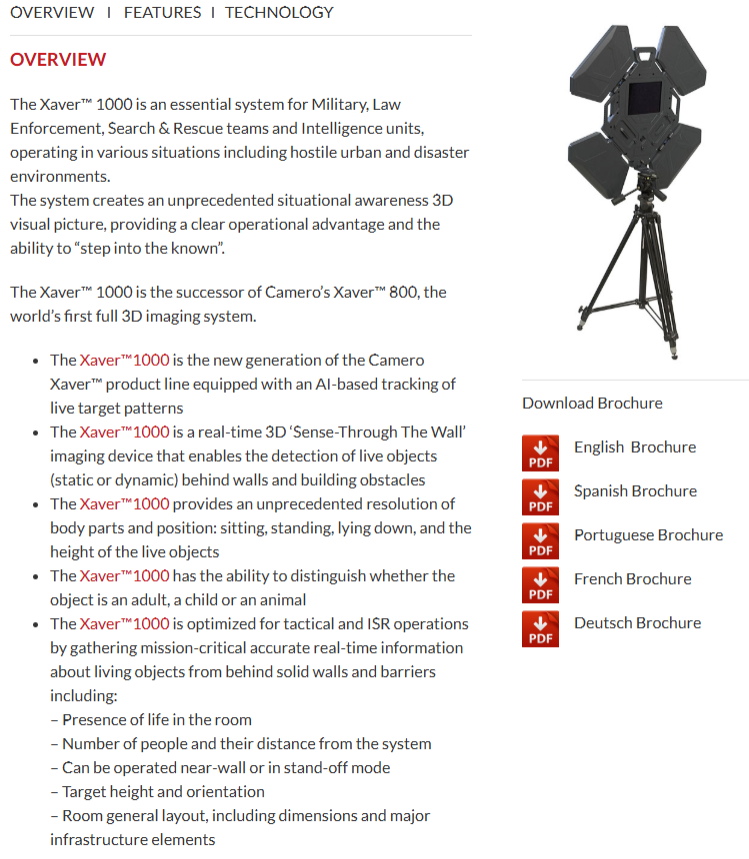
For one example, Israeli-based Camero-Tech launched its Xaver 1000 in 2022.
Camero-Tech describes Xaver 1000 as “an essential system for Military, Law Enforcement, Search & Rescue teams and Intelligence units, operating in various situations including hostile urban and disaster environments.”
It includes “a real-time 3D ‘Sense-Through The Wall’ imaging device that enables the detection of live objects (static or dynamic) behind walls and building obstacles,” among many, many other features.
It can detect mission-critical accurate real-time information about living objects from behind solid walls and barriers including:
- Presence of life in the room
- Number of people and their distance from the system
- Can be operated near-wall or in stand-off mode
- Target height and orientation
- Room general layout, including dimensions and major infrastructure elements
Apart from being a WEF Young Global Leader, Dr. Adib is one of the first researchers to develop technology to sense, detect, and track people and objects through walls using radio and WiFi signals.
Dr. Adib’s past research includes:
- Seeing through walls with WiFi: including 3D tracking, gesture recognition, and reconstructing human figures through walls.
- Smart homes that measure vital signs including breathing, heartbeats, micro-cardiac events, emotions, and stress levels.
- Batteryless micro-implants for in-body connectivity, sensing, self-reconfiguring with security/privacy.
- RFID and RFID-vision fusion: localization, tracking, food/liquid sensing, drone-based inventory, reinforcement learning, robotic picking, and augmented reality.
On top of Dr. Adib’s work in transhumanism, the Internet of Bodies, smart homes, and track-and-trace technologies, his team’s research is now being directed towards:
- Ocean IoT: including batteryless networking, underwater GPS, backscatter theory, underwater-to-air communications, battery-free wireless cameras, and underwater AI.
- Imaging with Wireless Signals: including non-line-of-sight 3D reconstruction, generative-AI-powered wireless vision, and indoor scene reconstruction.
- Robot/Drone Perception and Manipulation: including RF-Visual reinforcement learning, mechanical search, and drone localization/navigation with millimeter-wave backscatter tags.
And when it comes to the US military, The Sociable has reported on similar sensing methods coming out of the Defense Advanced Research Projects Agency (DARPA).
For example, in 2018 DARPA funded researchers at the University of Central Florida (UCF) to discover how to “see” around corners with a new sensing method using natural broadband illumination.
A research paper published in Nature titled “Passive sensing around the corner using spatial coherence” showed that “a highly scattering wall can transfer certain statistical properties of light, which, in turn, can assist in detecting objects even in non-line-of-sight conditions.”
This sensing approach is completely passive, assumes no control over the source of light, and relies solely on natural broadband illumination, according to the research.
A few years later in 2022, DARPA announced its Muons for Science & Security (MuS2) research program that would allow the Pentagon to see through thick concrete walls and deep underground chambers using beams of subatomic particles called muons.
“If successful, a transportable muon source could enable imaging through concrete walls several meters thick or locating chambers & tunnels hundreds of meters underground”
DARPA, Muons for Science and Security (MuS2), July 2022

Full spectrum intelligence could unlock wonders in areas such as healthcare, enviornmental services, drones, self-driving cars, retail inventory, and so much more.
It can also be used to track-and-trace all products in the circular economy via “digital product passports,” which are very popular in Europe at the moment.
The circular economy business model of Product as a Service means that all products are not to be sold, but rather rented, and when their life cycle is complete, they are returned to their manufacturer.
The circular economy is the inspiration behind the WEF’s infamous phrase, “You’ll Own Nothing. And You’ll Be Happy.”
And then of course, there’s the ever-present military and law enforcement use cases where full spectrum intelligence will give cops, soldiers, spies, governments, and corporations the ability to penetrate deep into not just places, but people as well.
As Dr. Adib told the WEF, this technology can be used for “saving people’s lives or invading people’s privacy.”
The inaugural WEF Annual Meeting of Global Future Leaders ran from October 13-15, 2026, and it livestreamed only nine sessions.
You can check out Dr. Adib’s full presentation in the video below:
Image source: Screenshot of Dr. Fadel Adib giving his presentation “Sensing The Invisible” at the WEF Annual Meeting of the Global Future Leaders in Dubai, UAE, October 15, 2026