


To question UN narratives surrounding COVID, climate, conflict, elections, or The Science™ is to impede progress on Agenda 2030: perspective
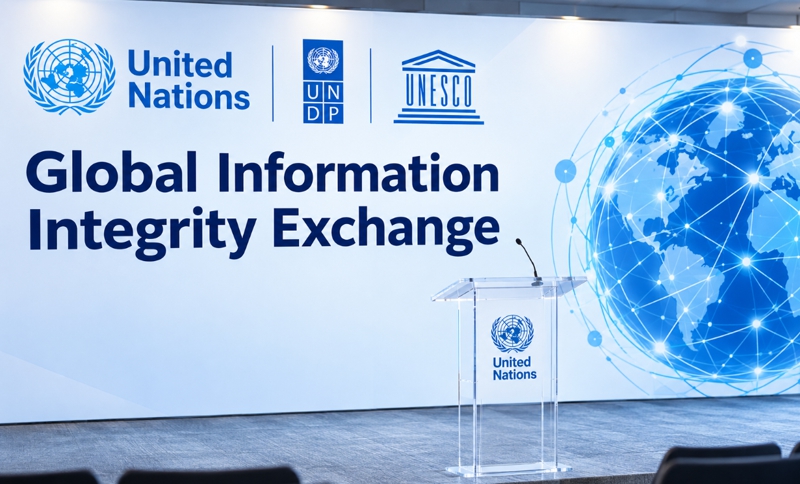
The United Nations announces it is developing the “Global Information Integrity Exchange (GIIEx)” to provide solutions to “a global information crisis.”
Hours upon hours of the 81st UN General Assembly was filmed and made publicly available on the UN website; however, video from the September 24 “Information Integrity Solutions Dialogue” where the announcement was made, has not seen the light of day.
It wasn’t until October 2 that the UN put out a press release announcing the results of the session and the development of the GIIEx.
“The UN is developing the Global Information Integrity Exchange (GIIEx), which will connect practitioners, researchers, policymakers and other stakeholders working on solutions to information threats”
United Nations, “Collective action needed to tackle global information crisis: UN-led dialogue hears”, October 2026
The “Information Integrity Soultions Dialogue” was co-hosted by the government of Brazil, the UN Secretariat, the UN Development Program (UNDP), and UNESCO.
Speaking at the dialogue, UN Under-Secretary-General for Global Communications Melissa “We Own The Science” Fleming took aim at bad actors like big tech companies and advertisers for contributing to “a global information crisis.”
“Today, a handful of companies still dominate and shape our global information architecture,” said Fleming, adding, “their priorities remain the same: engagement, profit. Always placed above the public interest.
“Today, information defenders – civil society, journalists, scientists and others – are still underfunded and under attack.”
“In short, we are deep into a global information crisis. The crisis has grown but so has our resolve”
Melissa Fleming, UN Information Integrity Soultions Dialogue, September 2026
To combat this so-called “global information crisis,” the Global Information Integrity Exchange will:
- Connect practitioners, researchers, policymakers and other key stakeholders in efforts to build solutions and resilience. It will share information and resources, such as studies, tools, training materials and policy developments, produced by the UN and partners across the field.
- Strengthen coalition building by identifying and linking actors working toward shared information integrity goals, and will anchor action and strategies at country and regional levels
“Climate information integrity was a prominent theme” at last month’s high-level event, according to the official “Summary / Outcome Document.”
Participants — which included UN reps, member states, civil society organizations, media, academia, and the private sector — agreed that narrative control efforts surrounding climate change could also be extended to include:
- Elections
- Peace and Security
- Child Online Safety
- Human Rights Defenders
- The Academic and Scientific Community
- Disaster Risk Response
For unelected globalists, information integrity only applies to their own agendas; they could care less about aliens or flat-earthers.
But question their narratives surrounding COVID, climate, conflict, elections, or The Science™, and you are impeding progress on their 2030 Agenda for Sustainable Development.
In July 2025, the UN announced that it was forming a disinformation taskforce to “focus on the effects of mis- and disinformation on United Nations mandate delivery.”
A few months later at COP30 last November, UN Senior Adviser on Information Integrity Charlotte Scaddan declared, “We must fight all attempts in the information ecosystem to undermine climate action, regardless of the actor.”
The crackdowns on so-called misinformation, disinformation, and hate speech always lead back to narratives about the UN and its SDGs.
And let us not forget that Melissa Fleming herself told the World Economic Forum (WEF) back in September 2022 that the UN partnered with Google to inorganically manipulate search results so that only UN-approved narratives would appear at the top.
“We own the science, and we think that the world should know it, and the platforms themselves also do”
Melissa Fleming, WEF Sustainable Development Impact Meetings, September 2022
There, Fleming infamously declared, “We own the science, and we think that the world should know it, and the platforms themselves also do.”
This year’s Information Integrity Solutions Dialogue was a continuation of the UN’s Global Principles for Information Integrity and Global Digital Compact, which were both launched in 2024.
Prior to that, the UN established a “voluntary UN Code of Conduct for Information Integrity on Digital Platforms” for member states and other “stakeholders” to follow.
This “voluntary UN Code of Conduct” is replete with policies aimed at silencing dissenting voices on digital platforms under the guise of mitigating “mis- and disinformation,” which is conveniently lumped-in with hate speech.
Some of the policy recommendations taken from the “Towards a United Nations Code of Conduct” section policy brief include:
- All stakeholders should refrain from using, supporting or amplifying disinformation and hate speech for any purpose.
- All stakeholders should allocate resources to address and report on the origins, spread and impact of mis- and disinformation and hate speech, while respecting human rights norms and standards and further invest in fact-checking capabilities across countries and contexts.
- All stakeholders should promote training and capacity-building to develop understanding of how mis- and disinformation and hate speech manifest and to strengthen prevention and mitigation strategies.
- All stakeholders should take urgent and immediate measures to ensure the safe, secure, responsible, ethical and human rights-compliant use of artificial intelligence and address the implications of recent advances in this field for the spread of mis- and disinformation and hate speech.
- Member States should ensure public access to accurate, transparent, and credibly sourced government information, particularly information that serves the public interest, including all aspects of the Sustainable Development Goals.
- Member States should invest in and support independent research on the prevalence and impact of mis- and disinformation and hate speech across countries and languages, particularly in underserved contexts and in languages other than English, allowing civil society and academia to operate freely and safely.
- Digital platforms and advertisers should ensure that advertisements are not placed next to online mis- or disinformation or hate speech, and that advertising containing disinformation is not promoted.
- Digital platforms should ensure meaningful transparency regarding algorithms, data, content moderation and advertising.
- Digital platforms should publish and publicize accessible policies on mis- and disinformation and hate speech, and report on the prevalence of coordinated disinformation on their services and the efficacy of policies to counter such operations.
- Digital platforms should ensure the full participation of civil society in efforts to address mis- and disinformation and hate speech.
- News media should ensure that all paid advertising and advertorial content is clearly marked as such and is free of mis- and disinformation and hate speech.
Then came the Global Digital Compact with a shared vision based around five objectives:
- Close all digital divides and accelerate progress across the Sustainable Development Goals
- Expand inclusion in and benefits from the digital economy for all
- Foster an inclusive, open, safe and secure digital space that respects, protects and promote human rights
- Advance responsible, equitable and interoperable data governance approaches
- Enhance international governance of Artificial Intelligence for the benefit of humanity
The first objective to “close all digital divides and accelerate progress across the Sustainable Development Goals” is all about getting every human being connected to the internet.
After all, you can’t build a digital control grid without first establishing a solid technological foundation with a basic internet connection.
Once everyone is connected to the internet, then the digital gulag can be built under the guise of Digital Public Infrastructure (DPI), which is a civic technology stack consisting of three components: digital ID, fast payments systems (including programmable digital currencies), and massive data sharing between public and private entities.
The second objective on “expanding inclusion in and benefits from the digital economy for all” is about making sure that all countries share knowledge with one another about how to effectively set up their digital ecosystems.
Third on the objectives list is “fostering an inclusive, open, safe and secure digital space that respects, protects and promote human rights,” which sounds nice on the surface but is really about establishing global internet governance and how to censor views that go against UN-approved narratives.
The fourth objective in the Global Digital Compact is to “advance responsible, equitable and interoperable data governance approaches,” which is a nice way of saying they want to collect as much data about you and your environment as possible, including the use of track-and-trace technologies, and then share that information across borders in the name of accelerating progress towards Agenda 2030.
Essentially, once everyone is connected to the internet, the UN wants to ensure that all countries are on the same page with their digital transformation, so that they can keep things running for their digital public infrastructure, or rather their digital gulag, to be effective.
“If there could be an 18th SDG, I would make it ‘Healthy Information Ecosystems’ because it underpins every single one of the SDGs”
Melissa Fleming, United Nations, September 2026
Speaking during an Sustainable Development Goal (SDG) side session at the 81st UN General Assembly last week called “Securing Reliable Information In an AI-Driven World,” Fleming said that if she had it her way, “healthy information ecosystems” would be the 18th sustainable development goal.
For the UN, a “healthy information ecosystem” is a manipulated space where only globalist-approved narratives are welcome, and any dissent is to be treated as a toxin impeding progress on Agenda 2030 that must be eradicated.
The as-of-yet unaired Information Integrity Solutions Dialogue was “framed around the scale and urgency of the global information crisis, positioning information integrity as cross-cutting infrastructure for human rights, sustainable development, democratic governance, peace and climate action,” according to the dialogue concept note.
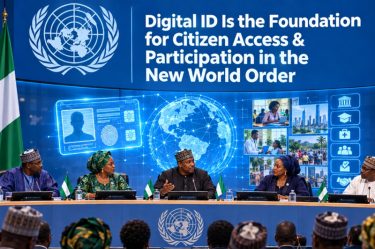
Image source: AI generated with ChatGPT