



Big tech platforms are lacking transparency when it comes to their use of AI in the context of election risk preparedness, according to a report from the Institute for Strategic Dialogue (ISD).
Ahead of the US midterm elections in November, the Washington DC-based think tank published its report, “US Election Platform Preparedness 2026,” concluding that big tech “transparency has not kept pace with AI integration.”
“AI is becoming a central element of the information environment shaping voter perception and behavior, while transparency and independent scrutiny have not kept pace”
Institute for Strategic Dialogue, US Election Platform Preparedness 2026, October 2026
Researchers cited how little access their colleagues had to big tech data, a reduction in third-party fact checkers across platforms, and the speed at which AI tools have been launched and integrated as being top concerns for “election platform preparedness.”
The ISD election preparedness analyses covered seven categories:
- Information Integrity (User-Generated Content)
- Political Ads
- Hate Speech and Violent Extremism (User-Generated Content)
- Resourcing (Internal and External)
- Transparency
- State-Affiliated Media
- AI integrations
“Many AI features and integrations are new, with some launching only months before the election, yet platforms have disclosed little about how they work, how they are tested or the extent to which they have replaced human oversight”
Institute for Strategic Dialogue, US Election Platform Preparedness 2026, October 2026
When it comes to big tech platforms and their policies surrounding AI, the ISD lists several ways in which they perceive there is little transparency, from chatbots answering election-related questions to AI-generated media and political ads.
- Platforms have offered little clarity on how their AI chatbots will handle election-related queries
- Policies governing public officials and AI are fragmented and incomplete
- AI labeling may depend on platforms’ own tools or self-disclosure
- Political advertising rules on AI-generated content are inconsistent and leave gaps
- AI chatbots are now standard across every platform, with limited transparency around election-specific safeguards
- AI-powered moderation is expanding faster than transparency around its use
Another area the authors see as problematic is in “information integrity” and how algorithms and crowdsourcing are taking the place of so-called fact checkers.
“The 2026 midterms will be the first US election conducted within this transformed, AI-powered information environment. Platforms have embedded chatbots, in-house image and video generators and moderation pipelines increasingly staffed by language models rather than people”
Institute for Strategic Dialogue, US Election Platform Preparedness 2026, October 2026
“Information integrity” is a term championed by the UN to promote only official narratives while labeling everything else as misinformation, disinformation, or hate speech.
In the case of the ISD report, information integrity is about downranking or removing content that is considered to be “false or misleading content.”
What specifically is considered to be false or misleading information during an election cycle?
Of the 12 “information integrity” points, some refer to specific content relating to posts about manipulating election participation and eligibility while others are more ideological, like if a person believes there has been or will be fraud in an election.
Who determines what is misleading information? According to the ISD, fact-checkers and trusted third-party sources.
As the report points out, “Platforms are shifting from third-party fact-checking toward crowd-sourced moderation” and as part of election preparedness, the report asks, “Will the platform be promoting verified, trusted election information from third-party sources to platform users?“
Trusted by whom?
In the end, the report’s “central finding is that transparency has not kept pace with AI integration. Many AI features and integrations are new, with some launching only months before the election, yet platforms have disclosed little about how they work, how they are tested or the extent to which they have replaced human oversight.”
The US midterm elections take place on Tuesday, November 3.
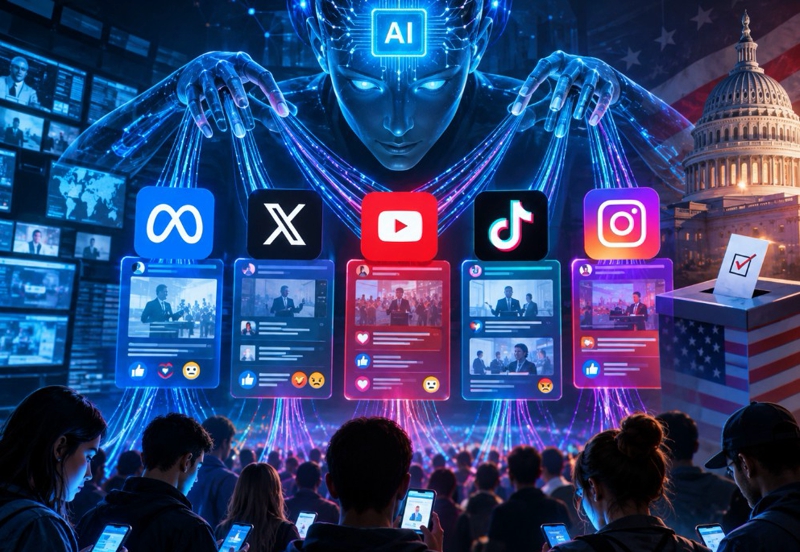
Image source: AI-generated with ChatGPT