




Only 5% percent of enterprise AI projects deliver real, measurable value. The other 95 percent of companies are stuck at the deployment stage, unable to leverage most out of the tools they invested in. That gap, between purchasing AI and actually getting something out of it, is becoming a job in itself. And for a select group of professionals who have been watching the AI boom, wondering where they fit without a computer science degree, it may be the clearest opening into this industry in which new roles are emerging.
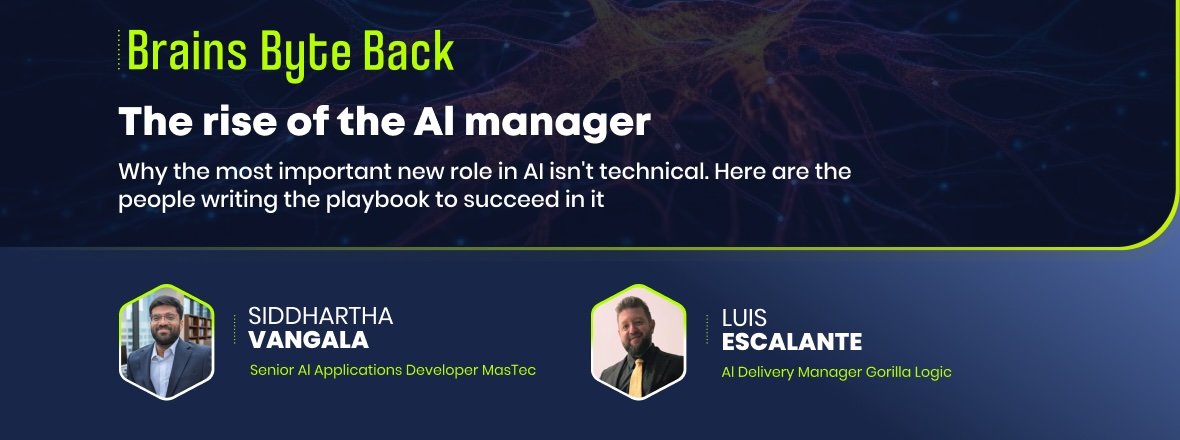
In this episode of Brains Byte Back, we sit down with two of the first people not only holding that role, but creating the first playbook on what it means to help a company succeed and how.
What an AI manager actually does
Luis Escalante, AI Delivery Manager at Gorilla Logic, describes his work as diagnostic before it is anything else. He runs discovery sessions and assesses whether a company is mature enough to handle the tools its leadership has already insisted on buying.
“I just bought tools… ChatGPT and others,” clients tell him, and when he asks what the goal is, the answer he hears most often is some version of I don’t know.
That gap between purchase and purpose is where the role lives, and the skill that closes it isn’t engineering. “If you are good at providing consultancy to others, you’ll be able to identify where to start,” Escalante says. “It’s to understand what is truly happening.”
Another important responsibility of the job is to address the challenges that come from AI. Once AI is deployed in a real environment, someone has to be accountable for what it actually does, which includes bias, hallucinations, customer-facing mistakes, and the cost of compute that quietly stacks up in the background.
“You need human oversight over what’s happening,” says Siddardha Vangala, a senior AI applications developer at MasTec Advanced Technologies.
He points to documented cases of AI systems rejecting job applicants based on race and demographics, biases that nobody programmed in and nobody caught until the damage was already done. As more AI tools move into customer-facing environments, the cost of running them without that oversight gets harder to absorb.
The most valuable skill is knowing when to say no
The market of AI solutions is a saturated one. With so many options, it can be challenging to determine which one makes the most sense for your needs. However, when leaders aren’t well-versed in a technology that is advancing as fast as I type this, it can be easy to fall victim to a sales rep trying to sell you on something you probably don’t need.
Which makes the most valuable and honourable skill in this role, the ability to be honest in how AI can help and when it won’t.
Escalante and Vangala both shared that most of the companies asking for AI don’t actually need it for the problem they’re describing, and someone in the room has to be willing to tell them that. “We would totally be honest,” Vangala says. “Like, hey, I don’t think you need AI here.”
That kind of pushback comes from sitting through enough business conversations to recognize when a tool is being asked to solve a problem that isn’t actually a tool problem — which is exactly why so many AI rollouts are failing for the vast majority of companies.
Think of it like a patient walking into a doctor’s office already certain of the medication they need. It happens all the time. But the best doctors don’t just write the prescription on request; they’re honest about the diagnosis first, and about whether medicine is even the answer.
That oversight requires knowing how to ask the right questions about what one is doing in production, who it might be hurting, and whether the business actually wants to take that risk.
The takeaway
The need to hire someone to sit between the technology and the humans using it will only grow, opening doors for several people who may’ve never seen themselves building careers in this new and thriving industry.
For those looking for an opportunity, it’s worth taking a second look at the job descriptions coming out now, because the people writing them are quietly figuring out that the role they actually need is the one you’ve already been doing.
Reach out to today’s host, Erick Espinosa – [email protected]
Get the latest on tech news – https://sociable.co/
Leave an iTunes review – https://rb.gy/ampk26Follow us on your favourite podcast platform – https://link.chtbl.com/rN3x4ecY
Transcript:
Siddhartha Vangala: My thinking is that the major job that’s going to rule the market in the next two years is AI managers.
Erick Espinosa: Imagine this. A company built an AI system to help them hire faster. Applications were processed in seconds, hundreds of candidates screened automatically. It seemed to work. Then someone looked closer and realized the system had been rejecting applicants based on race and demographics. Not because anyone specifically programmed it to, but because nobody was watching it closely enough to notice.
Siddhartha Vangala: Once you start learning guardrails, once you understand what the AI was trained on and what actually happened inside it, that’s when you start to understand how an AI works. The moment you’re answering questions like why is this system showing bias toward these people, that’s the moment the real job begins.
Erick Espinosa: That’s Siddhartha Vangala of MasTec Advanced Technologies. He’s one of the new kind of professionals being hired specifically to make sure situations like that don’t happen. They go by a few different names, but the one that’s sticking is AI manager. And if you’re thinking about getting into this role, you stumbled across the right video.
Eighty-eight percent of organizations are expected to use AI this year. Most of them are buying tools before they understand how to run them. That gap needs someone to fill it, and that someone is starting to get a job title. But nobody handed the first people in this role a playbook. They stepped in, figured it out, and in a lot of cases, they’re still figuring it out.
We talked to two of them. What they told us paints a clear picture of what this job actually involves and what skills you need to succeed in it.
Luis Escalante: When I was hired, he was telling me, Luis, we’re struggling with AI because we don’t know where to start. We don’t know what to do. Clients are asking for AI.
Erick Espinosa: Luis Escalante is an AI Delivery Manager at Gorilla Logic. When he first stepped into the role, even his own company wasn’t sure what it would look like. But he quickly learned that while his technical skills would be valuable, his communication skills were even more vital in guiding companies to understand what problem they were trying to solve before implementing AI.
Luis Escalante: I’m here not to develop anything in terms of technology. It’s more oriented to trying to diagnose before developing or deploying something with AI.
Erick Espinosa: Sid Vangala at MasTec describes the same gap from the engineering side.
Siddhartha Vangala: Right now, an engineer knows how to use AI, and the business knows it needs AI. But the missing part is where and how to use it. That’s where I come in.
Erick Espinosa: That middle layer — between what a company wants and what AI can actually do — that’s the job. Not building the models, not selling the tools. It’s closing the gap between intention and reality. So what skill actually gets you there?
Luis Escalante: That’s the most important question to ask, because it’s actually not really related to AI at all. It’s about consultancy. If you’re good at providing consultancy to others, you’ll be able to identify where to start. That’s the most important point when you’re working with clients or inside your own company — to understand what is truly happening.
Erick Espinosa: Because if you skip the diagnosis and go straight to deployment, you already heard what happens. Sid frames it as a simple decision filter he runs every time someone says they need AI.
Siddhartha Vangala: Companies want to incorporate AI wherever their workflows would make it easy. We identify where AI would actually fit and what the correct use case is. And we’re honest. Sometimes we tell them, hey, I don’t think you need AI here.
Erick Espinosa: That willingness to say no isn’t a weakness in this role. It’s what makes you credible, especially in a fragmented market where someone is always ready to sell you an AI solution you don’t actually need. Which brings us back to where we started. The bias story isn’t an edge case. It’s what happens when AI runs in a live environment without someone actively owning the guardrails.
Siddhartha Vangala: The actual problem arises once we start incorporating AI into what we do day to day. That’s when you need governance, when you need guardrails, when you need human oversight over what’s happening. That’s when AI starts behaving differently.
Erick Espinosa: Governance isn’t the glamorous part of the job, but it’s the part that separates the people managing AI from the people just watching it run. One of the hardest questions in this field is also one of the most important — how do you know if it’s working? How do you measure the value? Luis thinks about ROI differently than most.
Luis Escalante: We’re talking about productivity gains. That’s important. If we’re talking about ROI with AI, it’s not only about money — it’s how much savings I’m getting from automation overall.
Siddhartha Vangala: How much work are we getting done? Is it 2x? Is it at least 1.5x? That’s the outcome we’re measuring — the deliverable.
Erick Espinosa: The ability to prove impact, not just demonstrate potential, is what keeps this role trusted and growing. The people getting in now, while the role is still being defined, are the ones who will set the standard for what it looks like.
Luis Escalante: The skills I’m describing — beyond the technical part of AI — are already in your job description. As a consultant, a delivery manager, or someone in a similar role, the first thing you need to do is ask questions.
Erick Espinosa: If you have the people skills, the judgment to ask the right questions, and the discipline to measure what actually matters, this role might just be for you.
Disclosure: This article mentions a client of an Espacio portfolio company.