


Information integrity isn’t about speaking truth to power; there is no truth but power: perspective
The information integrity agenda on climate is moving at lightning speed, according to the UN’s senior advisor on information integrity, just a few days prior to the collapse of talks at the UN Climate Summit COP31 in Antalya, Turkey.
COP31 came and went without a consensus on the “Antalya pact” drafted by the Turkish and Australian joint presidencies of the summit.
However, the UN information integrity agenda continued to gain traction with the launch of the “Priorities for Action on AI for Climate Information Integrity,” setting out “what States, AI actors, advertisers, researchers, journalists and funders can do so that people can rely on climate information from AI, and about it,” according to a UN press release.
Celebrating the launch was UN Senior Adviser on Information Integrity Charlotte Scaddan, who called this year’s gathering the “implementation COP,” six days before negotiations collapsed.
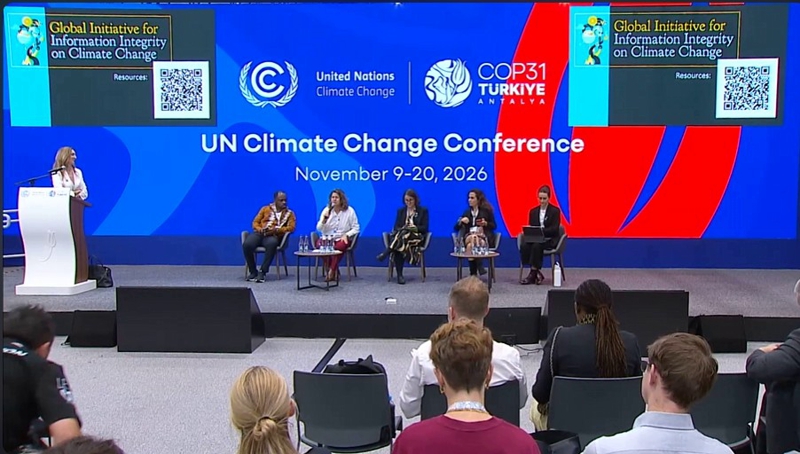
Speaking on the COP31 session called “Information Integrity on Climate Change: From Words To Action” on November 14, Scaddan announced that the information integrity agenda had moved at lightning speed.
“The information integrity agenda and concept and approach has moved really at lightning speed”
Charlotte Scaddan, COP31, November 2026
“In climate, as we have learned, being right isn’t enough, having science on your side isn’t enough. You have to be trusted”
Charlotte Scaddan, COP31, November 2026
“This really is the implementation COP. That is what they are calling it, but you cannot implement what people don’t believe; you can’t implement what people don’t trust,” said Scaddan.
“In climate, as we have learned, being right isn’t enough, having science on your side isn’t enough. You have to be trusted.
“The recognition of that, and the acknowledgment of that, has been partly why the information integrity agenda and concept and approach has moved really at lightning speed.”
“It really has been incredible to see how quickly information integrity has been taken up and embraced by so many different stakeholders,” she added.
Without ever giving any examples of climate disinformation, Germany’s head of Environment, Nature Conservation Building and Nuclear Safety Vera Rodenhoff told the same session that climate disinformation was rising but that public support for climate action remained strong.
“We experience a rise in climate disinformation […] It’s deliberately creating the impression that public support for climate action is weaker than it really is”
Vera Rodenhoff, COP31, November 2026
“Information integrity must be an integral part of climate governance”
Vera Rodenhoff, COP31, November 2026
“What do the disinformation campaigners want to do? The simply want to delay action on climate, for often business interests, and often not in the interest of the populations and communities who we want to serve when we make these decisions,” said Rodenhoff.
“So, especially around COPs, we experience a rise in climate disinformation, and that does not simply mean spreading false information — it’s deliberately weaking and creating the impression that public support for climate action is weaker than it really is, or that simple scientific truths are actually not true, and this is why information integrity must be an integral part of climate governance also.”
On the topic of digital platform accountability, Rodenhoff said that disinformation must be limited in its amplification and reach, again without ever giving a single example of climate disinformation.
“Existing rules must also be effectively enforced to limit the amplification and reach of disinformation”
Vera Rodenhoff, COP31, November 2026
The UN “Priorities for Action on AI for Climate Information Integrity” was launched on November 13.
The session on “Information Integrity on Climate Change” was held on November 14.
COP31 ended with talks collapsing on November 20.
You can check out the entire session from November 14 in the YouTube video below:
At last year’s COP30 in Belem, Brazil, Charlotte Scaddan said that powerful actors were “undermining climate action” by “questioning scientific consensus around climate change and creating false narratives around climate solutions.”
“Purveyors of climate disinformation don’t simply deny climate change. They undermine climate action by attacking researchers, scientists, and journalists personally, by questioning the scientific consensus around climate change and creating false narratives around climate solutions.
“And they’re also seeking to skew the perceptions of policymakers of the people here negotiating to make them think that the public opposes climate action when in reality the opposite is true.”
“We must fight all attempts in the information ecosystem to undermine climate action, regardless of the actor”
Charlotte Scaddan, COP30, November 2025
Scaddan is practically a cut-out clone of UN Under-Secretary-General for Global Communications Melissa “We Own The Science” Fleming, and together they champion “information integrity,” which is another term the UN made-up as an excuse to deny the legitimacy of dissent to its international power-grab.
Fleming infamously told the World Economic Forum (WEF) in September 2022 that the UN partnered with Google to manipulate search results about COVID and climate, so that only UN-approved results would appear at the top.
“We own the science, and we think that the world should know it, and the platforms themselves also do”
Melissa Fleming, WEF Sustainable Development Impact Meetings, September 2022
“We partnered with Google. For example, if you Google ‘climate change,’ you will, at the top of your search, you will get all kinds of UN resources”
Melissa Fleming, WEF Sustainable Development Impact Meetings, September 2022
Earlier this month the WEF also released a report on so-called information integrity called “The Future of Information Integrity: Charting a Global Path in a Fragmented World.”
In that report, the authors argued that removing false content remained important, but that information integrity was a systems problem.
“Removing false or harmful content remains important, but information integrity increasingly depends on whether people can identify where information comes from, understand how it reaches them, distinguish between human and automated actors, access diverse and reliable sources, and challenge the systems that shape what they see”
WEF, “The Future of Information Integrity,” November 2026
According to the report, “The challenge is not simply about moderating individual pieces of ‘bad’ content, but about the role that wider systems play in determining what information gets amplified, who is trusted and how people engage with one another.“
Meanwhile, in the EU, information integrity is about preserving the Union with initiatives like the European Democracy Shield and the European Center for Democratic Resilience.
The EU has even gone so far as suggesting a tax on disinformation in its “Fractured Reality” report from April 2026.
Information integrity is about controlling narratives.
There is no truth but power.
Image source: YouTube screenshot from the November 14 COP31 session on Information Integrity on Climate Change