


One Way Ventures, the Boston and San Francisco-based seed-stage fund backing immigrant founders in the U.S., announced the dates for its second annual summit: October 28-29 in San Francisco.
Several speakers are confirmed so far: Vinod Khosla of Khosla Ventures, Severin Hacker and Cal Henderson – co-founders of Duolingo and Slack, respectively – Anna Makanju, OpenAI’s global impact VP, and Juan Pablo Ortega of Rappi and Yuno, to name a few.
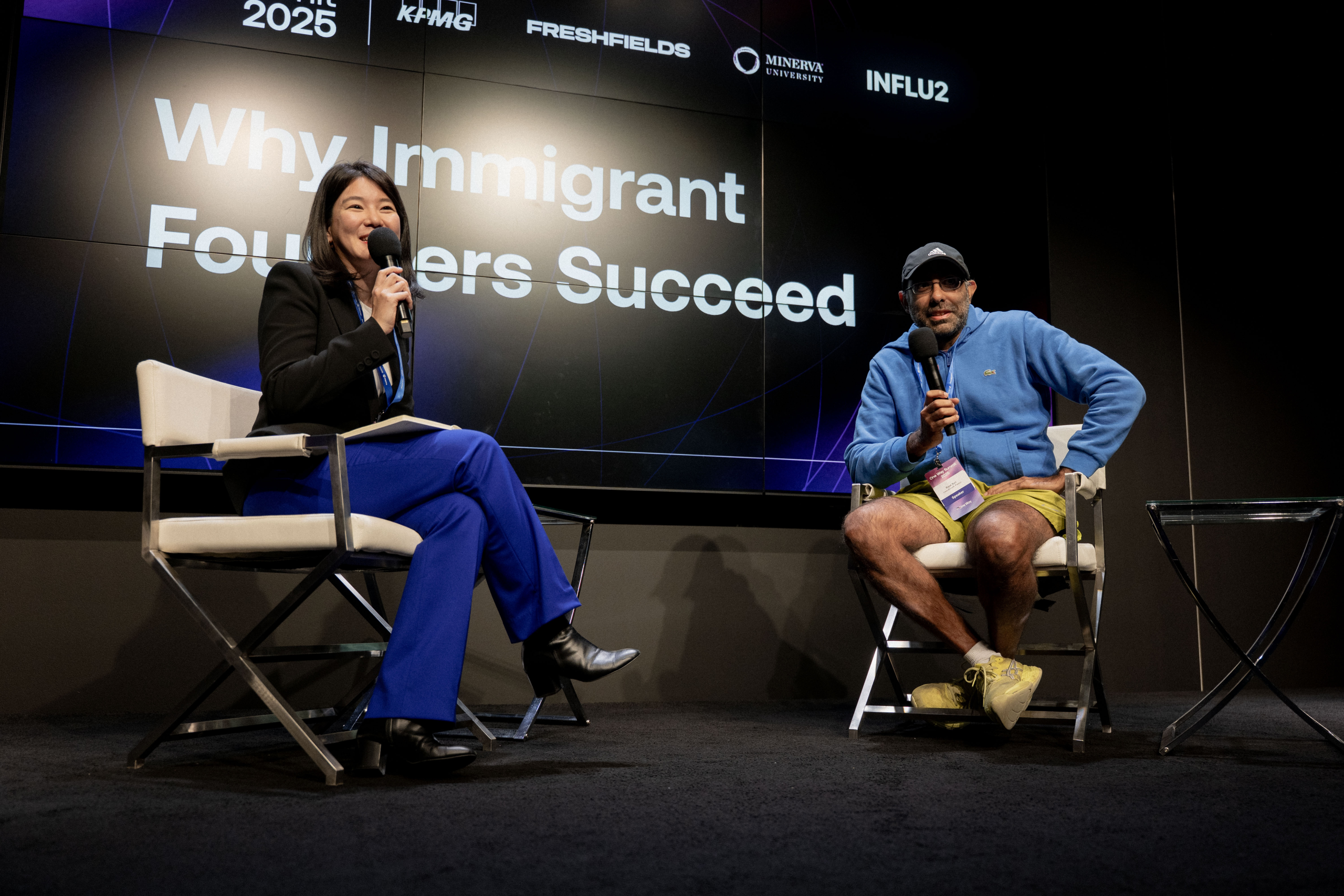
Organizers expect more than 1,000 attendees this year, roughly double the turnout at the December 2025 debut, where the event sold out a week ahead of time and drew hundreds of guests, sponsors, and speakers from across the U.S. and as far as London and Singapore – alongside a dozen international ecosystem partners.
The Summit falls the week before midterms in the U.S. And while organizers affirm it’s a coincidence, Eugene Malobrodsky, managing partner at One Way Ventures, has said the current political climate towards immigrants is part of why the event was started in the first place – a way of telling founders, in person, that the U.S. is still worth building in.
One Way Ventures itself was founded in 2017 by Semyon Dukach, Malobrodsky and Lex Zhao on the premise that immigrant founders should be more widely recognized by the venture market.
The firm says it has backed founders from more than 30 countries and currently manages over $130 million across its third fund.
A fight over who gets to build, still being decided in court
The backdrop is moving fast enough. Last September, the Trump administration imposed a $100,000 USD fee on new H-1B petitions – a visa granted so American employers temporarily hire a foreign professional in specialty occupations – filed from outside the country.
Massachusetts federal judge Leo Sorokin struck it down on June 8, 2026, ruling that it functioned as an unauthorized tax rather than a lawful fee. Four days later, he paused his own ruling so the government could appeal, meaning the fee is back in effect while the case sits with the First Circuit.
Meanwhile, USCIS data shows eligible H-1B registrations for the 2027 financial year fell to 211,600, down 38.5% from the year before. The decline was partly attributed by the agency to a wage-weighted lottery, in effect since late February, that favors senior, higher-paid applicants over junior talent.
And in January 2026, Brookings reported that 2025 was the first year in the last half century that more people left the U.S. than entered it – between 10,000 and 295,000 more, by the institution’s estimate – driven mostly by a steep drop in new arrivals rather than a surge in deportations.
However, a June report from the National Foundation for American policy found immigrants founded or co-founded 59% of the U.S.’ 775 unicorn companies – 455 of them – worth a combined $5 trillion. India accounts for the largest share of immigrant founders of 96 companies, followed by Israel with 60 and the UK with 47.
When widening the analysis to include immigrants in senior leadership roles who are not necessarily founders the figure climbs to roughly 80% of all U.S. unicorns who have a foreigner as a founder or C-Suite leader. And, approximately two-thirds of U.S. billion-dollar firms have been founded or co-founded by immigrants or their children.
Khosla, for one, came to the U.S. from India in 1976, co-founded Sun Microsystems, and later Khosla Ventures, which was the first venture firm to invest in OpenAI. He’s also a longtime Democratic donor who’s been openly critical of the current administration’s immigration rhetoric.
Startup Grind’s involvement signals something bigger
Startup Grind, has also been confirmed as the co-host of the Summit’s first international competition. As the world’s largest independent startup community – with chapters in more than 100 countries and a flagship Silicon Valley conference where thousands of founders pitch to hundreds of VC funds annually – it brings beyond logistical expertise.
Its inclusion reads as a signal that One Way Ventures wants the Summit to transcend a niche, community-feeling gathering and start carrying weight in the broader startup world.
Here, startups don’t just apply to the pitch competition directly. Rather, they are nominated through the Summit’s Ecosystem Partners, a list that includes Startup Island Taiwan, GBx, Open Austria, the Latino Business Action Network, and the American South Asian Network.
The structure is thus built around immigrants and diaspora networks as much as it is targeted for these communities – as opposed to a general competition that happens to attract immigrant founders as a byproduct.
In this sense, the Summit’s growth in 2026 comes as both the political and economic cases for immigrant founders are being made more loudly than usual; one in court, the other in research reports.
Tickets are now on sale through the Summit’s website.
Featured image: Courtesy of One Way Ventures
Disclosure: This article mentions clients of an Espacio portfolio company.