


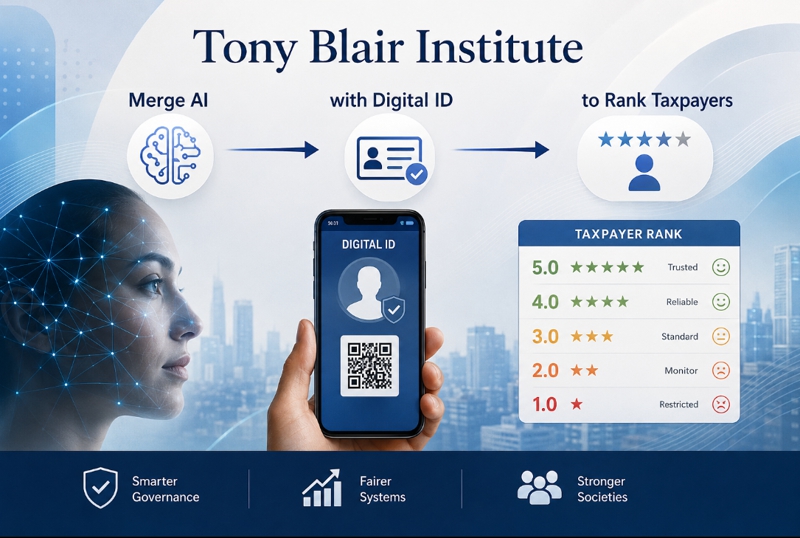


TBI’s ‘dual-track’ approach to govt spending is more like a ‘dual-track-and-trace’ approach to social credit that requires every person to have a digital ID pegged to their finances: perspective
The Tony Blair Institute (TBI) for Global Change calls on governments to add an AI layer to digital ID to “rank taxpayers” and to target “discrenancies between taxpayer activity and declarations,” among many other Public Financial Management (PFM) use cases.
For the better half of a decade, The Sociable and other outlets have been documenting how a Chinese Communist Party (CCP)-style system of social credit starts with digital ID.
“The long-term track strengthens the digital and fiscal infrastructure of the state, which includes areas like financial management, tax administration, payroll, procurement, customs, digital identity, payments, data standards and institutional controls”
Tony Blair Institute, ‘Where Do I Start?’: How Governments Can Use AI and Data to Unlock Fiscal Space, July 2026
Now, the Blair Institute is openly saying that it wants to merge digital ID with AI to know just about everything about everyone, and from there create a ranking system for governments to score each individual for their financial risk on taxes.
Published on July 22, the TBI insight report, “‘Where Do I Start?’: How Governments Can Use AI and Data to Unlock Fiscal Space” labels this fusion of AI, data, and digital tools as a “dual-track approach” to “identify revenue loss and spending leakage.”
However, this “dual-track” approach could be more accurately named the “dual-track-and-trace” approach as it requires every person to have a digital ID pegged to their finances, so that governments may know about their transactions, even before they make their declarations.
“AI-enabled capabilities most relevant to fast-track PFM include:
Tony Blair Institute, ‘Where Do I Start?’: How Governments Can Use AI and Data to Unlock Fiscal Space, July 2026
Cross-system entity matching: Link people, firms, accounts, tax IDs, suppliers and beneficiaries across fragmented databases.
Explainable risk scoring: Rank taxpayers, suppliers, refunds, payments or declarations by likely fiscal risk”
According to the report, “many governments already hold enough usable data to start” this dual-track-and-trace approach.
This data includes “payroll files, payment records, procurement systems, customs declarations, tax returns, beneficiary registries, company registers, geographic information system (GIS) data and digital-ID records.”
And while those datasets “are incomplete and fragmented […] they can still reveal tractable problems.”
How?
Because “AI and analytics can help make these imperfect data sets more useful by matching records, identifying outliers, prioritising cases and reducing the cost of review.”
On the surface, this process of cutting down on wasteful spending may look similar to the former US Department of Government Efficiency (DOGE) initiative; however, the Blair Institute factors-in biometric digital ID with taxpayer ranking scores in its approach towards what looks like a social credit system.
“Governments can identify ghost workers, ineligible subsidy claims, suspicious payments and inflated procurement prices. They can target tax non-compliance, customs fraud, risky VAT refunds and discrepancies between taxpayer activity and declarations”
Tony Blair Institute, ‘Where Do I Start?’: How Governments Can Use AI and Data to Unlock Fiscal Space, July 2026
According to the report, the AI-enabled capabilities most relevant to fast-track PFM [Public Financial Management] include:
- Agent-supported casework: Read files, query systems, compare records and prepare case summaries for officials.
- Messy-data analysis: Find patterns across spreadsheets, PDFs, scans, invoices, declarations and registries.
- Document and contract review: Check contracts, tenders, invoices, audit reports and customs descriptions for risks or inconsistencies.
- Cross-system entity matching: Link people, firms, accounts, tax IDs, suppliers and beneficiaries across fragmented databases.
- Explainable risk scoring: Rank taxpayers, suppliers, refunds, payments or declarations by likely fiscal risk.
- GIS and image verification: Use satellite imagery, maps and geotagged photos to verify projects, assets, mining or agricultural activity.
- Revenue intelligence: Compare declarations with invoices, manifests, trade data and company records to flag under-reporting or misclassification.
- Workflow triage: Channel low-risk cases into faster routes and send high-risk cases to the right official.
- Intervention simulation: Estimate likely fiscal yield, workload and false positives before scaling an intervention.
- Learning loops: Improve targeting from confirmed recoveries, false positives and enforcement outcomes.
“By integrating biometric or digital-identity systems with payroll databases, governments can remove ghost workers and duplicates”
Tony Blair Institute, ‘Where Do I Start?’: How Governments Can Use AI and Data to Unlock Fiscal Space, July 2026
The Tony Blair Institute’s latest insight report echoes what Oracle co-founder Larry Ellison told the former UK prime minister at the World Governments Summit in February 2025 — that all the data should be combined, so that AI can make sense of all the fragmented information.
In a one-on-one chat with Blair at last year’s World Governments Summit, Ellison called for the creation of a single, unified data platform for every country’s health data in order to feed AI systems and make governments more efficient.
The problem, according to Ellison, was that the data to train AI models was scattered across some 3,000 databases, and he believed they should all be unified under one, solitary database.
“All this [fragmented] information we have about our country […] We need to take that and unify that into a single database, so when we ask questions, the data model has all the information it needs to answer the question, discover the insight, and recommend an action”
Larry Ellison, World Governments Summit, February 2025
Just two weeks after Blair and Ellison spoke, the Tony Blair Institute for Global Change published a lengthy blueprint for the creation and execution of a digital ID-linked National Data Library.
According to the report from February 2025 called, “Governing in the Age of AI: Building Britain’s National Data Library:”
“The National Data Library (NDL) has the potential to become a vital piece of enabling infrastructure for public-service delivery and economic growth in the United Kingdom.
“It is intended to unlock the full potential of public-sector data by enabling secure, seamless, quick and scalable access to linked data sets.”
“None of this would be possible without efforts to improve the broader data infrastructure, including efforts around interoperability and digital identity”
Tony Blair Institute, Governing in the Age of AI: Building Britain’s National Data Library, February 2025
“Payroll files, payment records, procurement systems, customs declarations, tax returns, beneficiary registries, company registers, geographic information system (GIS) data and digital-ID records are incomplete and fragmented, but they can still reveal tractable problems”
Tony Blair Institute, ‘Where Do I Start?’: How Governments Can Use AI and Data to Unlock Fiscal Space, July 2026
Tony Blair is a member of the Labour Party, and the Labour Party is made up almost exclusively of members of the Fabian Society.
The Fabian Society’s goal is to achieve socialism with “multilateral international cooperation,” and it’s tactics are not geared towards quick, revolutionary change, but rather the slow creep towards a “classless society,” to be achieved incrementally and gradually over decades, one tiny policy change at a time, until the globalist agenda is fully realized.
And who’s backing TBI? Why, none other than CIA-backed Oracle co-founder Larry Ellison, who is good friends with Blair.
A recent article co-published by The New Statesman and Democracy for Sale in Lighthouse Report states that “Ellison invested $130 million in the TBI [Tony Blair Institute] between 2021 and 2023, with a further $218 million pledged since then.”
Together, Blair and Ellison want to build national data libraries on every person, place, and thing in every country — to feed AI with that data and to know everything about the population.
It all starts with digital ID, which is a main component of Digital Public Infrastructure (DPI), alongside programmable fast payment systems and massive data exchanges between public and private entities.
DPI is the foundation of the incoming digital control grid where everything you do or say can be monitored, tracked, traced, and fed into a social credit system that rewards “good” behavior while punishing the “bad.”
Image source: AI generated with ChatGPT