

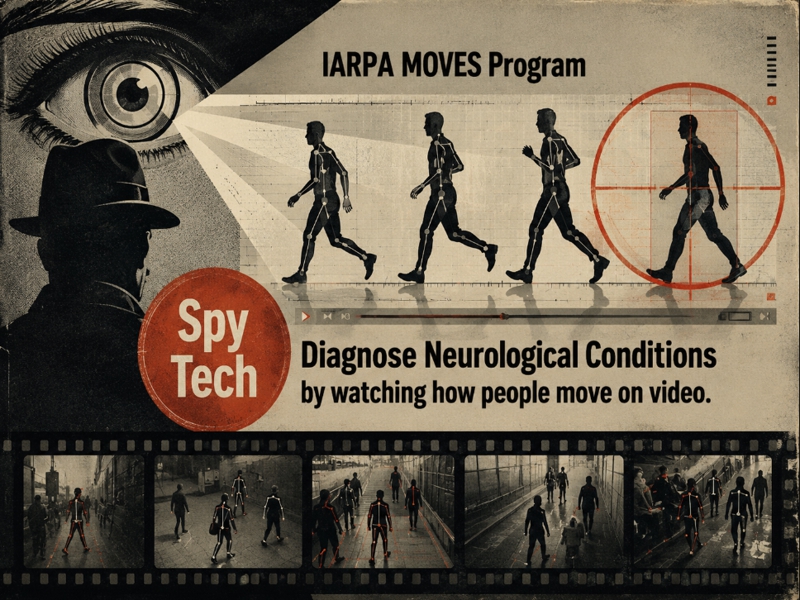


IARPA, the US spy tech agency, is working on how to diagnose various neurological conditions by analyzing video clips of how people move.
Last April, the US Intelligence Advanced Research Projects Activity (IARPA) announced the launch of its Movement Observation and Video-based Evaluation System (MOVES) program aimed at diagnosing neurological health conditions from open source video clips.
These neurological conditions include:
- Parkinson’s Disease
- Huntington’s Disease
- Amyotrophic Lateral Sclerosis
- Cerebellar Ataxia
- Essential Tremor
- Dystonia
Shakes, tics, tremors, gaits, jerks, imbalances, and difficulties in walking, talking, swallowing, and breathing are all to be analyzed and diagnosed from video clips that may not have great angles or resolution.
And the people in the videos may be wearing all types of clothing like winter jackets, tunics, kurtas, headwear, and camo that could obfuscate their neurological conditions.
“MOVES seeks create algorithms that aid clinicians in making diagnoses of a small set of neurological conditions using less than ideal or challenging video that may be taken from non-clinical angles and which may also include obstructed views and fully clothed subjects“
IARPA, MOVES program, April 2026
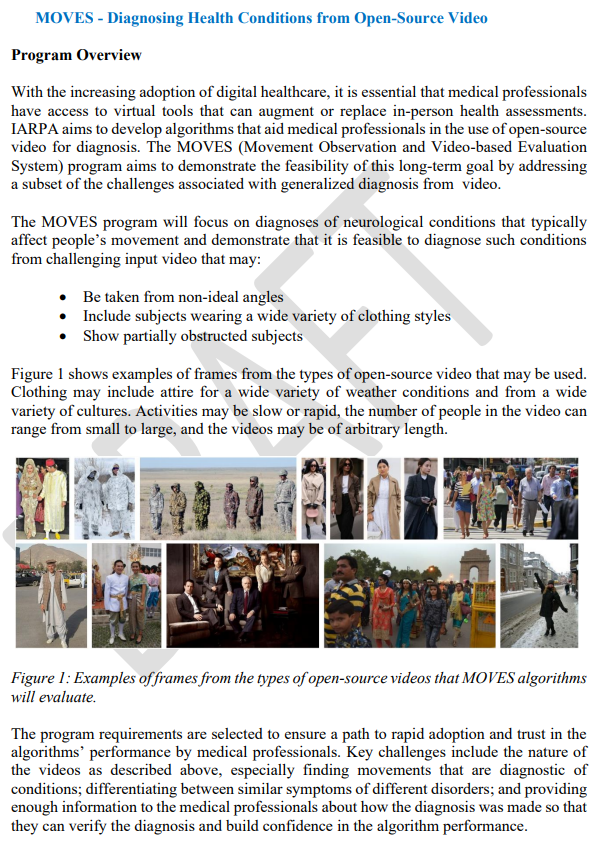
The MOVES program draft solicition begins with some clever word play that may make you infer that it’s for healthcare purposes, but it’s important to remember that IARPA develops tech for spy agencies that lie, cheat, and steal secrets for Uncle Sam.
“With the increasing adoption of digital healthcare, it is essential that medical professionals have access to virtual tools that can augment or replace in-person health assessments” — this is how the MOVES program description starts.
Sounds benevolent, no?
But if we ignore that first sentence and go straight to the second one; we see what the program is actually about:
“IARPA aims to develop algorithms that aid medical professionals in the use of open-source video for diagnosis.”
The algorightms will aid the medical professionals in the diagnoses and the medical professionals will assess the accuracy of the algorithms, and both will ultimately aid the spy community in knowing more about its targets’ ailments.
Why would spooks want to know what neurological problems some people have?
Could it be they want to identify weaknesses in persons of interest as they are actively being surveilled and targeted by the intelligence community?
Or perhaps they already know their targets’ weaknesses and MOVES could help confirm their identities?
A lot of potential scenarios at play.
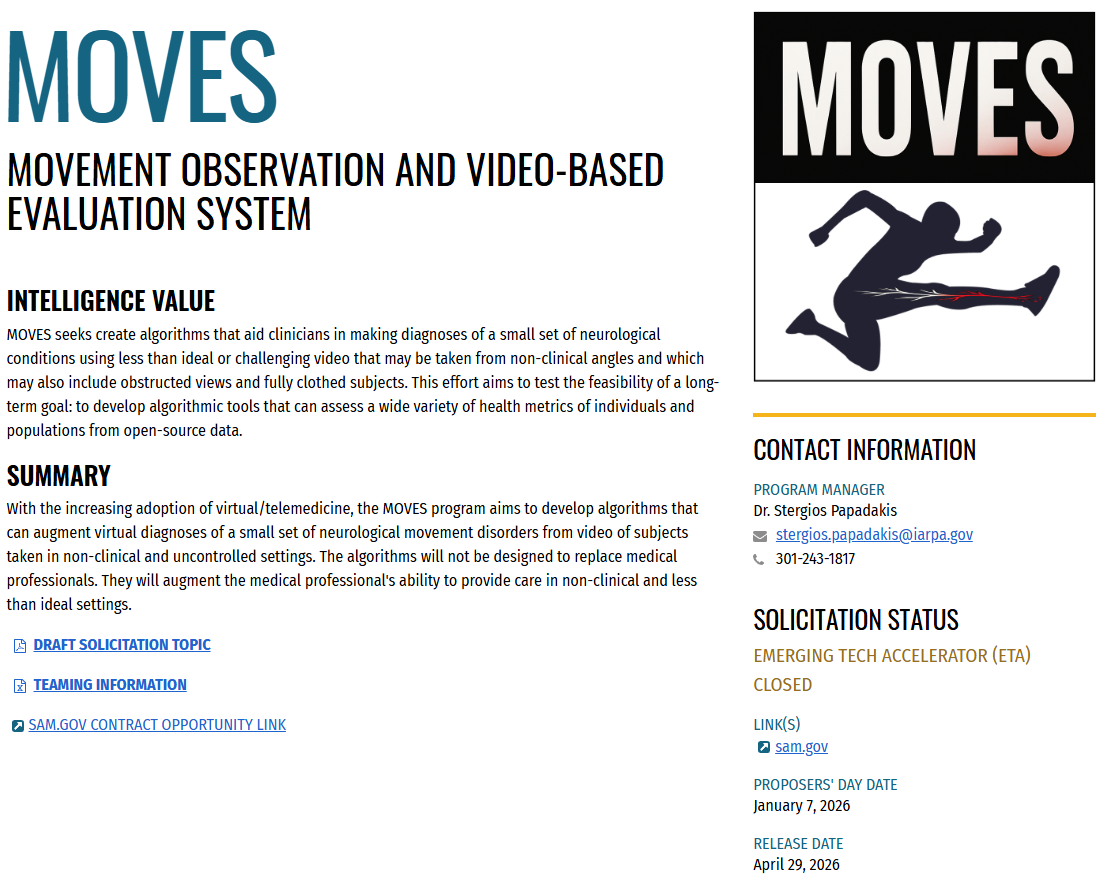
“With the increasing adoption of virtual/telemedicine, the MOVES program aims to develop algorithms that can augment virtual diagnoses of a small set of neurological movement disorders from video of subjects taken in non-clinical and uncontrolled settings”
IARPA, MOVES program, April 2026
“The output animations will be matched to the movements of the source video to allow medical professionals to perform diagnoses directly from the original video with the aid of the skeletal and unclothed body animations”
IARPA, MOVES program, April 2026
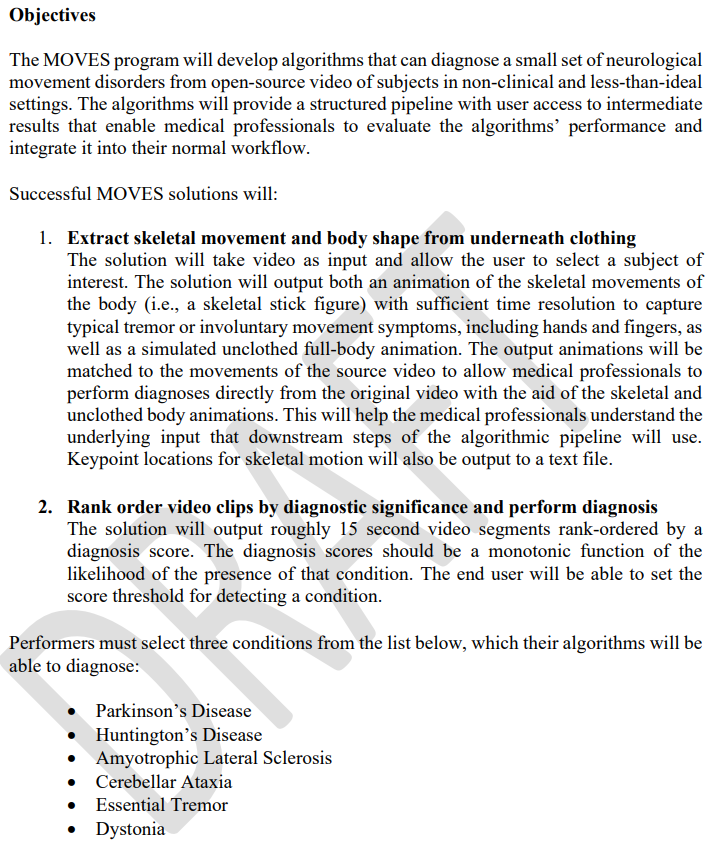
In the end, IARPA is looking to achieve two specific solutions:
- Extract skeletal movement and body shape from underneath clothing:
- The solution will take video as input and allow the user to select a subject of interest. The solution will output both an animation of the skeletal movements of the body (i.e., a skeletal stick figure) with sufficient time resolution to capture typical tremor or involuntary movement symptoms, including hands and fingers, as well as a simulated unclothed full-body animation.
- Rank order video clips by diagnostic significance and perform diagnosis
- The solution will output roughly 15 second video segments rank-ordered by a diagnosis score. The diagnosis scores should be a monotonic function of the likelihood of the presence of that condition. The end user will be able to set the score threshold for detecting a condition.
Heading up the MOVES program is IARPA program manager Dr. Stergios Papadakis, who joined the organization in 2024, according to his bio.
Before that, Dr Papadakis spent 20 years at the Johns Hopkins University Applied Physics Laboratory where he worked as “a senior scientist and chief scientist, leading research and development efforts on a wide range of novel sensors and sensor systems for biometrics, electronic hardware security, radio frequency, optics and photonics, and CBRNE [Chemical, Biological, Radiological, Nuclear, and Explosive] detection.”
Dr. Papadakis is also the currrent program manager for IARPA’s Biometric Recognition & Identification at Altitude and Range (BRIAR) program.
The Sociable reported on the BRIAR program announcement in September 2019 under the headline “Spy agencies want to accurately ID people from drones and rooftops.”
This was two years before the BRIAR program officially began in 2021.
The MOVES program was launched in April along with several other research programs, and there may be some overlap between them.
For example, the Locations Using Sound (LocUS) program is attempting to geolocate image, audio, and video clips, both indoors and outdoors.
Any image, audio, or video clip, whether recorded indoors or outdoors, is to be accurately geolocated within 250 meters of the target, with 90 percent confidence, according to the LocUS draft program overview.
And this is without using biometric identification methods like face recognition or voice recognition.
If you were to combine MOVES with LocUS, you could take a look at a low-res video of someone seemingly unidentifiable, and you would know not only their exact location, but also whether or not they had a neurological disorder as well, and if so, which one.
Image Source: AI generated with ChatGPT