


A visitor in Chicago searches Google for the best bakery in town and gets ten links. They ask ChatGPT the same question and get three names. For a growing number of customers, that short list is the whole search, and a business that ranks first on Google can still be left off it.
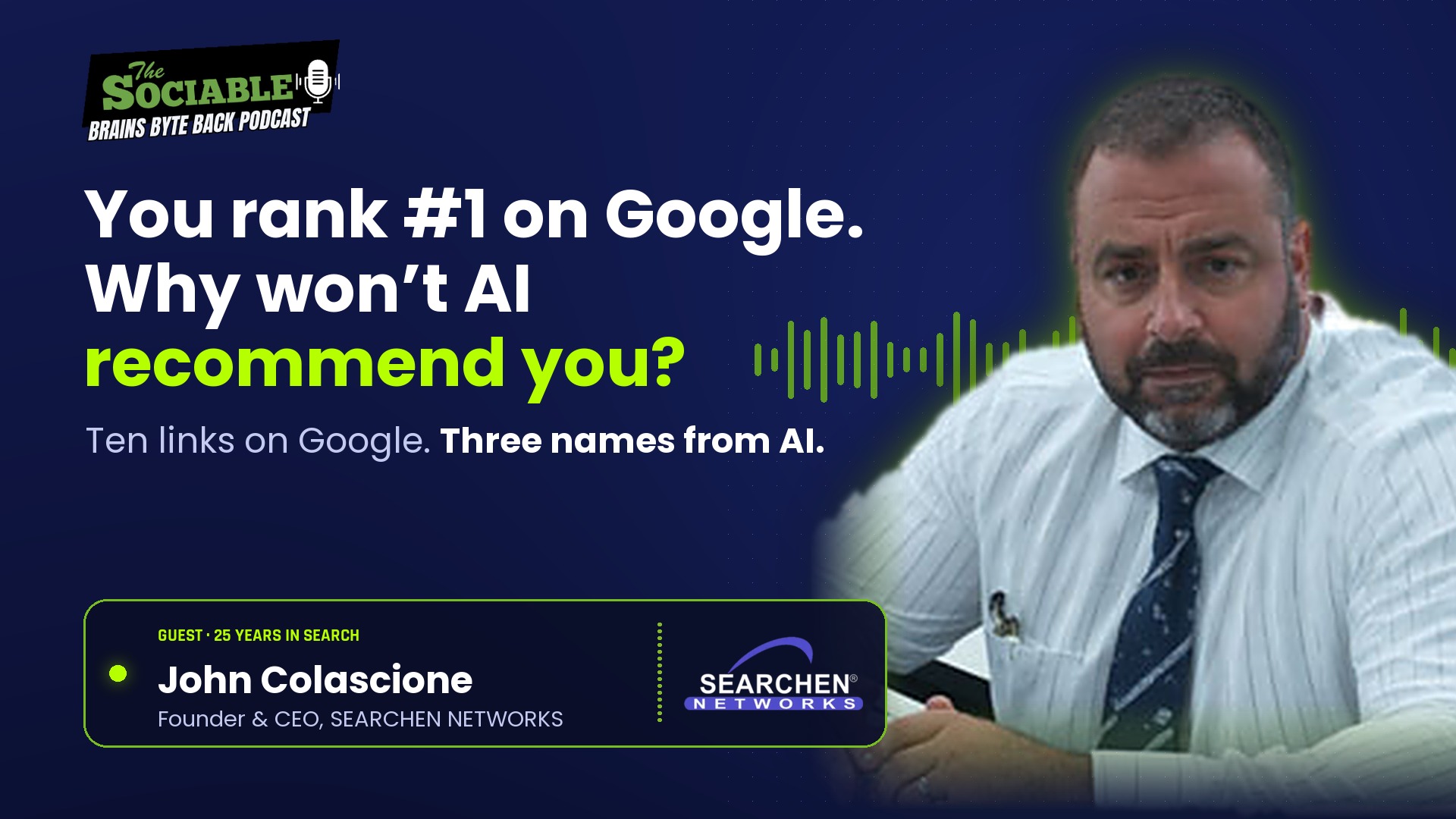
So how does AI decide who makes the cut? On this episode of Brains Byte Back, host Erick Espinosa speaks with John Colascione, founder and CEO of SEARCHEN NETWORKS. Colascione taught himself the internet while driving a truck, then built an online directory business, growing his monthly income from Google AdSense. With more than 25 years in search, he explains what changes when AI answers the question instead of a list of links.
Here’s what you’ll learn:
Rankings. A first-page ranking still matters, but it isn’t the whole game. A Washington University study of more than 55,000 Google searches found that nearly 30% of the domains cited in Google’s AI Overviews weren’t on the first page of results. Colascione says AI looks for third-party validation, such as reviews, press and brand mentions, more than backlinks.
Checking. Start by asking AI about yourself. Try prompts such as “What do you know about [business] in [city]?” in ChatGPT, Claude, Gemini and Perplexity, and see whether they can read your site, describe what you do and recommend you. Colascione notes that some websites block AI crawlers without the owner realizing it, and that AI answers can get details wrong.
Consistency. Make your business facts identical everywhere: your name, address, phone number, hours and services on your website, Google Business Profile, Yelp, Apple, Bing and Facebook. When those details don’t match, Colascione says, AI has a harder time trusting what it finds.
Mentions. Get talked about off your own website. In a study of 75,000 brands, the SEO company Ahrefs found that the most-mentioned brands showed up in Google’s AI Overviews more than ten times as often as the next group down. Detailed customer reviews, local news coverage, YouTube videos and listings with groups such as your chamber of commerce all add to that picture.
AI can only recommend a business it can find, understand and verify, so the work is making sure the internet tells a clear, consistent story about yours.
John’s free AI Visibility Audit is available at searchen.com/ai
Find out more about John Colascione
Learn more about https://www.searchen.com/
Reach out to today’s host Erick Espinosa
Transcript
John Colascione: It’s a lot better to be published about than just publish your own content.
Erick Espinosa: So, picture this. You’re visiting Chicago and you have a craving for some bagels. So, you look for the best bakery in town. You hop on Google and Google gives you maybe about 10 different links. And Rosa’s Bakery is up there as number one. But most people these days are hopping on to, let’s say, ChatGPT. And the recommendations there are probably top three. And Rosa’s isn’t even one of them. Welcome to The Sociable’s Brains Byte Back Podcast. I’m your host, Erick Espinosa, and I want to start off by thanking you for joining me. This episode, we are going to keep it practical. It’s for businesses of any size that wants to show up when customers ask AI for recommendations. My guest today is John Colascione. He’s the founder and CEO of SEARCHEN NETWORKS. He spent 25 years in search, and he got his start in a very different type of business.
John Colascione: I used to drive a truck. And I started dabbling with the Internet. This was around 2001 when Google was just becoming something that people were starting to use on a consistent basis. And I was actually living off revenue from AdSense for many years. It was the majority of the money that I made. Now it’s a very small portion of the money that I make.
Erick Espinosa: By John’s account, that directory business was bringing in roughly $40,000 to $50,000 a month from Google AdSense. Then search changed, and now it’s changed again.
John Colascione: It’s probably going to make three to five recommendations. And, you know, you’re going to hope to be one of those mentions,. You know, it’s not like if you have a first page ranking, you’re going to be dominant in AI search.
Erick Espinosa: So, how do you become one of those names? That’s the big question for businesses and brands these days. But stick around. I’m going to show you three things you can do this week. So, AI actually knows your business exists and recommends it. If you rank first on Google, why doesn’t ChatGPT or other LLM platforms recommend you?
John Colascione: It used to be that if you dominated Google search, you were going to dominate pretty much everything. But the majority of that traffic has dried up. I mean, the whole system is becoming a pay-to-play system. You know, Google, you have sponsored ads, you have local service ads, you have map packs, you have sponsored map packs, and the organic people start to get relegated to the bottom of the page or maybe page two.
Erick Espinosa: A Washington University study of more than 50,000 Google searches found that nearly 30% of the sites Google’s AI Overviews cited weren’t on the first page at all. Ranking still matters. It’s just not the whole game anymore.
John Colascione: They’re looking for similar things, but they’re looking for them in different ways. They’re looking at reviews. They’re looking at any kind of third party validation. They’re looking at press releases. They’re looking at the information that’s being put out on press releases. It can be verified by other third party, you know, likely to not be manipulated sources. And they’re still looking at fundamental SEO things. They’re looking at, you know, they’re looking at backlinks, but not the same as the search engines were. The search engines were really looking at anchor text, you know, how many backlinks you had. You know, but AI is looking at brand mentions. You know, maybe not at a web link. Maybe you’re just written about. You don’t even really have to have a web link. You know, you’re being cited in a source. You’re being talked about. You’re being discussed. And your brand is being found. And if your brand is being found often, you know, the more verifiable information about that brand, the more likely it is to get mentioned.
Erick Espinosa: Okay, let’s start with the first takeaway. Takeaway number one. I feel like this is the most obvious and we’ve all done it, whether or not it’s ourselves or our companies. Ask the AI about your brand. Before you fix anything, find out what it already says.
John Colascione: Sometimes you may even find out that your site could potentially be blocking AI bots. They’re either blocking the AI bots from learning or they’re blocking the AI bots from reading. That’s really bad. You can figure that out just by saying, here’s my website. What do you see? And if they go to visit the website, they’ll tell you if they’re being blocked. There are plenty of times where you’ll put something in there and it’ll say, I’m not aware of this business. Or there’s not enough information for me to give you an answer about this business. You don’t want to be in that territory. The challenge is, do they mention you? Do they cite you? And then they do even more important. Do they suggest you? Do they make a recommendation to be used?
Erick Espinosa: Now pause and screenshot this. Run these three prompts in ChatGPT, Gemini, Perplexity, and Claude. Then look at who does get recommended and why.
John Colascione: And you could take a good look at who’s being mentioned, why they’re being mentioned. And for the most part, they’re probably going to be fairly popular. They’re probably going to be fairly cited. They’re probably going to have their information is going to be corroborated in many different places. The AI agent knows that this is probably a good recommendation. You know, it’s like a probability engine.
Erick Espinosa: And showing up is only half of it. AI also gets things wrong. That same study checked Google’s AI answers against the pages they were linked to, and roughly one in nine statements didn’t hold up. So if AI is talking about your business, make sure that what it’s actually saying is true.
John Colascione: I do see a lot of hallucination and unusual turned information in some instances. So when you’re using an AI engine, you really do have to police it. You have to try and, you know, make sure it knows what it’s talking about.
Erick Espinosa: Takeaway number two. Make your facts identical everywhere. Your name, your address, phone, hours, and services on your website, and Google Business Profile, Yelp, Apple, Bing, Facebook, everywhere.
John Colascione: What’s more necessary is accuracy. So, in other words, if your business hours on your website don’t match your Google profile and don’t match your Yelp page, that’s going to be real bad for getting your business hours referenced in AI. Because it creates, you know, inaccuracy, you know, and they’re looking for accuracy. So, I think it’s important to make sure your business is accurate, up to date, matches the information all over the place. Because you remember that’s third-party validation and they find that more important than what is on your site. What you say is not as important as what other people say.
Erick Espinosa: And takeaway number three. And the one I want you to remember. Get talked about off your own website. Look, one analysis of 75,000 brands found the most mentioned brands got over 10 times the AI Overview mentions of the next tier down. So you’re probably wondering where do I start? Well, four places. First is with reviews because the words your customers use matter.
John Colascione: When that person writes that review about your business, if they say this business is fantastic, okay, that’s not going to go as far as if somebody says, I really like this company. I think they’re a great property management company. They did such a great job with my tenant screening and they got me a great, they got me a great tenant. Now the words in the review, so you got property management, company, you got tenant placement, you got tenant, you know, these keywords are going to get associated with that business.
Erick Espinosa: Second is local press. And believe me, as someone who’s worked many years in local press, it’s a lot easier than you think.
John Colascione: You got to go back to old school principles a little bit. Take a step back. And yeah, earned media is fantastic. It’s just a little harder to do. And people sometimes they get frustrated. How am I going to get earned media? It’s not really that difficult. There’s always a way to spin everything. If you have a little animal hospital, say you’re a little small animal hospital business, what do you do? All right, well, you can start off with having a grand opening. Maybe join your chamber. Sometimes they’ll do a ribbon cutting. And you can be in the newspaper. You can get a nice photo, a ribbon cutting of the business. Do a press release. The chamber might put something out. The chamber will probably list you on their website. That’s earned media.
Erick Espinosa: The start of my career in news was on the assignment desk at a local news station. But what I always search for at the end of the day were local stories talking about real humans. And it doesn’t take a lot for you to pick up the phone, call the assignment desk and be like, hey, you know, like you mentioned, an opening or something that you think that kind of speaks to the community. You’d be surprised how responsive news outlets are to those types of stories.
John Colascione: You have to take the extra initiative. There’s a lot of noise out there.
Erick Espinosa: Third is YouTube. In that study that I mentioned of 75,000 brands, YouTube mentions were the factor most closely linked to showing up in ChatGPT and Google’s AI answers.
John Colascione: So in other words, the video should be about the company or about the person, about the brand or about the entity that you hear a lot.
Erick Espinosa: And fourth, probably the easiest one: get listed in all directories that matter for your business. I’m talking about Chamber of Commerce, your industry associations and the Better Business Bureau.
John Colascione: There’s a heck of a lot of free places you can get listed. And I don’t think it’s a waste of time. And if an LLM goes to use one of these directories and you’re there, it’s better than not being there.
Erick Espinosa: So there are three things people have to work on this week. Ask the AI about yourself. The second is make your facts match everywhere. And the third is get mentioned somewhere credible beyond your own website.
John Colascione: They would go to searchen.com/ai and they could run a free scan and see what it tells them about their business. If they’re being found and being mentioned and being cited.
Erick Espinosa: Do those three things and you give AI a reason to recommend your company and your brand name. John’s free AI Visibility Audit and his WordPress plugin are linked below. If this helped, feel free to send me a message or send it to a business owner who still thinks that ranking first on Google is enough. I’m your host for Brains Byte Back Podcast, Erick Espinosa.