


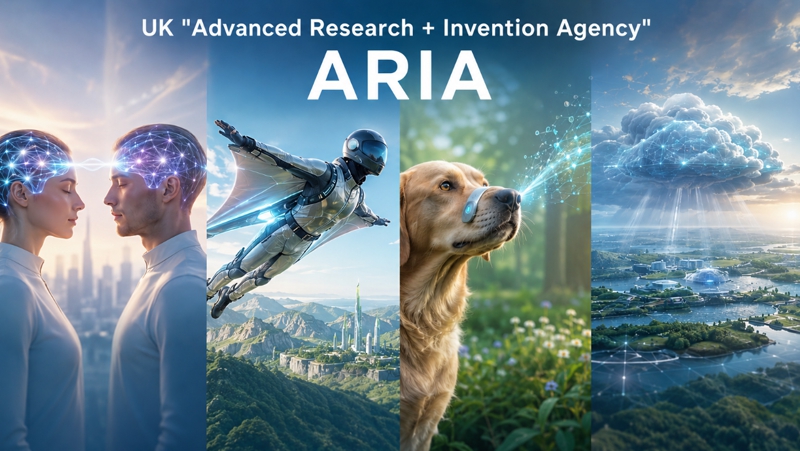


Today, the UK’s Advanced Research and Invention Agency (ARIA) announces the launch of seven refined research opportunities aimed at hacking humans, nature, and the climate.
ARIA has been busy refining its approach to research opportuntities by consolidating 14 spaces into seven.
Secure brain-to-brain communications and memory sharing, flying suits programmed from living systems, sensors that can smell like dogs, cloud brightening for weather manipulation, and a whole lot more are all on ARIA’s agenda.
“We are announcing seven new opportunity spaces that represent a bringing together of the previous 14 opportunity spaces that we had before. We have identified patterns that were running through those opportunity spaces and we are consolidating those into seven opportunity spaces that we think represent really key long-term investments for the UK and the world”
Kathleen Fisher, ARIA, August 2026
The seven research opportunity spaces now include:
- Programmable Physiology
- Scalable Neural Interfaces
- Trust Everything, Everywhere
- Nature-Inspired Computation
- Adaptive Machines
- Resilient Climate and Ecosystems
- Abundant Manufacturing
ARIA CEO Kathleen Fisher, who took over the role from Ilan Gur in February, said that if these research opportunities were to come to fruition they “would represent really transformative changes for society.”
Fisher is a former program manager at the US Defense Advanced Research Projects Agency (DARPA) where she developed and led the High-Assurance Cyber Military Systems (HACMS) program that ran from 2012 to 2017.
During a demonstration of the HACMS program’s capabilities in 2017, the Pentagon staged a cyberattack on an unmanned Boeing helicopter called Little Bird, and the software developed at DARPA was able to successfully stop the hackers in mid-air.
For Fisher, ARIA’s Trust Everything, Everywhere opportunity sits near-and-dear to her heart.
“If I were coming in as a program director, I would situate a program in the ‘Trust Everything, Everywhere’ opportunity space because that is my personal area of expertise,” she said.
And with that, let’s take a look at the seven refined opportunity spaces, starting with Fisher’s favorite.
Trust Everything, Everywhere
Trust Everything, Everywhere consolidates three previous research spaces: Mathematics for Safe AI, Collective Flourishing, and another that shares the same name of the current space.
Now, the Trust Everything, Everywhere opportunity sees humans working with AI in ways that would allow for a diversity of ideas in safe and trusted environments.
For example, ARIA program managers “seek to build the structures and tools that let a plurality of minds coexist and thrive, and resist the slide toward monoculture, centralised control or conflict.”
Some structures and tools that ARIA is exploring involve “verifiable neuro-privacy” such as “secure brain to brain” communications” and “one-time memory sharing,” along with a type of “verifiable CRISPR” that would take bio samples for authentication.
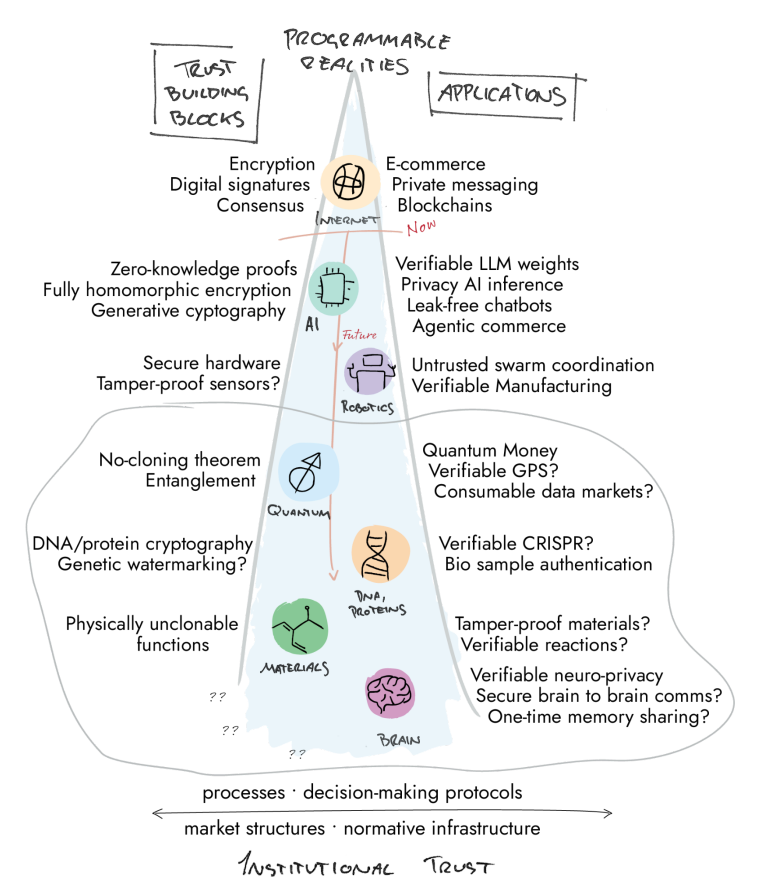
According to the Trust Everything, Everywhere description, “Many of today’s hard trade-offs – security vs. freedom, speed vs. accountability, openness vs. control – are caused by constraints in our technological and institutional stack → the right building blocks can solve these tensions and increase our options.”
Now let’s go from programming machines to programming human biology with the next opportunity space.
Programmable Physiology
The Programmable Physiology research space combines two previous opportunities: Scultping Innate Immunity and Bioenergetic Engineering.
With Programmable Physiology, ARIA is looking to “revolutionize medicine by developing technologies that allow us to read, model, and modulate human biology at systems scale, spanning molecular networks, cell states, tissues, and whole-body physiology.”
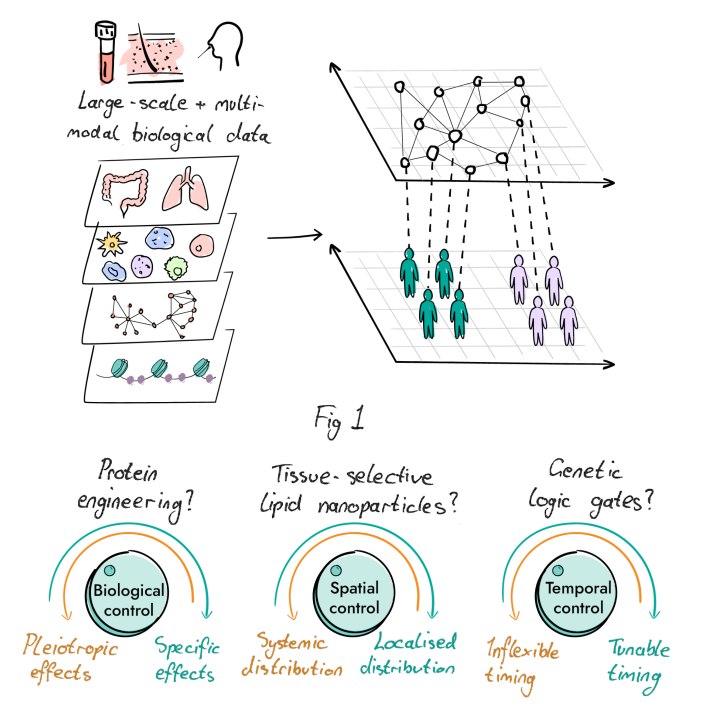
The idea here is to not just throw a drug at one particular part of the body, but rather to consistently monitor what’s happening inside the body across all biological functions in order to intervene when there is a disruption or imbalance.
As the program description puts it, “Modern medicine has largely learned to drug individual targets, not steer systems → programmable physiology requires matching the sophistication of our interventions to the complexity of human biology, moving from single-node perturbations to combinatorial, state-shifting control.”
In this way, ARIA is looking at states of being — taking complex disease states and turning them into healthy ones.
Next up on the refined opportunities spaces is all about brain-computer interfaces.
Scalable Neural Interfaces
Scalable Neural Interfaces is one of ARIA’s original opportunity spaces and still bears the same name.
This program looks to treat neurological and neuropsychiatric disorders by using minimally invasive technologies, such as brain modulation through electrical and acoustic fields.
These are non-invasive technologies that don’t require brain implants or surgery.
For this space, the belief is that “Targeted interaction with the human nervous system can improve the human condition across an incredibly wide range of disease states and cognitive domains.”
“To fully understand and treat disorders of the brain,” according to the opportunity, “we’ll need neural technologies that simultaneously offer chemical, temporal, and spatial specificity → this is achievable only by connecting the frontiers of engineered hardware with the frontiers of engineered biology.“
Now, let’s move on to the next opportunity space that looks to nature for inspiration.
Nature-Inspired Computation
ARIA’s Nature-Inspired Computation space is pretty self-explanatory, and it consolidates two previous opportunities: Nature Computes Better, and Extending our Perception.
Nature is extremely efficient in just about every sense of the word — it can sense, organize, self-replicate, heal, compute, store data, conserve energy, and transform light into food, just to name a few examples.
According to the ARIA description, “Living systems have co-evolved sensing and intelligence – they compress a rich, high-dimensional world into efficient, compact representations from multimodal inputs that capture physical, chemical, acoustic, magnetic and thermal properties today’s computers miss.”
Imagine being able to harness the olfactory systems of dogs that can “smell” seizures before they happen, or using reptile genes to be able to see in infrared.
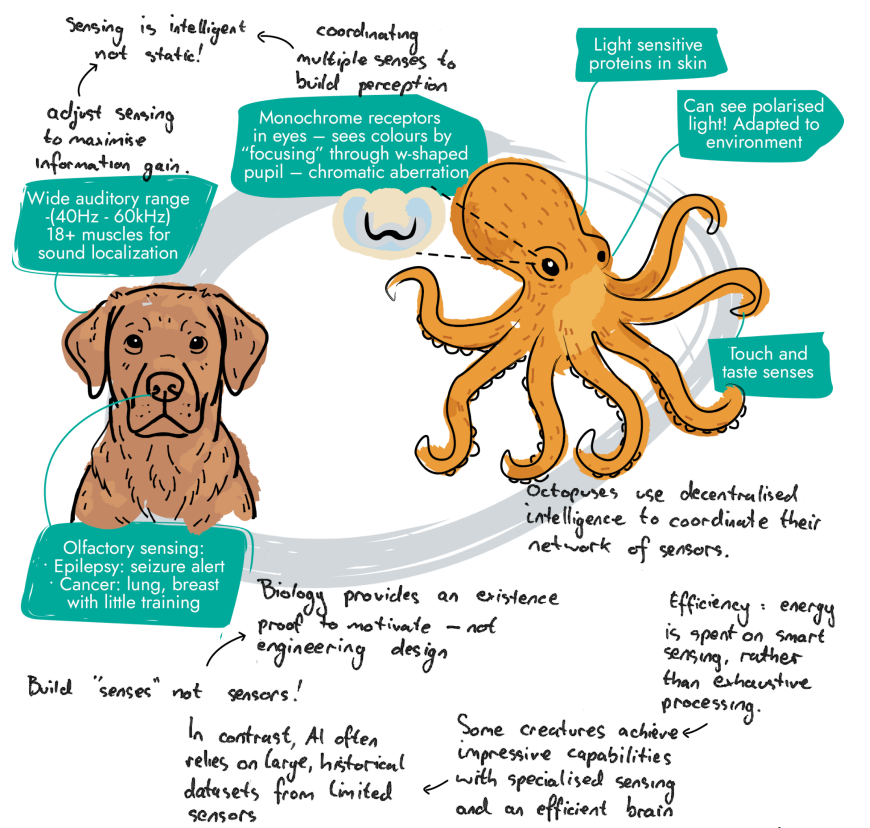
With this space, ARIA believes that understanding nature “could open up entirely new frontiers of engineered biology, computation, and algorithms.”
From there, “engineered systems could perceive and infer far beyond human range, as well as adapt, generalise and gain enormous efficiencies in data, compute and energy use.“
Moving from hacking humans, machines, and nature, the next controversial thing to hack is the climate.
Resilient Climate and Ecosystems
ARIA’s Resilient Climate and Ecosystems space is a consolidation of three others: Future Proofing Our Climate and Weather, Scoping our Planet, and Engineering Ecosystem Resilience.
The belief behind this opportunity is that “Living systems and a stable climate underpin our food, health, materials, and security, and both are under growing strain.”
The idea is to monitor and analyze everything that affects the weather, and then once that’s understood, to intervene and control the weather directly.
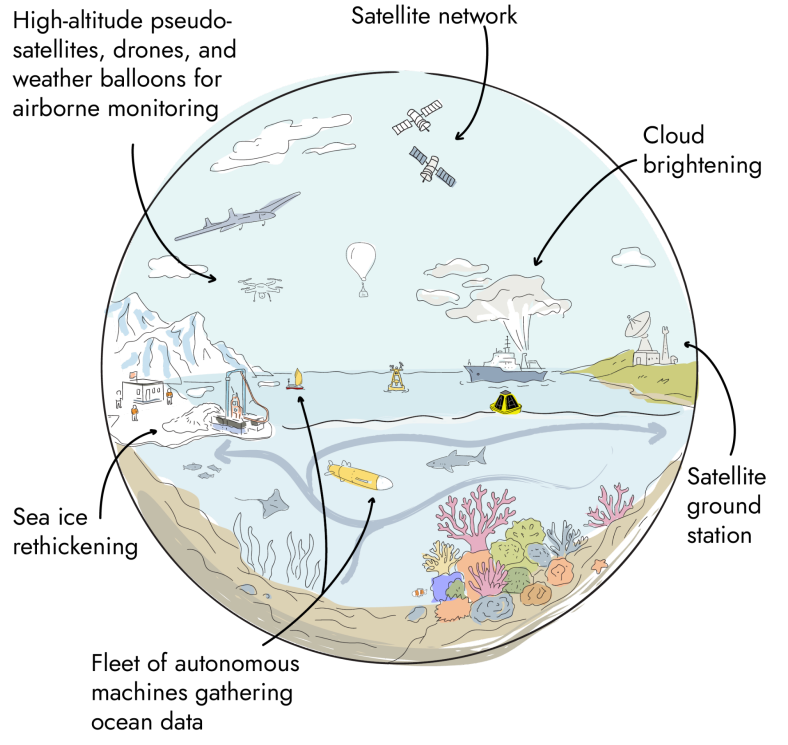
In December 2023, ARIA published an opportunity space document entitled, “Managing our climate and weather through responsible engineering,” which was authored by ARIA program director Mark Symes.
Under the “core beliefs” section, Symes wrote:
“Through carefully-considered engineering solutions it may eventually be possible to actively and responsibly control the climate and weather at regional and global scale.”
As far as methods into controlling the weather go, Symes cited studies involving:
- Blocking the sun as a potential means to cool global land temperatures.
- Solar Radiation Management (SRM) techniques, which “reflect a small percentage of the sun’s light and heat back into space.”
- “Cirrus Cloud Thinning,” which theoretically would “allow more longwave radiation to escape to space.”
Next up on the newly revised opportunity spaces involves programming matter like software for manufacturing.
Abundant Manufacturing
ARIA’s Abundant Manufacturing space combines its previous Programmable Plants and Manufacturing Abundance opportunities.
Programmable plants was exploring how to make edible vaccines, as well as designing plants that could create a rain-proof shelter from a single seed.
With Abundant Manufacturing, ARIA envisions a future “where anyone, anywhere, at any time can program matter like software to assemble what we need, ranging from molecules to skyscrapers.”
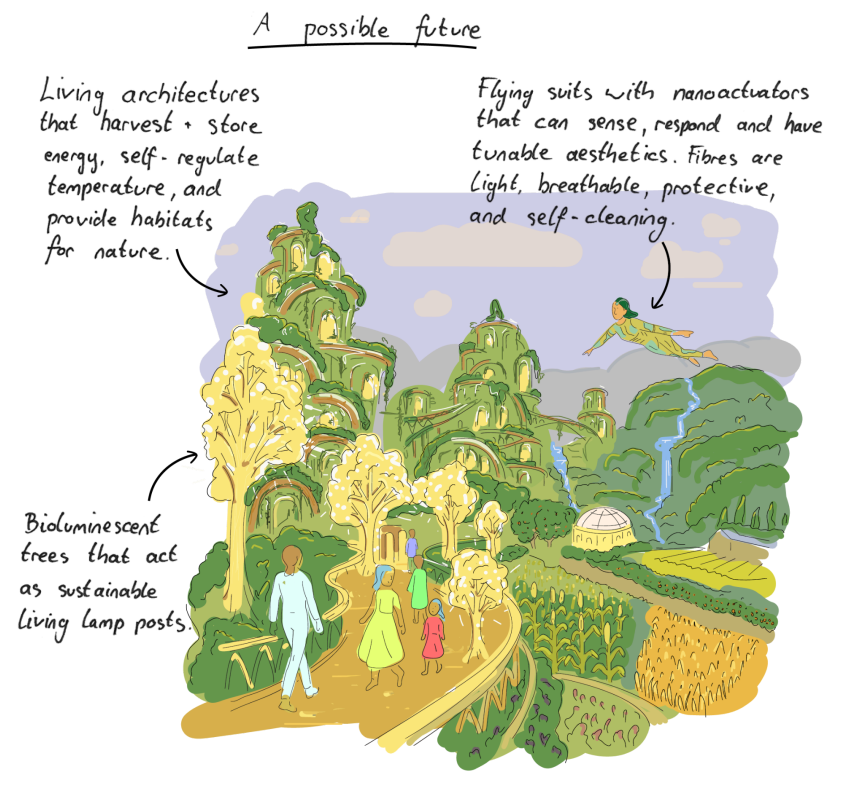
Suits that can make you fly, trees that become living lamposts, and living architectures that can harvest and store energy while self-regulating temperature are all on the table.
These ideas, in part, stem from the belief that living systems “represent an ideal platform to realize a future of sustainable abundance as our food and material systems struggle with unsustainable supply and a volatile climate.”
And to round off the seventh refined research opportunity space announced today, we have machines that can sense, think, and act in any given environment.
Adaptive Machines
ARIA’s Adaptive Machines opportunity consolidates the Smarter Robot Bodies and Scoping Our Planet spaces.
For this space, ARIA is working under the assumption that “intelligent machines that adapt to unpredictable environments can help humanity thrive.”
Therefore, “We need adaptable machines designed with a systems approach that can sense, think, and act seamlessly in the physical world.“
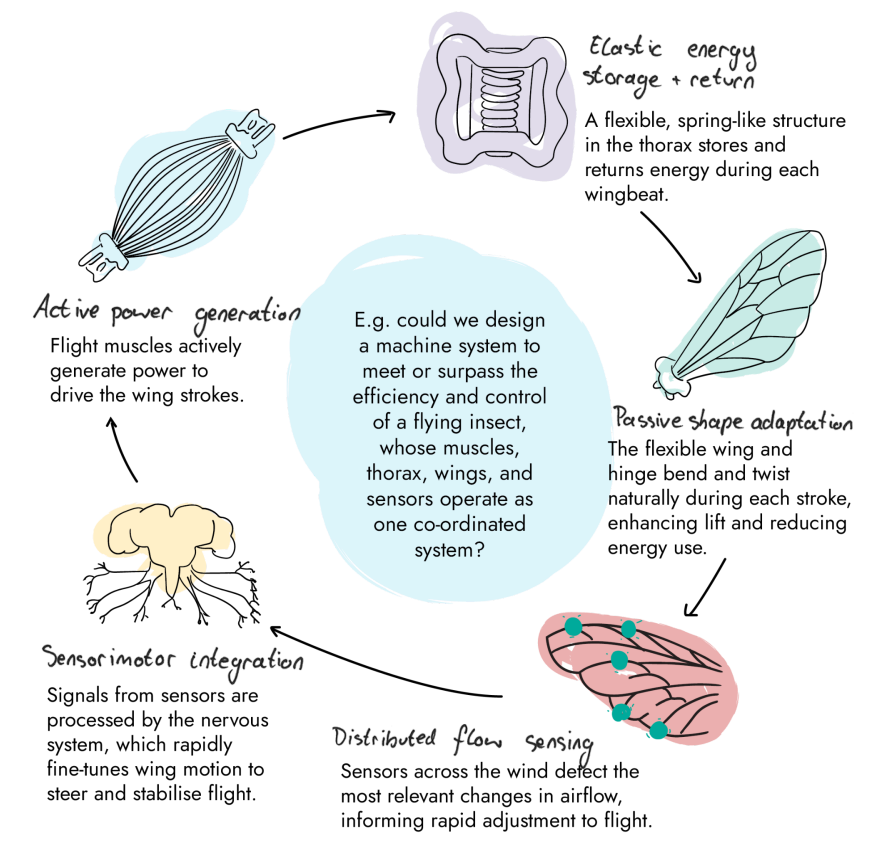
Adaptive Machines is another nature-inspired approach to technology that goes beyond the computional side and into the hardware and robotics realm.
One example given is designing a machine that can operate just like an insect or even surpass its natural abilities.
Inspired by DARPA and launched in 2023, ARIA is a non-departmental public body, sponsored by the UK Department for Science, Innovation and Technology.
Image source: AI generated with ChatGPT