AI erodes information integrity, weakens shared reality required for public trust: UN
July 6, 2026
SHARE
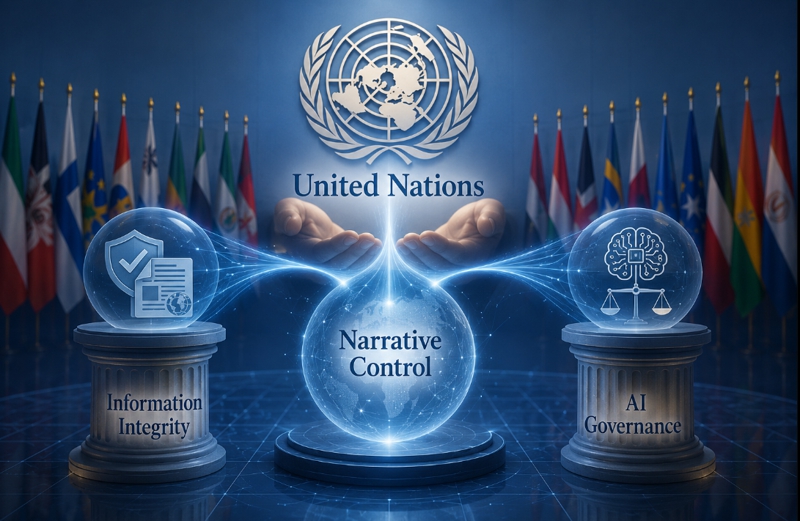
Unelected globalists want the same exact power and influence over narratives and information that big tech has for themselves: perspective
AI is eroding information integrity while weakening “the shared reality required for public trust, social cohesion, and democratic deliberation,” according to the United Nations preliminary scientific report on artificial intelligence.
Last week, the UN launched its “Preliminary Report of the Independent International Scientific Panel on AI” to serve as a guide for the “Global Dialogue on AI Governance” in Geneva, Switzerland on July 6.
The authors assert that the report makes no policy recommendations in its efforts to shine a light on what the panel considers to be the biggest opportunities, risks, and impacts of artificial intelligence.
Among the many, many risks mentioned in the AI report is this notion of “information integrity,” which is a term that the UN uses to promote its own narratives while discounting all others as being misinformation or disinformation.
“AI makes it easier to produce and target persuasive content at scale, including content designed to mislead, contributing to a gradual erosion of information integrity that can weaken the shared reality required for public trust, social cohesion and democratic deliberation”
United Nations, Preliminary Report of the Independent International Scientific Panel on AI, July 2026
— United Nations Information Service in Nairobi (@UNISNairobi) July 1, 2026
“AI-mediated news and information systems may also affect the financial sustainability of journalism and other institutions that support information integrity”
United Nations, Preliminary Report of the Independent International Scientific Panel on AI, July 2026
Speaking of disinformation, the authors of the report claim, “There are documented cases of elections being heavily influenced by AI-generated deepfakes targeting candidates.”
That sounds serious!
How did they arrive at that conclusion?
Their claim is hyper-linked to an opinion piece by the Brennan Center For Justice at New York University School of Law that says right there in the subtitle: “Artificial intelligence didn’t disrupt the 2024 election, but the effects are likely to be greater in the future.”
While the opinion piece cites various instances where AI-generated content was indeed distributed during election cycles, the Brennan Center flat-out says that “no direct, quantifiable impact on election outcomes has been identified.”
And yet, the UN report says the opposite of the very article it is referencing, claiming that elections were “heavily influenced by AI-generated deepfakes.”
That’s just one example of “information integrity” that the UN claims to care so much about.
But for the the panel’s co-chair, journalist and 2021 Nobel Peace Prize recipient Maria Ressa, going after individual posts that use AI to convey messages is a lost cause, and for her it’d be best to rewire the entire information infrastructure.
For example, just after declaring at a press conference that the UN panel did not make policy recommendations, Ressa made the policy recommendation to “regulate the persuasion and manipulation machinery” rather than “individual pieces of content.”
“The most urgent governance shift is from content moderation to system architecture. That’s the main part. You regulate the persuasion and manipulation machinery itself. You don’t police individual pieces of content. The report is actually very firm here because governance that only chases outputs will always fall behind systems that are engineered to generate content at scale”
Maria Ressa, Launch of the preliminary report by the Independent International Scientific Panel on Artificial Intelligence Press Conference, July 2026
"The most urgent [AI] governance shift is from content moderation to system architecture. You regulate the persuasion & manipulation machinery itself. You don't police individual pieces of content" Maria Ressa, UN Preliminary AI report press conference https://t.co/LTz55HCvqopic.twitter.com/W7sfS6jRYC
According to the UN report, “Algorithms optimized for engagement also amplify polarizing and emotionally charged content, meaning platform architecture itself can function as a persuasion mechanism.”
Does polarization automatically equate to misinformation or disinformation?
Without polarity, there is no argument or debate. Everyone just thinks the same way.
Without emotion, there is no passion for argument or debate. Everyone just feels the same way.
If the plan is to “regulate the persuasion” machinery, then the AI would only share information that some authoritarian body authorized it to share, and the UN would call this safeguarding information integrity.
“The concentration of AI capabilities in a small number of firms and countries could enable authoritarian capture and undermine democratic accountability”
United Nations, Preliminary Report of the Independent International Scientific Panel on AI, July 2026
Tech companies themselves are already authoritarian in the way they allow information to disseminate.
Now, unelected globalist groups like the UN want the same exact power and influence over narratives and information that big tech has for themselves.
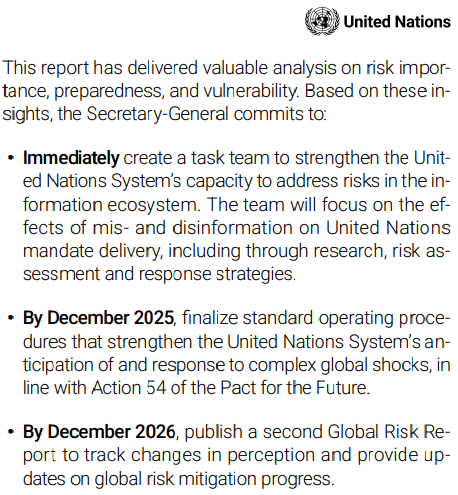
This task force on disinformation was never about addressing misinformation or disinformation that would lead to any type of real-world truth, but rather its sole purpose was to focus on how certain information would affect the UN’s Agenda 2030 mandate, aka the “Sustainable Development Goals (SDGs).”
“The Secretary-General commits to: immediately create a task team to strengthen the United Nations System’s capacity to address risks in the information ecosystem. The team will focus on the effects of mis- and disinformation on United Nations mandate delivery, including through research, risk assessment and response strategies”
United Nations, Global Risk Report, July 2025
As you may recall, the UN held the Summit of the Future in 2024 in order to accelerate progress on the SDGs.
At that event, UN member states signed the “Pact for the Future,” which included the “Global Digital Compact,” which called on nations to “foster an inclusive, open, safe and secure digital space,” which has no place for what the UN considers mis-and disinformation.
And that’s why the disinformation taskforce was conceived — to be a continuation of the “Pact for the Future” and the “Global Digital Compact” to quash any narratives that may impede upon the UN’s mandate delivery — Agenda 2030.
“The integration of AI into surveillance infrastructure has expanded the capacity for population-scale monitoring and societal control”
United Nations, Preliminary Report of the Independent International Scientific Panel on AI, July 2026
The UN “Preliminary Report of the Independent International Scientific Panel on AI” hit upon many, many risks and opportunities not covered in this story.
For example, it says that “the gap between rapidly improving capabilities and effective risk management methods may lead to catastrophic outcomes. For example, advanced technical abilities may allow novice private actors to use AI in malicious ways across a range of applications such as fraud, social engineering, cybersecurity, disinformation, biotechnology and financial manipulation.”
Additionally, “Reliable methods for retaining control over highly autonomous AI systems are lacking. There are no scientific guarantees that AI agents will not violate instructions, and evidence is accumulating of cases where they already violate them. In laboratory settings, AI systems have been shown to violate their safety instructions to avoid being shut down.”
This week, the UN is holding the Global Dialoge on AI, using the report as a launchpad for discussion.
Brains Byte Back interviews startups, entrepreneurs, and industry leaders that tap into how our brains work. We explore how knowledge & technology intersect to build a better, more sustainable future for humanity. If you’re interested in ideas that push the needle, and future-proofing yourself for the new information age, join us every Friday. Brains Byte Back guests include founders, CEOs, and other influential individuals making a big difference in society, with past guest speakers such as New York Times journalists, MIT Professors, and C-suite executives of Fortune 500 companies.
That Sales Call Might Be a Bot. In Most States, It Doesn’t Have to Tell You
byThe Sociable
AI sales agents and AI phone calls now sound convincingly human, but in most U.S. states, companies aren't legally required to disclose when you're talking to a bot. In this episode of Brains Byte Back, journalist Erick Espinosa speaks with Cameron Powell, a partner at DeepLaw, about the patchwork of AI disclosure laws in the U.S. and how they compare to Europe.
Listeners in a 2025 Queen Mary University of London study mistook AI-cloned voices for real people 58% of the time. Meanwhile, social media is full of people cornering bots that refuse to admit what they are, and just as many people selling AI sales agents to businesses. This episode looks at what the law actually requires.
What you'll learn:
Europe: Article 50 of the EU AI Act, in force since August 2026, requires AI systems that interact with people to disclose that they're machines.
Maine: the strongest U.S. rule. Bots in commerce must disclose whenever they could pass for human, and consumers can sue.
Utah: a bot only has to admit it's AI if you ask directly.
California: its two bot laws were written for online bots and pre-recorded calls, not AI that talks back in real time.
New Jersey: disclosure only applies to bots selling merchandise or real estate.
The FTC: it can treat undisclosed bots as deceptive in commercial cases but, according to Powell, has never seriously enforced it.
What businesses using AI for sales, marketing and customer service should consider next.
Quick answers:
Do AI sales calls have to tell you they're AI? In most U.S. states, no. Maine requires disclosure when a bot could mislead a consumer; Utah requires it only if you ask; New Jersey only for merchandise and real estate sales.
Does the EU require AI disclosure? Yes. Article 50 of the EU AI Act requires it.
How can you tell if a caller is a bot? Ask directly: ”Are you a real person?” In some states, the answer is legally protected. But not in most.
Guest: Cameron Powell, Partner at DeepLaw, a law firm advising companies on AI and innovation.
Host:Erick Espinosa, host and journalist, Brains Byte Back by The Sociable.