


A ‘healthy information ecosystem’ is a manipulated space where only globalist-approved narratives are welcome, any dissent is to be treated as a toxin impeding progress on Agenda 2030: perspective
Four years after declaring “We own the science” and admitting to partnering with Google to inorganically manipulate search results so that only UN-approved narratives would appear at the top, United Nations Under-Secretary-General for Global Communications Melissa Fleming says she would like “Healthy Information Ecosystems” to be the 18th Sustainable Development Goal (SDG).
Fleming has been one of the biggest promoters of what the UN calls “information integrity,” which lumps misinformation, disinformation, and hate speech all together under one umbrella.
Any information that impedes the UN’s progress on its 17 Sustainable Development Goals (SDGs), aka the 2030 Agenda, is considered to be an attack on “information integrity” and an affront to a healthy digital information ecosystem.
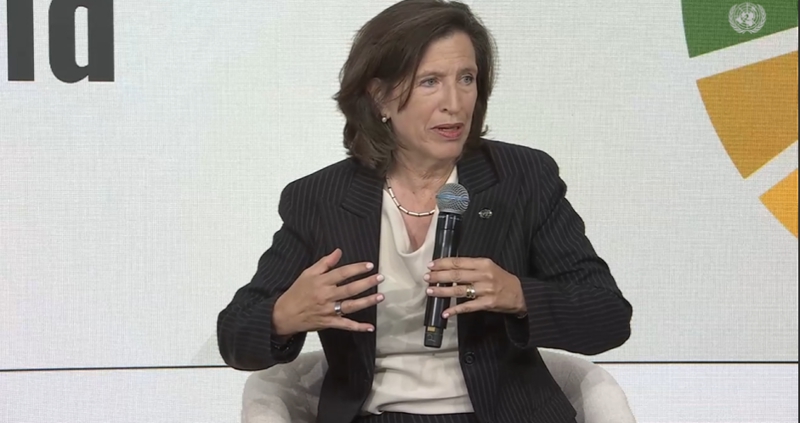
Speaking during an Sustainable Development Goal (SDG) side session at the 81st UN General Assembly last week called “Securing Reliable Information In an AI-Driven World,” Fleming said that if she had it her way, “healthy information ecosystems” would be the 18th sustainable development goal.
“If there could be an 18th SDG, I would make it ‘Healthy Information Ecosystems’ because it underpins every single one of the SDGs”
Melissa Fleming, United Nations, September 2026
“Without a healthy information ecosystem, it’s becoming increasingly difficult to make progress”
Melissa Fleming, United Nations, September 2026
During the same session Fleming said that search engine optimization was all but dead, and that AI summaries were more frequently appearing at the top of search results.
In wanting to spread UN narratives to as many people as possible, Fleming was begging for Large Language Models (LLMs) to scrape UN content.
“We want to be scraped, but we want the attribution as well. We want to be linked-back-to, and we’re seeing those links crash,” said Fleming.
“It is our goal to be as accessible as possible to as many people as possible in the language that they speak and in the platforms where they get their information,” she added.
“We want to be scraped, but we want the attribution as well. We want to be linked-back-to, and we’re seeing those links crash”
Melissa Fleming, United Nations, September 2026
Speaking of doing whatever it takes to get to the top of search results, four years ago this week, Fleming told the World Ecomonic Forum (WEF) Sustainable Development Impact Meetings “Tackling Disinformation” panel that the UN had partnered with several big tech companies, including TikTok and Google, to control COVID and climate narratives while claiming, “We own the science.”
“We partnered with Google. For example, if you Google ‘climate change,’ you will, at the top of your search, you will get all kinds of UN resources,” Fleming said in September 2022.
“We started this partnership when we were shocked to see that when we Googled ‘climate change,’ we were getting incredibly distorted information right at the top.
“We’re becoming much more proactive. We own the science, and we think that the world should know it, and the platforms themselves also do,” she added.
“We own the science, and we think that the world should know it, and the platforms themselves also do”
Melissa Fleming, WEF Sustainable Development Impact Meetings, September 2022
Fast-forward four years, and Fleming is now begging for LLMs to scrape, link, and attribute UN content.
“We are grappling now with how we can leverage these Large Language Models,” said Fleming at the UNGA 81.
“We’ve been told just forget SEO like Google search optimization — that role just doesn’t exist anymore, you shouldn’t even bother […] There’s one simple thing you could do, but it’s time consuming — get rid of the PDFs, apparently because LLMs don’t scrape PDFs. Of course UN.org and all of its ecosystem is full of PDFs, with rich report,” she added.
At the time of this publication, the first result for “climate change” that appears on Google search is an AI summary linking to the UN “What is Climate Change?” resource.
“Disinformation and hate speech have always existed […] but I have never been in a situation of having to try to communicate in an environment that is so toxic and is actively working against the forces for good”
Melissa Fleming, UN Summit of the Future, September 2024
In September 2024, the UN held its “Summit of the Future” to accelerate progress on the SDGs.
At that event, UN member states signed the “Pact for the Future,” including the “Global Digital Compact,” which called on nations to “foster an inclusive, open, safe and secure digital space,” which has no place for what the UN considers mis-and disinformation.
And that is what “information integrity” is all about — to quash any narratives that may impede upon the UN’s mandate delivery — Agenda 2030.
At a Summit of the Future side event in September 2024, Fleming admitted that the UN was exhausted going after disinformation and hate speech.
She appeared frustrated and genuinely surprised that people didn’t trust unelected globalist narratives.
“Disinformation and hate speech have always existed,” said Fleming, adding, “but I have never been in a situation of having to try to communicate in an environment that is so toxic and is actively working against the forces for good.
“We had no choice as the UN but to start to take action.”
Once again, there is no line between disinformation and hate speech, and the only thing the UN cares about is how certain information can hinder Agenda 2030.
Speaking again at the G20 Rio Summit in 2024 Fleming highlighted that part of the “Global Digital Compact” called for an assessment on the impact of mis- and disinformation on the SDGs.
Fleming claimed that climate disinformation was “powered by special interests” and “deceptive advertising” who were looking “to obstruct the energy transition,” who were “seeking to deny scientific facts,” who were “eroding trust in climate science and solutions while harassing the very people who are trying to bring those facts.”
Fleming also lamented that journalists, scientists, and climate activists were under attack for pushing UN-approved climate narratives.
Last year in June, Fleming spoke at the UN International day for Countering Hate Speech where she lamented that false and hateful information were undermining the UN’s work.
“AI is being misused to create and disseminate false and hateful information at scale […] It’s also undermining the work of UN agencies as false information spreads about our intentions and the work that we do”
In July 2025, the UN announced that it was forming a disinformation taskforce to “focus on the effects of mis- and disinformation on United Nations mandate delivery.”
A few months later at COP30 last November, UN Senior Adviser on Information Integrity Charlotte Scaddan declared, “We must fight all attempts in the information ecosystem to undermine climate action, regardless of the actor.”
The crackdowns on so-called misinformation, disinformation, and hate speech always lead back to narratives about the UN and its SDGs.
For the UN, a “healthy information ecosystem” is a manipulated space where only globalist-approved narratives are welcome, and any dissent is to be treated as a toxin impeding progress on Agenda 2030 that must be eradicated.
Image Source: Screenshot of Melissa Fleming at the United Nations 81st General Assembly